
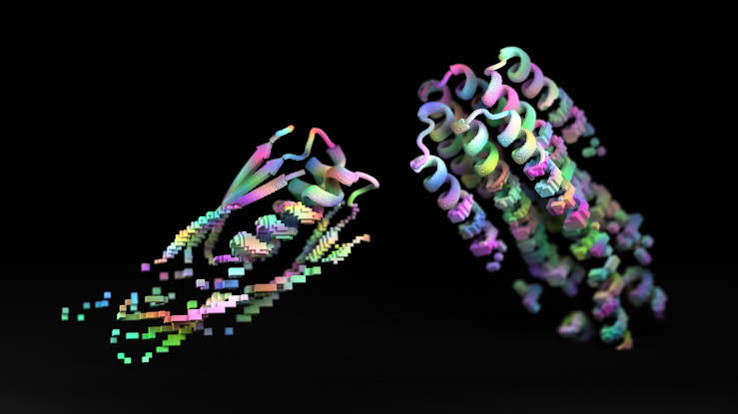
- Claude autonomously designed functional protein binders against 14 of 15 targets, producing 354 confirmed binders from 1,320 designs, all validated in physical wet-lab tests by Adaptyv Bio and Twist Bioscience.
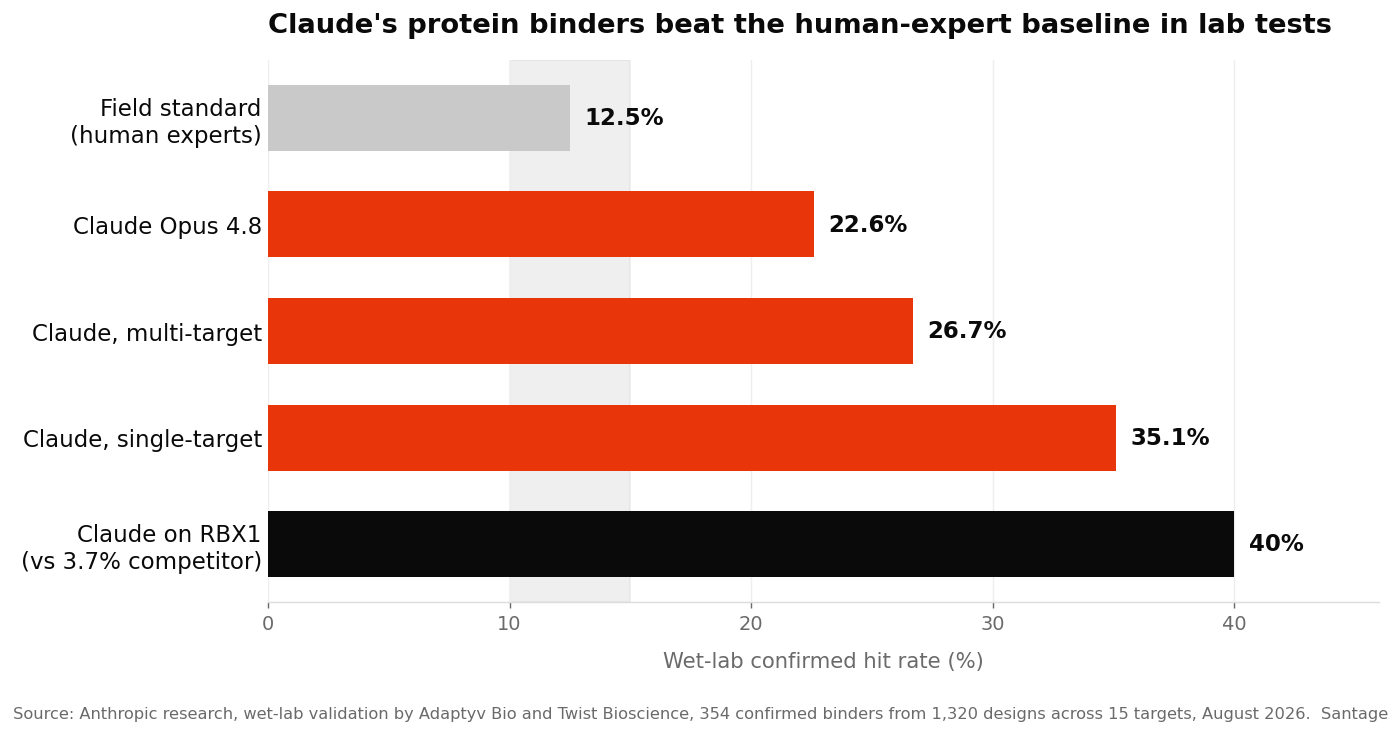
- Its best configuration hit a 35.1 percent success rate on single targets against a 10 to 15 percent field norm, and reached 40 percent on the RBX1 target where human competition entrants managed 3.7 percent.
- Separately, Claude Opus 5 read raw NMR and mass-spectrometry data in parallel and reported 96.4 percent purity against the lab's 96.33 percent, in under 25 minutes, after catching and correcting its own error.
Claude ran the whole design pipeline as an agent, then labs confirmed the results
Anthropic reported that Claude did not just suggest protein sequences. It ran the campaign. Given a long prompt, internet access, tool connectors, and a large pool of GPUs inside Anthropic's research environment, Claude Science, the model chose where on each target protein to bind, orchestrated existing open-source design and folding models, screened the candidates, and selected which to send for synthesis. It behaved as an autonomous agent operating the pipeline, not the autocomplete inside it.
The compute behind that autonomy was real: up to 12,500 Nvidia H100 hours across a single 48-hour session for one approach, and up to 2,500 H100 hours per target for another. The output then left the computer and went to the bench. Two independent laboratories, Adaptyv Bio and Twist Bioscience, synthesized 1,320 designs and tested them by surface plasmon resonance across five target concentrations. 95 percent of the designs expressed, and 354 came back as confirmed binders across 14 of the 15 evaluated targets.
Why beating a 10 percent hit rate rewrites drug-discovery economics
Designing a protein that binds a chosen target is the first step in building antibodies, diagnostics, and many therapeutics. The reason it is slow and costly is the failure rate. At a 10 percent hit rate, a lab synthesizes and tests roughly ten candidates to find one that works, and each test burns reagents, instrument time, and weeks. Claude's headline configuration reached 35.1 percent on single targets and 26.7 percent across a harder multi-target mode, while Opus 4.8 landed at 22.6 percent. Moving the hit rate from one in ten to one in three does not make the work three times faster in a straight line. It changes which projects are affordable to attempt at all, because the ratio of wet-lab spend to usable output shifts by a factor that compounds across every target a company chases.
Where Claude won, and where it failed
The result is not uniform, and the range is the most honest part of it. On RBX1, a component of the cell's protein-disposal machinery and a prized drug target, Claude confirmed binders 40 percent of the time and produced a binder roughly ten times tighter than the previous best. On TREM2, an immune receptor tied to Alzheimer's research, it hit 80 percent. On the enzyme 15-PGDH it beat the prior competition winner's binding strength by more than fiftyfold. It also failed outright on maltose-binding protein, could not surpass the best existing binder for the Nipah virus target, and one target was dropped for measurement-quality reasons.
| Target | Relevance | Claude result | Prior benchmark |
|---|---|---|---|
| RBX1 | Cancer, protein degradation | 40% hit, 3.9 nM affinity | 3.7% human hit, 25.7 nM |
| TREM2 | Alzheimer's immunology | 80% hit rate | 10 to 15% field norm |
| 15-PGDH | Fibrosis, aging | 33.4 nM affinity | 1.7 uM competition winner |
| MBP | Benchmark control | 0% (no binders) | field norm |
| Nipah virus | Antiviral | Did not beat best binder | competition best held |
The chemistry result matters as much as the biology
The less-noticed half of the disclosure is analytical, not biological. Claude Opus 5 was handed raw spectroscopy files and asked to do the interpretation a chemist does by hand.
Claude, working within Claude Science, returned processed NMR and LC-MS results in 23 and 19 minutes, respectively, working in parallel.Anthropic research, August 18, 2026
Its purity reading came out at 96.4 percent against the lab's 96.33 percent, and during the run it caught and corrected one of its own errors. A human chemist typically needs 30 minutes to an hour per sample. A system that can propose a molecule and also read the instrument output that verifies the molecule removes the human bottleneck from both ends of the routine design-test cycle.
A model that can both propose a molecule and interpret the instrument that checks it is not acting as a lab tool. It is acting as a lab member.
What a general model in the wet lab means for biotech
For most of the AI-for-biology era, the sharpest results came from specialized systems built for one job: the AlphaFold lineage for structure, newer models like Evo and Chai for design. Anthropic's campaign is a general reasoning model walking into that arena and posting competitive numbers by orchestrating those same specialized tools rather than replacing them. That reframes the build-versus-buy question for every biotech deciding whether to train a bespoke model or point a frontier agent at the problem, and it hints at why Anthropic is investing in a life-sciences workbench at all.
| Targets with confirmed binders | 14 of 15 evaluated |
| Designs synthesized and confirmed | 354 of 1,320, 95% expressed |
| Peak hit rate | 35.1% vs a 10 to 15% field norm |
| RBX1 hit rate | 40% vs 3.7% for human entrants |
| Compute per session | up to 12,500 Nvidia H100 hours |
| Spectra analysis | under 25 minutes at 96.4% measured purity |
The caution is worth stating plainly. Fifteen targets is a small set, a binder is not a finished drug, and two of the hardest targets defeated the model. But for two years the promise of AI in biology was prediction, telling you what a protein already is. Anthropic's campaign points somewhere else: the model designed proteins that did not exist, and independent labs confirmed the designs work, which turns a frontier model from a description of biology into a way to manufacture it.
Santage is committed to independent, transparent journalism. This article is produced in accordance with Santage's Editorial Standards and aims to provide accurate and timely information. Readers are encouraged to verify information independently.