
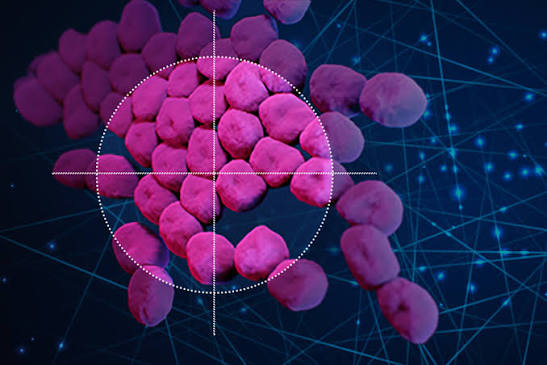
- Researchers at Stanford and the Arc Institute used the Evo 1 and Evo 2 DNA foundation models to design 302 candidate bacteriophage genomes, of which 16 came alive in the lab and killed E. coli, the first documented case of AI designing a functional organism found nowhere in nature.
- The work, published in Science on August 6, points toward AI-generated phage therapies against bacteria that no longer respond to antibiotics, a market that biology has struggled to crack for decades.
- It also moves the biosecurity debate from theory to demonstration, with Johns Hopkins specialists warning in a companion editorial that the governance needed to steer the capability does not yet exist.
Generative AI crosses from text into living things
For three years the frontier of AI has been measured in tokens: better answers, longer context, cheaper inference. A paper published in Science on August 6 measures it in something else entirely. A team led by Stanford's Brian Hie, with graduate student Samuel King and collaborators at the Arc Institute, used DNA foundation models to design complete viral genomes, then built them in the lab. Sixteen of the designs came alive and killed E. coli. It is the first documented case of an AI system designing a functional organism that evolution never produced.
The models, Evo 1 and Evo 2, are to DNA what a language model is to text. Evo 2 was trained on 9.3 trillion nucleotides spanning bacteria, archaea, eukaryotes, and phages, learning the grammar of genetic sequences the way a large language model learns the grammar of English. Pointed at bacteriophages, the viruses that prey on bacteria, the models proposed 302 candidate genomes. Most were nonviable. Sixteen worked.
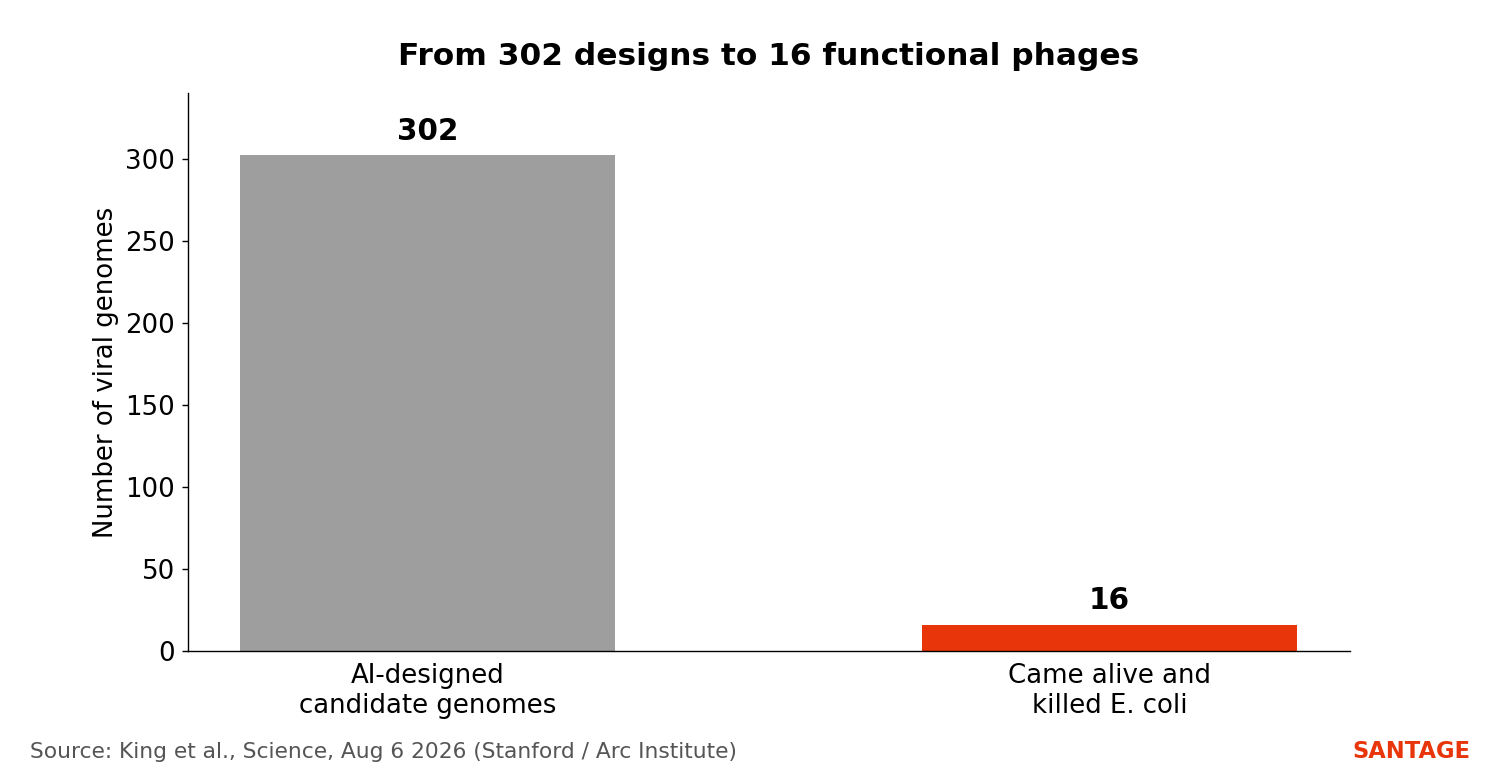
That yield is the signal. A five-percent hit rate from pure generation, with no natural template to copy, is the kind of number that turns a demonstration into a platform. And the target matters. A cocktail of the generated phages overcame E. coli strains that had grown resistant to a natural phage, the exact failure mode that makes bacterial infections so hard to treat. Antibiotic resistance kills more than a million people a year and has no easy pipeline behind it, because designing new phages by hand is slow and the space of possible genomes is astronomically large. A model that can propose viable candidates by the hundred changes the economics of that search.
| AI-designed candidate bacteriophage genomes | 302 |
| Came alive in the lab and killed E. coli | 16 |
| Nucleotides in Evo 2's training data, across all domains of life | 9.3 trillion |
| Published in Science | Aug 6, 2026 |
The same capability that heals can harm
The researchers were deliberate about where they aimed. Bacteriophages infect only bacteria, not humans, animals, or plants, and the team says it excluded eukaryotic viruses, the kind that can infect people, from Evo 2's training for safety reasons. They also argue that generated sequences read as effectively random against known pathogenic viral proteins, making a resulting phage highly unlikely to harm human cells. The design space was chosen to be useful and hard to misuse.
| Step | Detail |
|---|---|
| Design template | Bacteriophage ΦX174, a well-studied lytic phage |
| Models | Evo 1 and Evo 2, fine-tuned on ~15,000 Microviridae genomes |
| Genomes generated | ~300 whole-genome sequences with realistic architectures |
| Synthesized and tested | Nearly 300 candidate phages, screened against E. coli |
| Viable, effective phages | 16, with substantial evolutionary novelty |
| Headline result | A phage cocktail overcame ΦX174 resistance in three E. coli strains |
How the team went from a natural template to functional AI-designed phages. Source: King et al., Science, August 6, 2026.
The model that can design a virus to save a life is, in its architecture, the same model that could design one to take many.
That care does not close the question it opens. A companion editorial by biosecurity specialists at Johns Hopkins, published alongside the paper in Science, draws a blunt conclusion: the same method could in principle be pointed at human pathogens, and the governance to prevent that does not yet exist. The safeguards the field relies on, DNA-synthesis screening at the point a sequence is turned into physical genetic material, were built to catch known dangerous sequences. AI-generated genomes match nothing in the databases by design. Open-weight tools like Evo compound the gap, because once weights are public no lab can withdraw them, and the new White House AI framework leaves open-weight biological models largely untouched.
This is why the story belongs in the capital-and-capability column rather than the science section. AI-for-biology has attracted billions in investment on the promise that models could design drugs, proteins, and now organisms faster than any lab. The Evo result is the strongest evidence yet that the promise is real, and the clearest signal that the value and the risk arrive together. Every investor thesis about generative biology now has to price in a demonstrated dual-use capability and a governance regime that its own authors say is not ready.
The phage work will not reach patients soon. Clinical phage therapy is early, and regulators have never approved an AI-designed organism. But the threshold it crosses is the one that matters for the sector. Generative models have left the domain of language and images and started designing life that functions. The upside, new medicine against infections that kill, is enormous. So is the reason the people who built it are asking, in the same breath, for rules that do not yet exist.
Santage is committed to independent, transparent journalism. This article is produced in accordance with Santage's Editorial Standards and aims to provide accurate and timely information. Readers are encouraged to verify information independently.