In the architecture of modern AI, three layers sit in a stack. Large language models provide reasoning. Embeddings translate meaning into math. And between them, holding the entire edifice together, sits a layer of infrastructure that did not meaningfully exist five years ago: the vector database.
Vector databases are the reason AI systems can search the meaning of a billion documents in under 50 milliseconds. They are the infrastructure that makes retrieval-augmented generation possible at enterprise scale. And in 2026, the category is one of the fastest-growing segments of the data infrastructure market, with Bessemer Venture Partners identifying AI-native databases as one of the most significant new infrastructure categories of the decade.
- What they are: Specialised data systems that index and search high-dimensional vectors using similarity-based queries rather than exact matches
- Why they matter: The infrastructure layer that makes retrieval-augmented generation and enterprise AI search possible at production scale
- Leading systems: Pinecone, Weaviate, Milvus, Qdrant, Chroma, and pgvector for PostgreSQL-based deployments
- Core algorithm: Most production systems use HNSW (Hierarchical Navigable Small World) for approximate nearest neighbour search
- Typical performance: 10 to 50 millisecond query latency across millions to billions of vectors
- Primary use cases: Retrieval-augmented generation, semantic search, recommendation systems, anomaly detection, AI agent memory
- Market position: One of the fastest-growing data infrastructure categories identified by Bessemer Venture Partners
What is a vector database?
A vector database is a specialised data storage and retrieval system designed to index and search high-dimensional vectors, typically embeddings produced by AI models, using similarity-based queries rather than exact matches.
Unlike a traditional relational database that answers "find all customers named Smith," a vector database answers "find the ten documents most similar in meaning to this query." It compares the mathematical distance between stored vectors and a query vector to return the closest matches.
How do vector databases work?
The architecture of a vector database is purpose-built for one task: finding the nearest neighbours in high-dimensional space, as fast as possible.
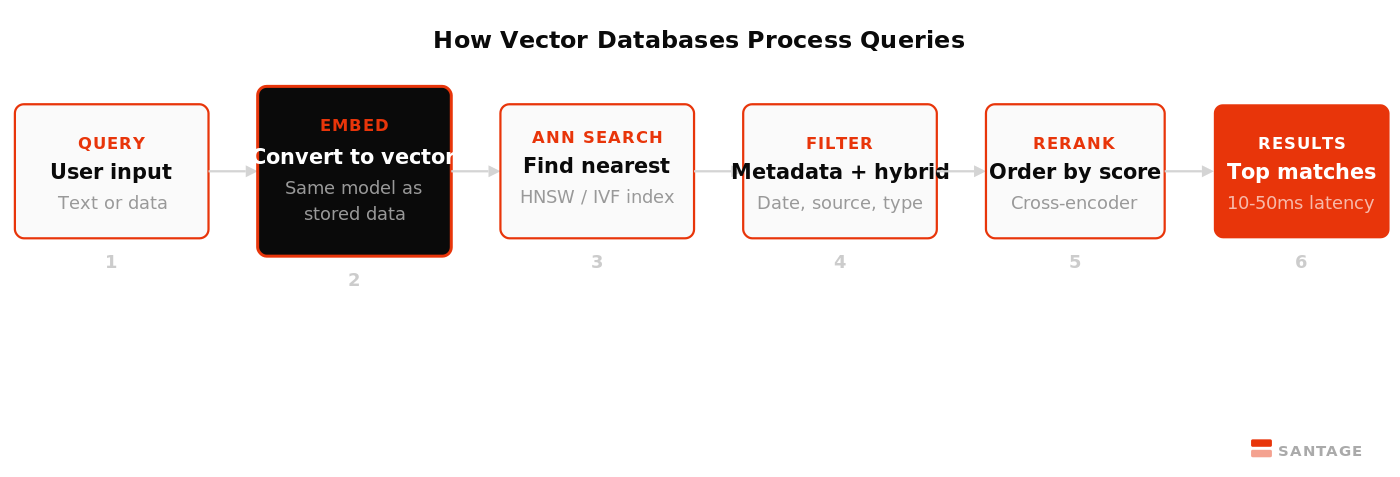
- Ingestion: Raw data is passed through an embedding model that converts it into vectors. These vectors, along with metadata, are stored in the database.
- Indexing: The database builds specialised index structures for high-dimensional similarity search. The most common is HNSW (Hierarchical Navigable Small World), a graph-based algorithm.
- Query embedding: When a user query arrives, it is embedded using the same model, ensuring the query vector exists in the same semantic space as stored vectors.
- Approximate nearest neighbour search: The database searches the index to find the closest vectors. ANN algorithms trade a small amount of accuracy for enormous gains in speed.
- Metadata filtering and hybrid search: Most production queries combine vector similarity with traditional filters and keyword matching (BM25) in a pattern called hybrid search.
- Ranked results: The database returns the top matches, ranked by similarity score, typically in 10 to 50 milliseconds.
The core idea behind vector databases
Vector databases search by meaning, not by match.
A traditional database asks "does this record exactly equal the query?" A vector database asks "which stored records are most similar in meaning to the query?" The first is deterministic and binary. The second is probabilistic and continuous.
How do vector databases differ from related systems?
| Concept | Difference |
|---|---|
| Vector DB vs Relational DB | Relational databases use exact matches on structured data. Vector databases use similarity search on high-dimensional vectors |
| Vector DB vs Search Engine | Search engines excel at keyword matching. Vector databases excel at semantic similarity. Modern hybrid systems combine both |
| Vector DB vs Vector Library | Libraries like FAISS provide algorithms but lack database features such as persistence, replication, and concurrent access |
| Vector DB vs Vector Index | A vector index is a data structure. A vector database is a full system managing indexes, data, metadata, and queries |
| Vector DB vs Graph DB | Graph databases excel at relationship traversal. Vector databases excel at similarity across unstructured data |
How do vector databases power RAG systems?
Retrieval-augmented generation is the single most important application pattern for vector databases. In a RAG system, the vector database holds embeddings of an organisation's knowledge base. When a user asks a question, the system retrieves the most relevant documents and passes them to a large language model as context.
This architecture has become so dominant that RAG models now account for 38.41% of enterprise LLM market revenue, according to Straits Research. Gartner's 2025 Hype Cycle identifies RAG-enabled vector search as a foundational capability.
What are the leading vector databases in 2026?
- Pinecone: The pioneer of managed vector databases. Prioritises ease of use and serverless operations. Has raised over $130 million in funding.
- Weaviate: Open-source with enterprise support. Distinctive strength in native hybrid search. Over one million monthly Docker pulls.
- Milvus: The scalability leader. Engineered for billions-of-vectors workloads with GPU acceleration and distributed deployment. Maintained by Zilliz.
- Qdrant: Performance-focused open-source option. Written in Rust. Strong support for complex metadata filtering.
- Chroma: Developer-experience-first option for rapid prototyping with minimal configuration.
- pgvector: PostgreSQL extension adding vector search to the most widely deployed relational database in the world.
What are the challenges of using vector databases?
- Infrastructure complexity: High-performance vector databases require careful capacity planning, index tuning, and memory management.
- Embedding model coupling: Changing embedding models typically requires re-embedding and re-indexing entire corpora.
- Cost at scale: A single 1,536-dimensional vector requires approximately 6 KB of storage. A billion vectors requires 6 TB before indexes.
- Data freshness: High-performance indexes often require batch updates rather than real-time inserts.
- Regulatory considerations: Under the EU AI Act, vector databases storing embeddings of sensitive data face regulatory scrutiny.
Where are vector databases used in practice?
- Enterprise knowledge: Microsoft Copilot, Google Workspace with Gemini, Notion AI, and Atlassian Intelligence all rely on vector databases.
- Customer support: Zendesk, Intercom, and Salesforce use vector databases for AI-driven support.
- AI search engines: Perplexity, You.com, and newer AI-first search engines use vector databases as core retrieval infrastructure.
- Financial services: JPMorgan and Goldman Sachs use vector databases for document analysis and compliance. Deloitte's 2025 report identifies vector-based retrieval as the most common AI infrastructure in the sector.
- Healthcare: Mayo Clinic and pharmaceutical companies use vector databases to search clinical literature and match patients to trials.
- Cybersecurity: CrowdStrike and Palo Alto Networks use vector databases to detect anomalous patterns across networks.
- AI agent memory: Emerging agent frameworks use vector databases as the memory layer for long-running autonomous agents.
The future of vector databases
- Hybrid search becomes the default: The combination of vector similarity, keyword matching, and metadata filtering in a single query interface is emerging as the standard.
- Consolidation into existing databases: PostgreSQL with pgvector, MongoDB Atlas, and Elasticsearch now offer vector search. Forrester predicts most enterprise vector workloads will run on extended traditional databases by 2027.
- GPU-accelerated retrieval: Nvidia's Blackwell architecture delivers substantial improvements for vector indexing and search.
- Multimodal storage: Vector databases are evolving to store and search across text, images, audio, and video.
- Agent memory: As autonomous AI agents proliferate, vector databases are becoming the memory layer for agent state.
The choice of vector database is no longer a tactical technology decision. It is an architectural decision that shapes what an organisation can build with AI for years to come.
Frequently asked questions
Sources and further reading
- Gartner. Hype Cycle for Generative AI. 2025. gartner.com
- Bessemer Venture Partners. State of the Cloud Report. bvp.com
- Straits Research. Enterprise LLM Market Report. 2025. straitsresearch.com
- MLCommons. ANN Benchmarks for Vector Search. mlcommons.org
- Deloitte. Financial Services Industry Outlook 2025. deloitte.com
- Forrester Research. The Vector Database Market Landscape. forrester.com
- European Commission. The EU AI Act. 2025. digital-strategy.ec.europa.eu