If large language models are the engines of modern AI, embeddings are the language they speak. Every word, image, audio clip, or document that passes through a modern AI system is first converted into an embedding. This is the quiet, foundational layer that makes semantic search work, that allows ChatGPT to remember context, that powers recommendation systems on Netflix and Spotify, and that enables enterprise AI to reason over proprietary data.
Despite this centrality, embeddings remain one of the least-understood concepts in AI. This guide explains what embeddings are, how they work, why they matter, and where they are headed.
- What they are: Numerical representations of data, typically vectors of 384 to 3,072 dimensions, that capture meaning in mathematical form
- Why they matter: The foundation layer beneath semantic search, recommendation systems, RAG pipelines, and every major AI retrieval application
- How they work: Similar items are placed close together in high-dimensional vector space; dissimilar items are placed far apart
- Leading providers: OpenAI, Cohere, Voyage AI, Google, and open-source options from BAAI, Nomic, and Hugging Face
- Typical dimensionality: Production systems use 512 to 1,536 dimensions; research models can reach tens of thousands
- Core use cases: Semantic search, recommendation engines, retrieval-augmented generation, clustering, anomaly detection
- Primary limitation: Embeddings inherit biases from training data and can become stale as language evolves
What is an embedding?
An embedding is a numerical representation of data, typically a list of hundreds or thousands of numbers, that captures the meaning and relationships of that data in a mathematical form an AI system can process.
Text, images, audio, video, code, even graph structures can all be converted into embeddings. The process compresses complex, high-dimensional information into a compact vector where semantically similar items end up close together and dissimilar items end up far apart. This is the property that makes embeddings so powerful. They transform meaning into math.
How do embeddings work?
The process of creating an embedding follows a consistent pipeline regardless of the data type:
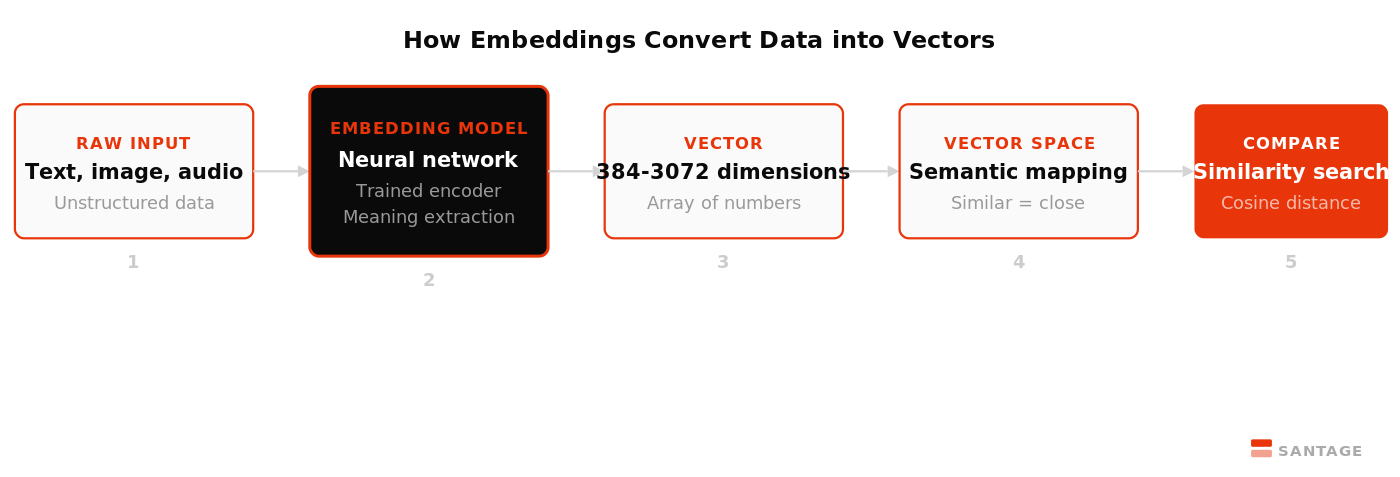
- Raw input: A piece of data is provided to the system. This could be a sentence, an image, a product description, or an entire document.
- Embedding model: The input is passed through a specialised neural network trained specifically to produce embeddings. These models are typically derived from or distilled from large foundation models.
- Vector generation: The model outputs a vector, typically between 384 and 3,072 dimensions. Each dimension captures some aspect of the input's meaning, though individual dimensions are not human-interpretable.
- Vector space mapping: The vector represents a point in a high-dimensional space. Similar inputs produce vectors that occupy nearby points in this space.
- Similarity comparison: When needed, vectors are compared using mathematical distance metrics such as cosine similarity or Euclidean distance. Closer vectors mean greater semantic similarity.
The breakthrough that made modern embeddings possible was the introduction of transformer-based architectures, published in the 2017 paper Attention Is All You Need.
The core idea behind embeddings
Embeddings turn meaning into geometry.
When text, images, or any other data is embedded, it is placed in a mathematical space where distance equals meaning. Two points close together represent two concepts close in meaning. This geometric property is what allows AI systems to reason about similarity at a scale and speed that keyword matching cannot match.
How do embeddings differ from related concepts?
| Concept | Difference |
|---|---|
| Embedding vs Token | A token is a unit of raw text. An embedding is the numerical meaning representation of that token |
| Embedding vs Vector | All embeddings are vectors, but not all vectors are embeddings. Embeddings are vectors designed to represent meaning |
| Embedding vs Keyword | Keywords require exact matches. Embeddings capture semantic similarity |
| Embedding vs Hash | A hash creates a unique identifier. An embedding creates a meaningful representation |
| Embedding vs Feature Vector | Feature vectors use hand-engineered attributes. Embeddings are learned automatically from data |
How do embeddings enable LLMs?
Large language models use embeddings at two critical points. Internally, every input an LLM processes is converted into embeddings before the model can operate on it. The transformer layers inside the LLM are sophisticated machinery for transforming these embeddings based on context.
Externally, when an LLM is connected to a knowledge base or search system, embeddings serve as the retrieval mechanism. The user's query is embedded, compared against stored embeddings, and the most relevant documents are returned to the LLM as context. This is the RAG pattern.
How do embeddings power vector databases?
Vector databases exist specifically to store, index, and search embeddings at scale. Traditional databases were built for exact matches on structured data. They cannot efficiently search across millions of high-dimensional vectors to find the closest match.
Pinecone, the leading managed vector database, has raised over $130 million in venture capital. Weaviate, its open-source competitor, now exceeds one million Docker pulls per month. The category did not meaningfully exist five years ago. Today it is essential infrastructure for every AI-native company.
Why are embeddings important for AI systems?
- Semantic search: Google, Perplexity, and enterprise search tools use embeddings to understand what users actually mean, not just what they typed.
- Recommendation systems: Netflix, Spotify, YouTube, and Amazon embed user behaviour and content into the same vector space, then recommend items whose embeddings are close to the user's.
- RAG pipelines: Every retrieval-augmented generation system uses embeddings as the retrieval mechanism.
- Clustering and classification: Embeddings allow organisations to automatically organise millions of documents by meaning.
- Anomaly detection: Banks and cybersecurity firms use embeddings to detect behaviours that deviate from normal patterns.
According to a16z analysis of the enterprise AI stack, embedding infrastructure is one of the three foundational layers of modern AI, alongside foundation models and vector databases.
What are the limitations of embeddings?
- Embedding drift: As language evolves, embeddings trained on older data become less accurate. Organisations typically re-embed their corpora every 6 to 12 months.
- Domain specificity: General-purpose embedding models perform poorly on specialised domains such as medical, legal, or highly technical content.
- Dimensionality trade-offs: Higher-dimensional embeddings capture more nuance but cost more to store and search.
- Bias inheritance: Embeddings trained on web-scale data inherit the biases present in that data, as documented by researchers at MIT CSAIL and Stanford.
- Interpretability: Individual dimensions of an embedding vector are not human-interpretable, creating challenges for auditing in regulated industries.
- Security: Research on arXiv has demonstrated that some embeddings can be partially reversed, raising privacy concerns.
Where are embeddings used in practice?
- Search and discovery: Google's MUM and BERT systems, Bing's vector search, and Perplexity's retrieval engine all use embeddings at their core.
- E-commerce: Amazon, Shopify, and Alibaba use embeddings for product recommendations, visual search, and personalisation.
- Healthcare: Mayo Clinic and academic medical centres use embeddings to organise clinical literature and medical imaging.
- Finance: JPMorgan and Goldman Sachs use embeddings for fraud detection and document processing. McKinsey research estimates generative AI could add $200-340 billion annually to global banking.
- Cybersecurity: CrowdStrike and Palo Alto Networks embed network traffic patterns to detect anomalies.
- Enterprise knowledge: Microsoft Copilot, Google Workspace with Gemini, and Notion AI all use embeddings to make internal documents searchable by meaning.
The future of embeddings
- Multimodal unification: Models like OpenAI's CLIP and Meta's ImageBind embed multiple modalities into the same vector space.
- Smaller, faster models: Nvidia's Blackwell platform cuts inference cost by up to 25 times, accelerating embedding adoption in cost-sensitive applications.
- API commoditisation: High-quality embedding models are becoming available via simple APIs at continuously falling prices.
- Privacy-preserving embeddings: Research at MIT CSAIL, Stanford, and Carnegie Mellon on differential privacy and federated learning applied to embeddings is growing under pressure from the EU AI Act.
Organisations that treat embeddings as a strategic capability rather than a technical curiosity will build meaningful AI moats. Those that treat embeddings as commodity will find themselves dependent on whoever controls the embedding layer above them.
Frequently asked questions
Sources and further reading
- Vaswani, A. et al. Attention Is All You Need. Google Research, 2017. arxiv.org/abs/1706.03762
- Gartner. Forecast Analysis: Generative AI Worldwide. 2025. gartner.com
- McKinsey & Company. The economic potential of generative AI. 2024. mckinsey.com
- Andreessen Horowitz. Emerging Architectures for Modern Data Applications. 2024. a16z.com/ai
- MIT CSAIL. Privacy-Preserving Machine Learning Research. csail.mit.edu
- Nvidia. Blackwell Architecture Technical Overview. 2024. nvidia.com