

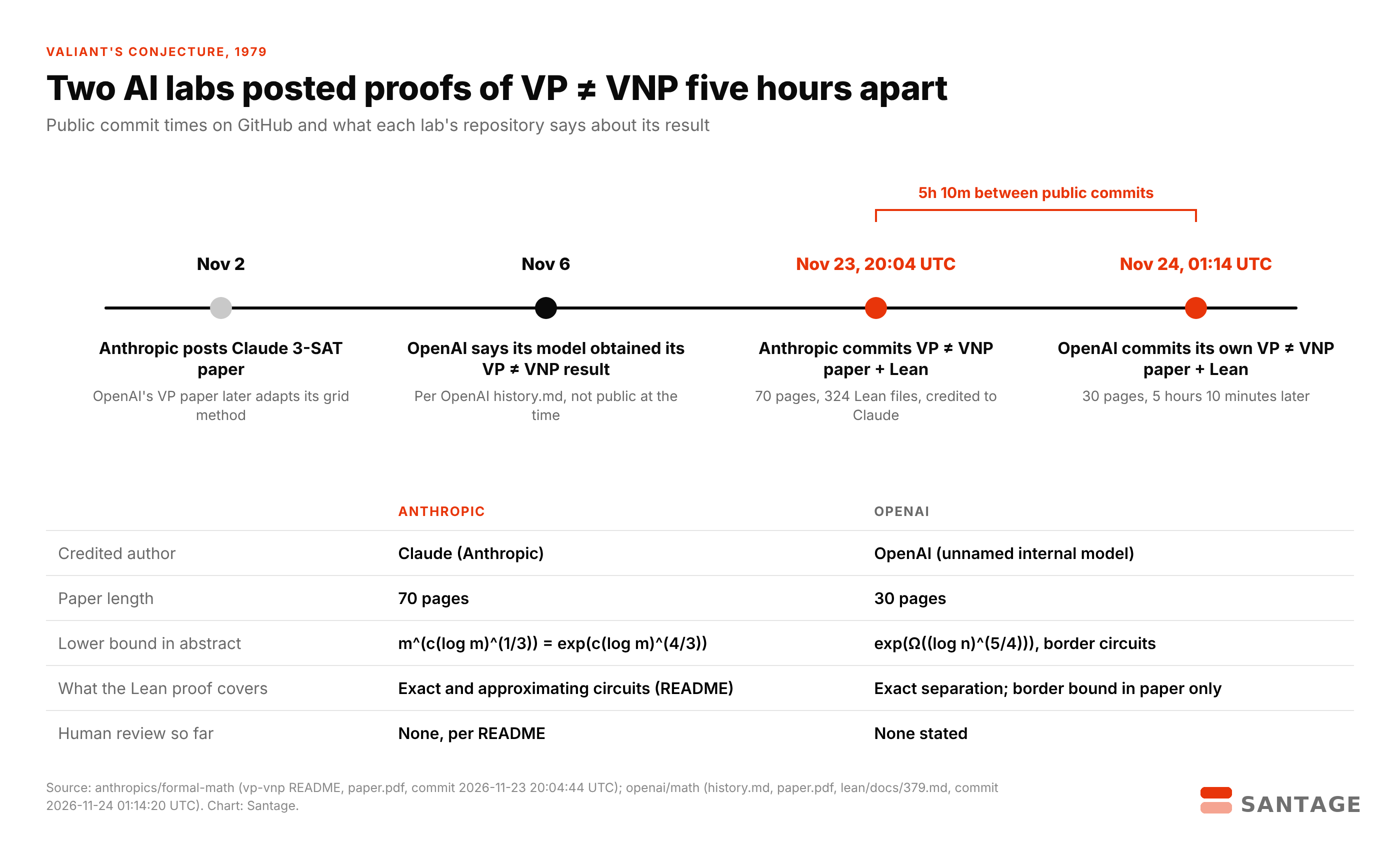
- Anthropic committed a 70-page paper credited to Claude, plus a Lean 4 formalization in 324 files, at 20:04 UTC on November 23. OpenAI committed a 30-page paper with its own Lean proof 5 hours and 10 minutes later.
- OpenAI's repository says its result "was obtained on November 6, 2026," and its paper adapts methods from an earlier Claude paper on 3-SAT.
- Both proofs pass a machine check, and both labs say the remaining step is human: confirming the formal statements say what the papers claim.
Two frontier labs have now staked public claims to the same 47-year-old problem in theoretical computer science within five hours of each other, and the way they did it shows that AI mathematics has entered a priority race whose rules on credit and checking are still being written. Anthropic posted a Claude-authored proof that VP is not equal to VNP on November 23, OpenAI followed with its own proof early on November 24, and neither result has yet been read by a human mathematician.
Valiant's conjecture asks whether the permanent has a shortcut
In 1979 Leslie Valiant split polynomial families into two classes. VP holds the families that small arithmetic circuits, built only from additions and multiplications, can compute efficiently. The determinant of a matrix lives there, which is why computers handle huge linear systems. VNP holds families defined by summing over exponentially many terms, and its standard example is the permanent, a formula that looks almost identical to the determinant with every minus sign turned into a plus. Valiant conjectured that the permanent has no efficient circuit at all, so VP and VNP are different.
The problem is widely described as the algebraic counterpart of P versus NP, and Anthropic's abstract is careful about the gap. Arithmetic circuits must work over every input in a field, while the Boolean circuits behind P versus NP only see zeros and ones, so the result "does not settle that conjecture." A confirmed proof would still answer one of the central open questions about how hard algorithms for these polynomials must be, and it would be among the most significant results yet credited to an AI system.
GitHub timestamps have become the evidence of priority
Both labs skipped the press release and the blog post and simply pushed a folder to a public repository, so the commit records now carry the weight that journal submission dates used to. Anthropic's commit landed at 20:04 UTC on Sunday evening in California. OpenAI's landed at 01:14 UTC and merged sixteen minutes later, with a single line added to its changelog.
"VP and VNP are different. This result was obtained on November 6, 2026."
OpenAI, openai/math history.md, November 23, 2026 entry
That November 6 date is a claim about OpenAI's internal records, which nobody outside the company can inspect. The public record shows Anthropic first. OpenAI's own repository says it defers "to the math community completely on matters of credit, precedence, and concurrent work," and its paper cites a Claude paper on 3-SAT from early November twice, adapting its grid method and its square scheme for steps in the VP proof. Whatever the final verdict on credit, the two systems are already building on each other's published output, the same way human research groups do.
The papers differ in ways that matter to specialists. Anthropic's abstract proves that a circuit for an m by m permanent needs more than m^(c(log m)^(1/3)) gates, which works out to exp(c(log m)^(4/3)). OpenAI's states exp(Ω((log n)^(5/4))) for border circuits. On the face of the two abstracts, Anthropic's bound grows faster, while OpenAI's paper is less than half the length.
| Anthropic | OpenAI | |
|---|---|---|
| Credited author | Claude (Anthropic) | OpenAI, unnamed internal model |
| Public commit | Nov 23, 20:04 UTC | Nov 24, 01:14 UTC |
| Paper | 70 pages | 30 pages |
| Stated lower bound | exp(c(log m)^(4/3)) | exp(Ω((log n)^(5/4))) |
| Lean scope | Exact and approximating circuits | Exact separation; border bound in the paper only |
| Human review to date | None, per README | None stated |
Source: anthropics/formal-math vp-vnp README and paper.pdf; openai/math paper.pdf, history.md and lean/docs/379.md. Table: Santage.
Lean can confirm that a proof follows from its statement. It cannot confirm that the statement is the theorem the world cares about, and that check still belongs to mathematicians.
A compiling proof still leaves the human check
Formal verification changed what an AI math claim is worth. Lean checks every step mechanically, so a proof that compiles cannot hide an arithmetic slip or a skipped case, and Anthropic's repository re-checks its proof with a second, independently written kernel. Both labs are explicit about the limit of that guarantee.
"Lean checks the proofs, but no machine checks that this file says what is claimed."
Anthropic, formal-math vp-vnp README, November 23, 2026
That single file is where the review now concentrates. Anthropic's Statement.lean defines arithmetic circuits, the classes and the theorem using only Mathlib, and a specialist has to confirm that those definitions match Valiant's. The same question is still open for the Claude-assisted Riemann hypothesis proof from three days earlier, where outside mathematicians compiled the code and are still checking whether its formal statement proves the intended claim. OpenAI flagged the same gap after its Exponential Time Hypothesis disproof in October, and the verification bottleneck has grown with every result since.
Open problems are now the frontier benchmark
OpenAI's repository explains the shift in one line: the company began evaluating models on open research problems after performance on its existing mathematical evaluations saturated. That collection now lists 722 manuscripts across 374 families, the archive Santage examined when OpenAI first published its unreleased model's papers. Anthropic is running the same play through its formal-math repository. For labs selling reasoning models to enterprises, a dated solution to a named conjecture is a harder signal than any benchmark score, and the November 23 sequence shows each lab is now willing to publish within hours of the other to hold its place.
If the community confirms either result, Valiant's conjecture will be settled by AI systems 47 years after it was posed, and the question of who reached it first may matter less than the fact that two labs' models arrived at it within weeks of each other, one partly using methods the other had published. Until then, the November 23 releases are best read the way OpenAI describes its own output: raw research data, timestamped and machine-checked, waiting for the human review that no compiler can supply.
Santage is committed to independent, transparent journalism. This article is produced in accordance with Santage's Editorial Standards and aims to provide accurate and timely information. Readers are encouraged to verify information independently.