
- On November 20, Alpöge posted a four-page note saying he had, working with Claude, found a proof of the Riemann Hypothesis, released as a Lean library of 175,187 modules and about 17 million lines of code.
- On November 21, the Lean and Mathlib communities, endorsed by the Lean FRO and the Mathlib Initiative, certified that both the statement and the proof are correct after independent kernels accepted all 1.47 million declarations.
- No human-readable version exists yet. Alpöge says a full write-up would be a "huge, unreadable document," so mathematicians now hold a verified theorem whose central ideas still have to be extracted and explained.
The Riemann Hypothesis, the most famous open problem in mathematics since Bernhard Riemann posed it in 1859, now has a proof that machines have certified as correct and that no human mathematician has yet read in full, after Anthropic mathematician Levent Alpöge released a 17-million-line formal proof built with Claude and the Lean and Mathlib communities vouched for it within a day.
Levent Alpöge and Claude released a 17-million-line Lean proof
Alpöge, a research scientist at Anthropic, published a short note titled "remark" on his website on Friday. Its central sentence is plain: "I believe I have, working with Claude, discovered a proof of the Riemann Hypothesis." He writes that the method also resolves the Generalized Riemann Hypothesis and that he expects it to reach the Extended Riemann Hypothesis with more time. The hypothesis states that every nontrivial zero of the Riemann zeta function has real part one half, a claim that controls how evenly the prime numbers are spread out.
The note is unusually candid about who did what. Alpöge says he guided the work to the right setting, after which "Claude far outpaced me near the finish line." He links the proof as 14 compressed archive parts rather than a paper, and says producing a full informal account is now routine but would yield "a huge, unreadable document." He also addresses the timing, one day after Anthropic's record stock market debut, calling it "horrible" and saying he messaged chief executive Dario Amodei before announcing. Anthropic has not issued a separate statement on the result.
Lean and Mathlib certified the proof in about a day
The speed of verification is what separates this claim from every previous announced proof of the hypothesis. Lean is a programming language in which each logical step must be accepted by a small trusted program called a kernel, and Mathlib is its shared library of formalized mathematics, which already contained a vetted statement of the Riemann Hypothesis.
The joint statement sets out four tests and says all four pass: the statement is Mathlib's own, the library compiles, two independent tools confirm the theorem proved is exactly Mathlib's statement, and several separately written proof checkers accept the exported proof. Two of those checkers carry their own formal proof that they cannot accept a false proof, which answers the worry that a flaw in Lean itself could be exploited.
"We hereby certify that both the statement and the proof of the Riemann Hypothesis are correct."
Lean and Mathlib communities, joint statement, November 21, 2026
MIT mathematician Andrew Sutherland, running checks with Claude Code, published the audit trail on a public verification page. The five headline theorems rely only on Lean's three standard axioms, and an independent sandboxed rebuild reproduced the 61.6-gigabyte proof export byte for byte. His page also limits the scope of the generalized result to Dirichlet L-functions, so broader families of L-functions remain open.
| 175,187 | Lean modules, about 17 million lines |
| 1.47M | Declarations accepted by independent kernels |
| 3 | Standard axioms the proof depends on |
| ~28 min | For the nanoda kernel to check it on 80 threads |
A certified proof that nobody can yet explain
The certification settles whether the proof is correct, while the question of what it teaches remains open. Mathematicians value a proof of the Riemann Hypothesis for the ideas that make it work, since those ideas tend to unlock neighboring problems, and here the ideas sit inside millions of lines of formal code that Alpöge says he has not fully mastered. His note offers only a glimpse, describing a Fourier-analytic argument that descends from Stepanov's method for function fields.
Mathematics has always treated understanding and verification as the same event. This proof splits them, and the field now has to decide which one it rewards.
The reaction among mathematicians reflects that split. Stanford's Brian Conrad called the release of a proof its author does not fully understand outrageous, according to The New York Times, while early independent checkers reported no problems. The Clay Mathematics Institute's $1 million Millennium Prize requires publication in a qualifying outlet and two years of scrutiny, so the prize question is years away regardless of what the kernels say.
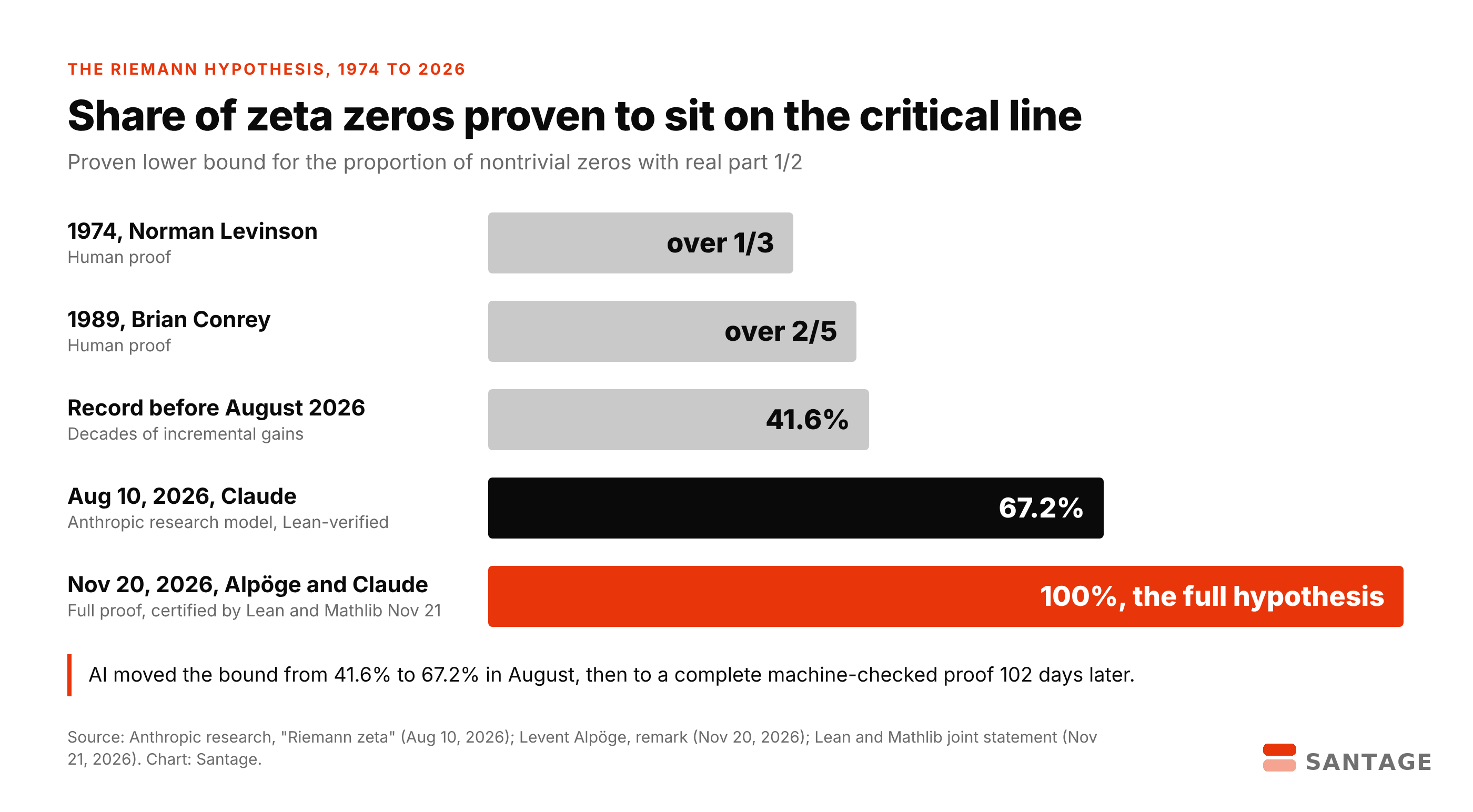
AI mathematics moved from 67.2% to the full hypothesis in 102 days
The result caps a fast run. In August, Anthropic reported that a research version of Claude had raised the proven share of zeta zeros on the critical line from 41.6% to 67.2%, a bound that had moved only a few points in five decades, and said it did not expect that technique to reach the full hypothesis. In October, OpenAI announced a proof of a weaker "quasi-Riemann" statement among hundreds of results, and Santage covered its Lean-verified refutation of the Exponential Time Hypothesis and Anthropic's proof of a quantum computing conjecture.
Conditional results across number theory now stand on their own
The practical consequences run through every theorem that was proved "assuming the Riemann Hypothesis," a large body of work that can now drop that condition. Sutherland's page already shows one: combined with an independent formalization, the proof yields Robin's and Lagarias's inequalities about divisor sums as hypothesis-free Lean theorems. The deterministic version of the Miller primality test, long known to be correct only under the Generalized Riemann Hypothesis for Dirichlet characters, also gains an unconditional footing. Everyday encryption is unaffected, because schemes such as RSA rest on the difficulty of factoring large numbers, which the hypothesis does not address. For AI labs, the result shows that a large language model paired with a formal checker can now deliver results whose correctness the world can confirm in a day, even when their meaning takes years to absorb.
The Riemann Hypothesis has been answered in the strict sense mathematicians use for correctness, and left open in the sense they use for insight. Verification that once took a community years now takes kernels about half an hour, which moves the scarce resource in mathematics from checking proofs to understanding them. The next year of work on Alpöge's archive will show whether AI systems can supply that understanding too, or whether humans will spend a generation reading what a machine found in six weeks.
Santage is committed to independent, transparent journalism. This article is produced in accordance with Santage's Editorial Standards and aims to provide accurate and timely information. Readers are encouraged to verify information independently.