

- The Bureau of Industry and Security filed rule 2026-23999 on November 23, listing seven entities it says pose a significant risk of diverting advanced computing chips to unauthorized end users.
- By Santage's count of Federal Register records, it is the first Entity List addition rule in 410 days, after 18 such rules in 2023 and 6 in 2025.
- Alibaba called the listing of its unit Apex Enterprise Solutions "erroneous" and said it will pursue all legal avenues.
The US Commerce Department has put Singapore cloud operator Megaspeed and six linked companies in Singapore, Malaysia and Thailand on its Entity List, including a Singapore subsidiary of Alibaba, in the first rule adding companies to the export blacklist since October 2025.
Seven companies now need a license for every US item
The rule went on public inspection at 4:15 PM Eastern on Monday and is due for formal publication on November 25. Every company it names now needs a US license to receive any item subject to the Export Administration Regulations, and applications will be reviewed under a presumption of denial. That covers far more than AI chips: servers, networking gear and US software all fall inside the license requirement. A savings clause lets shipments already en route under existing orders finish within 30 days, while new orders get no transition.
The interagency End-User Review Committee grounded the listing in diversion risk for advanced computing commodities, which is the core concern behind US controls on Nvidia's data center GPUs reaching China. Nvidia stopped selling to Megaspeed in June 2025, before any government action, and the company has been under US investigation since 2024.
| Country | Entity named in rule 2026-23999 |
|---|---|
| Singapore | Megaspeed International Pte. Ltd. (also 7Road International) |
| Singapore | Apex Enterprise Solutions (Singapore) Pte. Ltd., an Alibaba subsidiary |
| Singapore | Swiftdata Pte. Ltd. |
| Malaysia | MSFusion Sdn. Bhd. |
| Malaysia | PT Megaspeed International |
| Malaysia | Speedmatrix Sdn Bhd |
| Thailand | Megaspeed (Thailand) Co., Ltd. |
Source: Bureau of Industry and Security, Federal Register document 2026-23999, filed Nov 23, 2026. Table: Santage.
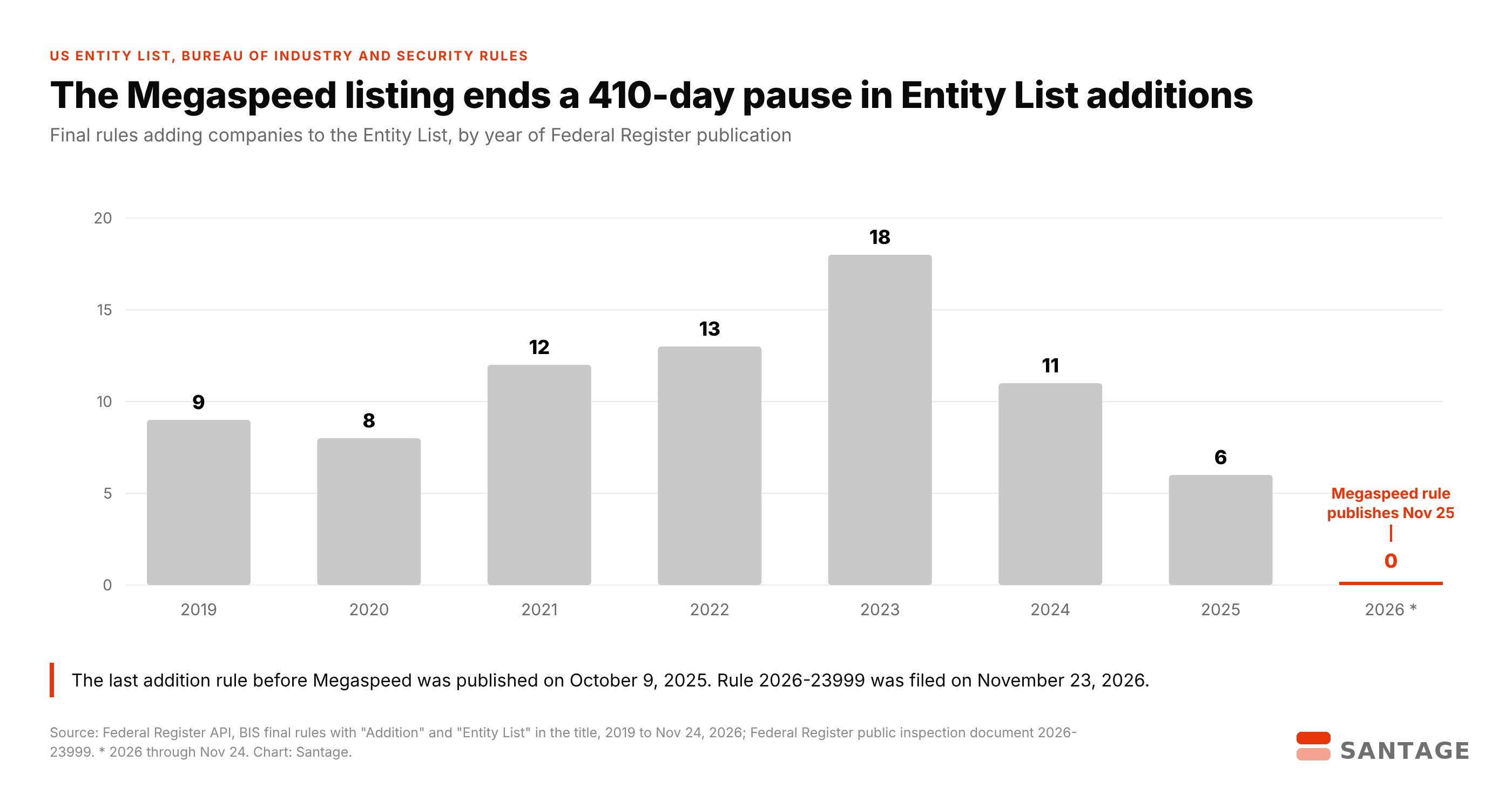
The Alibaba listing turns a chip-diversion case into a cloud story
Apex is the name most likely to move markets. Alibaba runs one of China's largest AI clouds and its Qwen models, and a blacklisted Singapore arm cuts one route through which a Chinese hyperscaler can buy US hardware for capacity outside China. Alibaba rejected the finding within a day.
"Adding Apex Enterprise Solutions to the Entity List is erroneous because Apex has never diverted advanced computing chips subject to US export restrictions."
Alibaba spokesperson, November 24, 2026, via Reuters on TradingView
| 7 | Entities listed across 3 countries |
| 410 | Days since the previous addition rule, Oct 9, 2025 |
| 30 | Days for in-transit shipments to complete |
| Nov 25 | Formal Federal Register publication |
The timing follows a week of tightening. BIS issued its remote-access rule for advanced chips on November 16, aimed at the same Southeast Asian data center corridor, and the listing landed on the day Nvidia reinstated Jensen Huang as CEO. Singapore says it will keep running its own investigation into Megaspeed under local law.
Washington's export controls have leaned for two years on chipmakers' own no-sell lists and on license conditions written into sales. The Megaspeed rule puts a parent cloud operator, its regional subsidiaries and a unit of one of China's largest cloud providers under a presumption of denial in one filing, and for every AI infrastructure buyer in Southeast Asia, that is the clearest sign yet that the compliance burden now sits with the data center as well as the chip vendor.
Santage is committed to independent, transparent journalism. This article is produced in accordance with Santage's Editorial Standards and aims to provide accurate and timely information. Readers are encouraged to verify information independently.