
- Hyundai Home Shopping's AI-REAL system generates a full sales broadcast, voice and video, and debuts at 3:20 p.m. KST on November 16 selling Jeju Heart Gold kiwis.
- In its trial, suppliers' costs for samples, insert video and related items fell by at least 80%, and sales reached 120% of the pre-set target, according to the company.
- Korean TV home shopping is under pressure: broadcast sales fell for a fourth straight year to 2.62 trillion won in 2025, and channel fees ate 73.3% of broadcast sales in 2024.
South Korean retailer Hyundai Home Shopping starts airing a sales program today that was produced entirely by artificial intelligence, with no presenter on set and no camera crew, after a trial in which the system cut participating suppliers' production costs by more than 80% and lifted sales to 120% of target.
AI-REAL replaces the host, the studio and the shoot
Hyundai Home Shopping announced on Sunday that AI-REAL will run on PLUS#, its data home shopping channel, the recorded-programming tier of Korean TV retail. The system produces the voiceover and every frame of the program, including scenes that are hard or costly to film, such as soil conditions on the farm or how produce moves through distribution. Earlier uses of AI in Korean home shopping swapped out a single presenter or a few scenes. Hyundai calls AI-REAL the industry's first fully generated broadcast.
The company will air at least one AI-made program a month, starting with produce, meat and seafood, and plans to extend the format to processed foods and household goods, categories where smaller suppliers have asked for airtime. Lim Hyun-tae, head of channel strategy, said the system was built to support smaller suppliers and give customers a different shopping experience, and that the company will push AI further into its operations.
| 80%+ | Drop in suppliers' sample and insert-video costs in the AI-REAL trial |
| 120% | Trial sales against the pre-set target |
| 1+ a month | Planned cadence of fully AI-made programs |
| 0 | Human hosts or camera crew on an AI-REAL broadcast |
Korean TV retail's cost structure explains the move
The economics behind AI-REAL sit in the industry's own numbers. The Korea TV Home Shopping Association's 2025 industry report puts TV broadcast sales for the seven licensed operators at 2.6181 trillion won, about $1.9 billion, down 0.9% and the fourth straight annual decline since 2021. Television's share of the operators' total sales slid from 51.5% in 2021 to 46.7%, as shoppers moved to mobile apps and live commerce. Over the same period, the fees that channels pay pay-TV platforms for prime slots kept rising, reaching 73.3% of broadcast sales in 2024 according to the association.
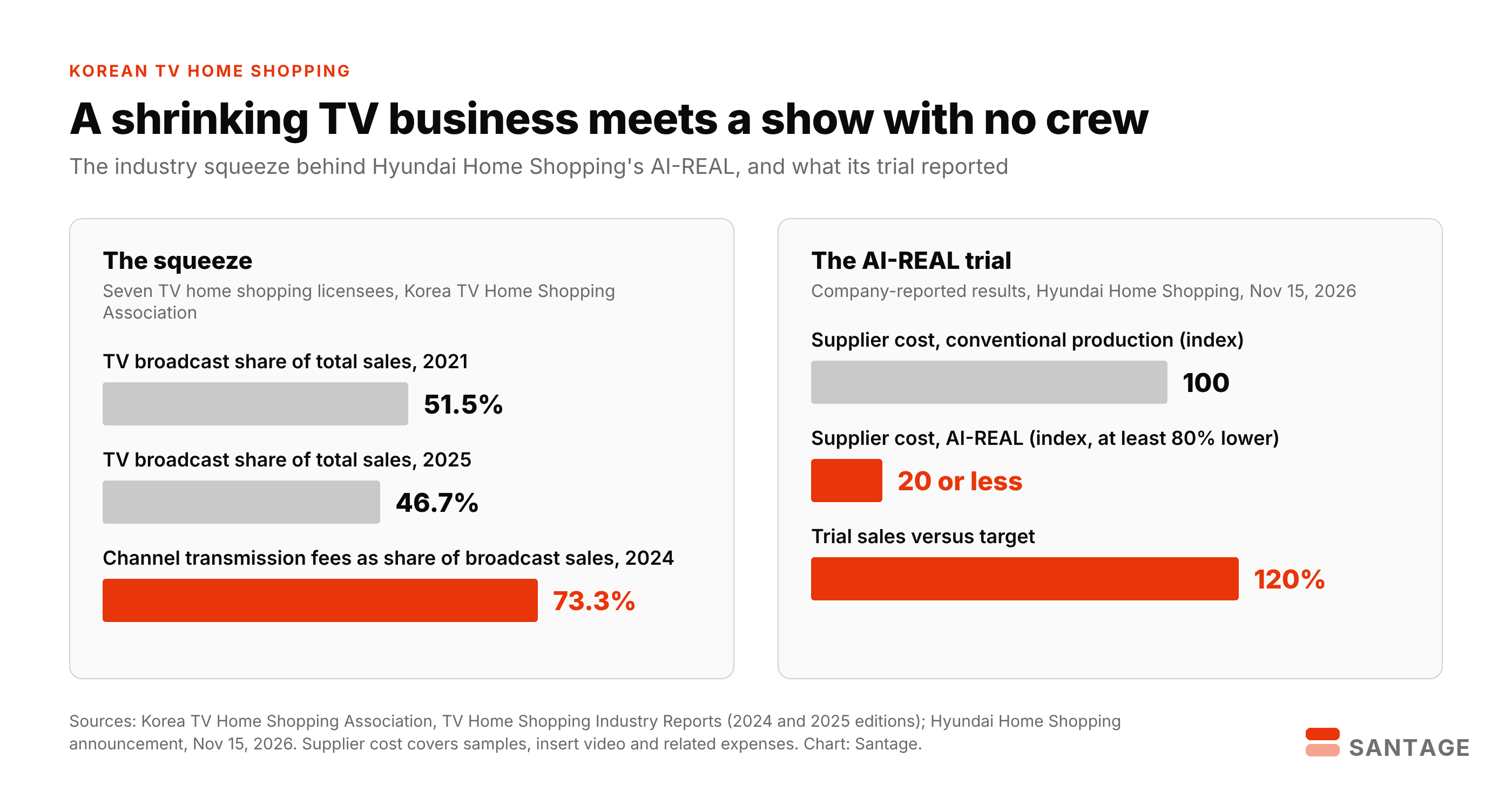
A channel that hands over roughly three quarters of its broadcast takings for its slot has little room left anywhere else in the cost stack. Production, which covers studios, presenters, camera crews, product samples and location footage, is one of the few lines an operator controls, and it weighs most heavily on the small farm and food suppliers that TV retail depends on for its schedule. AI-REAL targets that line directly, and the company frames the savings as a benefit for those suppliers, whose share of production costs is what fell in the trial.
Fresh produce explains why the launch starts with kiwis. A grower selling on TV typically has to supply samples and pay for insert footage of orchards, harvesting and packing, which means sending a crew to a farm for a few minutes of airtime. Generated scenes of soil, orchards and cold-chain trucks remove that trip, and a small cooperative that could never justify a location shoot can now appear with the same visual polish as a large brand. That widens the pool of suppliers a channel can schedule, which matters for an operator trying to fill airtime with exclusive products as broadcast revenue shrinks.
Korea's home shopping channels are racing to automate production
Hyundai is moving furthest in a sector that has spent two years putting generative AI into its studios, using multimodal video and voice models of the kind Santage covered in its report on fal's $16 billion valuation.
| Operator | AI in production | Stage |
|---|---|---|
| Hyundai Home Shopping | AI-REAL generates the full broadcast, voice and video, with no host or camera | Regular programming from Nov 16, 2026 |
| GS Shop | Generative AI virtual model appearing alongside human models in live broadcasts | Live special, early 2026 |
| Lotte Home Shopping | AI show host "Lucy" with synthetic voice | In use |
| SK Stoa | AI voice synthesis to update recorded T-commerce programs | In use |
| Hyundai Home Shopping (earlier) | AI avatar host, 3D clothing images, automatic short-form clips from high-rated segments | In use since 2023 |
Source: company announcements as reported in Korean business press, 2023 to 2026. Table: Santage.
Rivals report similar savings on narrower tasks. KT Alpha Shopping's production team has described cutting a promotional video that once cost 25 million won to about 150,000 won by generating models, sets and locations with AI, according to Korean press interviews in May. Hyundai's own path has been incremental: an AI avatar host in 2023, an automatic system in 2024 that clips high-rated segments into up to 100 short videos a week, and a partner-support chatbot that the company says took over most routine supplier queries. AI-REAL is the step where those pieces combine into a complete program.
When a broadcaster pays most of its revenue for the slot itself, the cheapest show is the one nobody has to film.
The trial numbers carry caveats a buyer would want answered
Both headline figures come from Hyundai's own trial, and the company has not said how many programs it ran, which products were tested or how the sales target was set. A 120% result against an internal target also says nothing about how the same show would have sold with a human presenter. Hyundai Home Shopping did say viewers found the broadcast as natural as one with a human host, a claim that will be tested once regular programming runs alongside its live channels. Korea's broadcasting rules for data home shopping, which already limit live formats, add a further question about how AI-generated scenes of farms and supply chains will be labeled for viewers, a concern that has grown with the spread of deepfake video.
For enterprise buyers outside Korea, AI-REAL is a clear production-scale test of generated commercial video in a regulated broadcast setting, with a cost result that can be measured against a known baseline. Korean TV retail has spent four years losing share to mobile while paying more for its channel slots, and Hyundai's answer is to remove the most expensive people and equipment from the studio. If monthly AI programs hold their sales as the format expands to processed food and household goods, the 80% cost cut will set the benchmark that rival operators, and video-commerce platforms in other markets, will be measured against.
Santage is committed to independent, transparent journalism. This article is produced in accordance with Santage's Editorial Standards and aims to provide accurate and timely information. Readers are encouraged to verify information independently.