
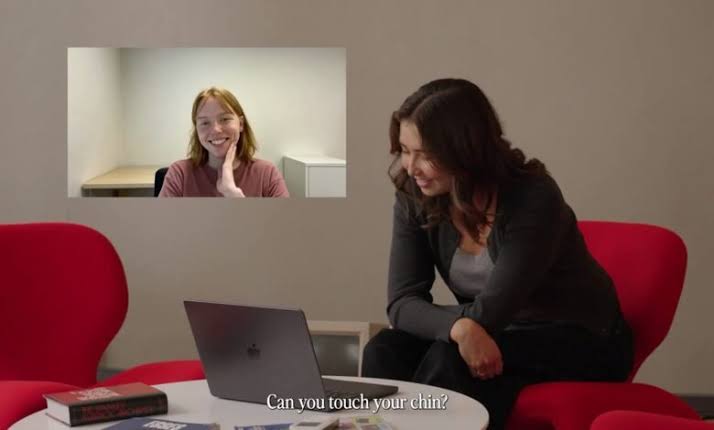
- In Tavus's own blind study, 48% of 54 participants judged Griffin-Lite to be human after a one-minute video call, against 2.4% of 41 participants for the company's previous system.
- On NVIDIA's independent VideoFDB benchmark, Griffin-Lite scored 3.73 out of 5 on perception against 4.20 for humans and 3.17 for Google's Gemini 2.5 Flash Native, with a 2.2-second median response time against 1.4 seconds for people.
- Tavus is holding Griffin back from customers until it builds disclosure features, while its existing platform already lets AI personas join meetings on Zoom, Meet and Teams through a calendar invite.
AI video startup Tavus says 26 of 54 people who spent one minute on a live video call with its new Griffin model believed they had been talking to a real person, and the company that ran that test already sells software that lets AI video personas accept calendar invites and join Zoom, Google Meet and Microsoft Teams calls.
Tavus's Griffin passed for human with 26 of 54 people on one-minute calls
Tavus announced Griffin on October 1 and calls it the first Human Interaction Model, a single system that watches and listens to a caller while generating its own voice and every pixel of its video in real time from one reference photo. Earlier avatar systems chained speech recognition, a language model, speech synthesis and a face animator, then waited for the caller to stop talking. Griffin re-decides what to do at sub-second intervals, so it can nod, laugh or interrupt mid-sentence and read a glance away as a pause for thought. Its speech engine clones a voice from about ten seconds of audio, and its video generator produces 720p footage in 320-millisecond chunks.
The headline number comes from a study Tavus designed and ran. Participants recruited through an independent research platform were told they would meet another participant for a one-minute chat about what they were looking forward to this year. Their partner was a Griffin-Lite persona. Only after rating the conversation were they asked whether they had suspected an AI.
| Tavus face-to-face study | Griffin-Lite | Previous Tavus system |
|---|---|---|
| Participants | 54 | 41 |
| Said partner was a real person | 26 (48%) | 1 (2.4%) |
| Average confidence, those who said “real” | 79% | Not reported |
| Average confidence, those who said “AI” | 81% | Not reported |
| When doubters first suspected | Within about 20 seconds | Not reported |
Source: Tavus research post, October 1, 2026.
The launch post passed 15 million views within a day.
Tavus is a commercial vendor with real distribution behind the research. The company says more than 150,000 developers and businesses use its current models, lists Amazon, Mayo Clinic and Salesforce among customers, and has raised $70 million from investors including CRV, Sequoia Capital, Scale Venture Partners and Y Combinator. It pitches Griffin for tutors who notice confusion, practice partners for difficult workplace conversations and support agents who can look at a broken part held up to the camera.
NVIDIA's benchmark puts Griffin ahead of Google and OpenAI and behind humans
The study is small, short and run by the vendor, and its setup told participants to expect a human, which works in Griffin's favor. The stronger evidence is external. NVIDIA and data partner David AI built VideoFDB, a benchmark of 237 clips from real two-person video calls that scores whether an AI reads cues such as a pause paired with a glance away. NVIDIA scored Griffin-Lite itself in September, and the VideoFDB leaderboard shows it first among systems given live video.
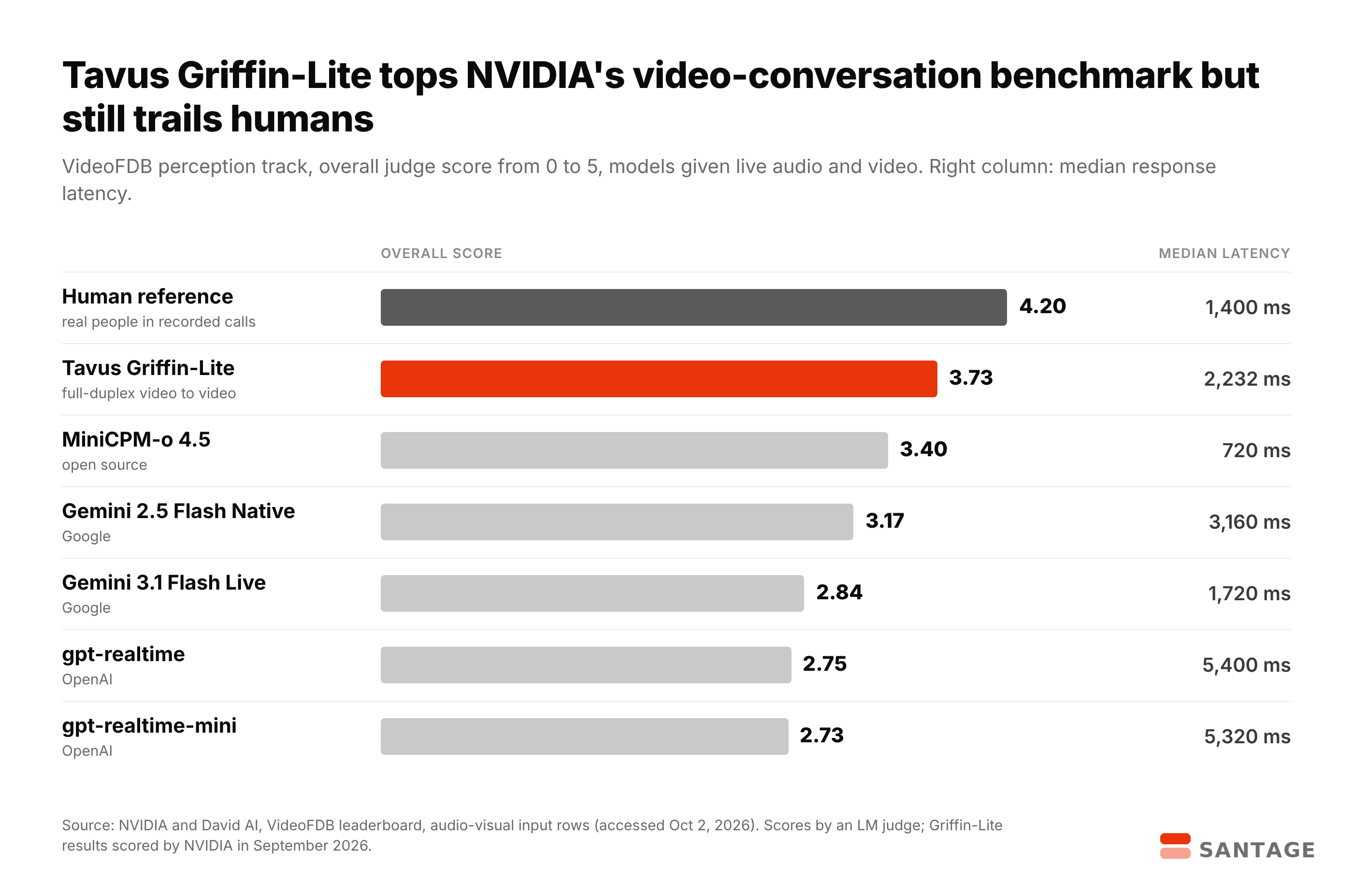
The gap to the field is wide. On the generation track, which grades the model's own face and voice, Griffin-Lite scored 3.83 against 3.92 for real people and 2.80 for the next system, Gemini 2.5 paired with an Anam avatar. NVIDIA's paper explains why the older approach loses: cascaded avatars only move after speech is produced, so they cannot nod or react while the user is still talking, and their latency runs 2.8 to 3.5 seconds behind humans. Griffin's 2.2-second median response is the one place it still trails people, and a one-minute call is too short for most callers to register that lag.
Tavus already sells the delivery channel a deceptive Griffin would need
Tavus's own launch post names the risk plainly.
“The same properties that make Human Interaction Models powerful interfaces for natural communications between human and machine allow them to deceive a human into believing it is not AI.”
Tavus Research, Griffin: The First Human Interaction Model, October 1, 2026
The company has kept Griffin-Lite to a research preview for selected testers and says a wider release will follow once disclosure features are in place. The reaction suggests that framing has not settled public concern. New York Times technology columnist Kevin Roose answered the launch with a post that drew more than 320,000 views.
The concern gains weight from what Tavus already ships. Its developer documentation describes a conferencing layer that gives an AI persona its own email address, accepts calendar invites, and joins Google Meet, Zoom or Teams a minute before start time “with its face’s likeness and voice.” The allowlist that limits who can send those invites is optional, and with none set, anyone who can email the address can schedule a join. Tavus's acceptable use policy requires customers to “clearly and prominently disclose” when people are talking to AI and bans impersonation without consent, so disclosure today rests on a contract clause enforced after the fact.
Griffin's 48% was measured on people who were never told they might meet an AI, and that is exactly the condition a fraudulent video call creates.
Disclosure becomes the product requirement for human-grade video AI
Regulation is partly in place. The EU AI Act's transparency rules under Article 50 have applied since August 2, 2026, and require systems that interact with people to tell them they are dealing with AI and label deepfake content. Those duties bind providers serving Europe, and enforcement depends on spotting a violation after a call has happened.
That leaves the design of the model itself as the practical control point. The disclosure features Tavus says it is building, such as persistent on-screen labels, watermarking of generated video or verified identity for meeting bots, will decide whether Griffin's realism reaches tutoring and customer support or fraud first. Google and OpenAI face the same design choice as their real-time multimodal AI models improve, since VideoFDB already scores them on this exact task.
Video calls have served as an informal identity check for years, the step people take when an email or a phone call seems suspicious. Griffin shows that one minute of face-to-face conversation no longer proves a human is on the other side, and the safeguard that replaces it will have to be built into the AI system, since the person on the call can no longer reliably tell.
Santage is committed to independent, transparent journalism. This article is produced in accordance with Santage's Editorial Standards and aims to provide accurate and timely information. Readers are encouraged to verify information independently.