
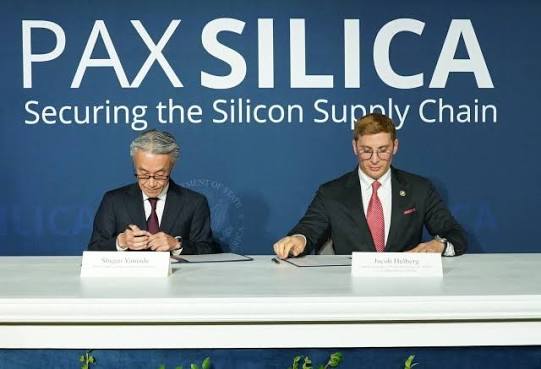
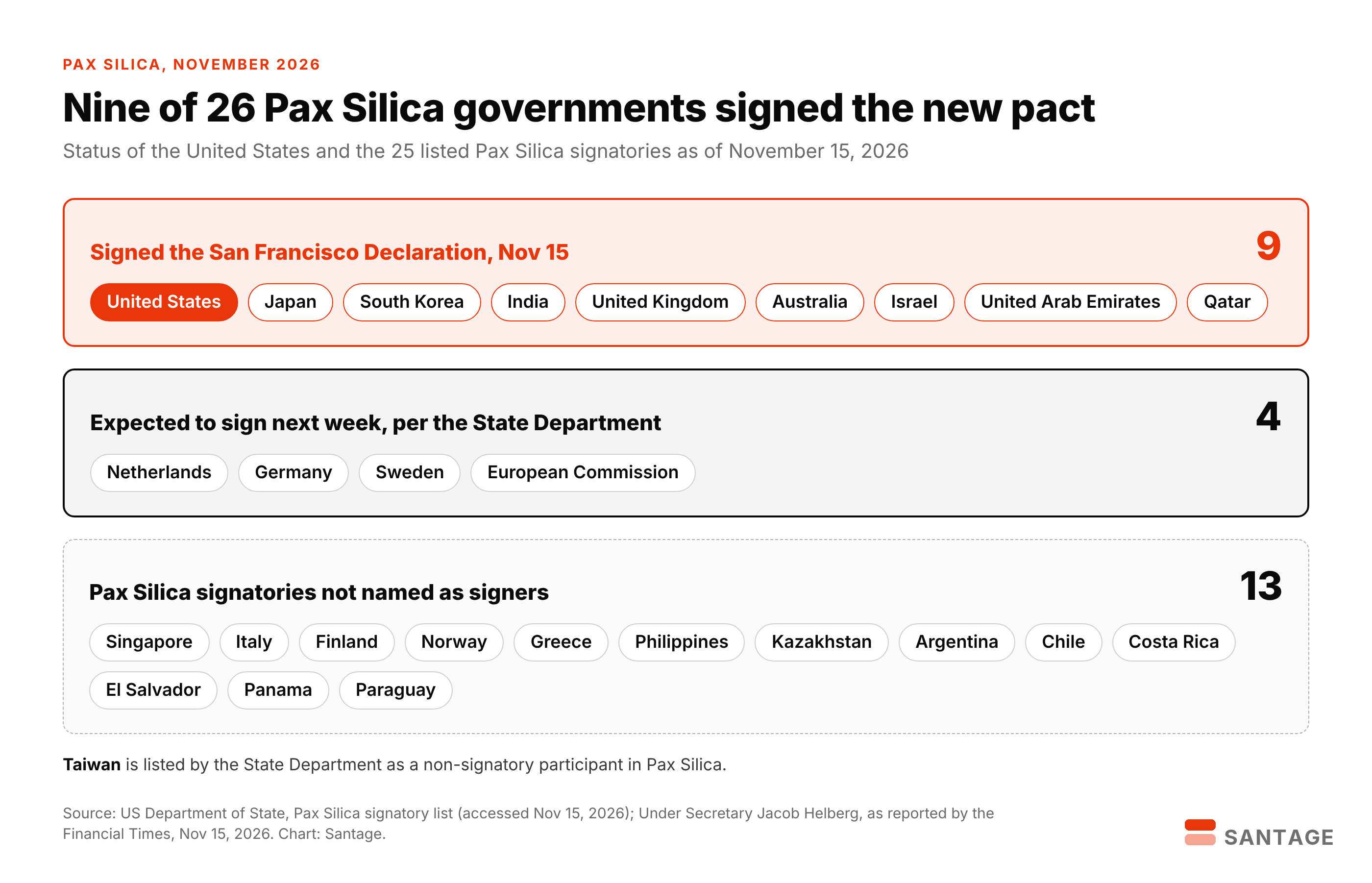
- The US, Japan, South Korea, India, the UK, Australia, Israel, the UAE and Qatar signed the San Francisco Declaration on November 15, committing to a joint list of critical AI technologies and supply chains to protect.
- Only 8 of the 25 governments on the State Department's Pax Silica list signed on day one; the Netherlands, Germany, Sweden and the European Commission are expected next week.
- Singapore, a founding Pax Silica signatory, was absent from the first signing, and Taiwan remains a non-signatory participant, so two of the most important nodes in the chip trade sit outside the core.
Nine governments led by the United States have agreed to draw up a shared list of the technologies and supply chains that artificial intelligence depends on and to protect them together, turning Pax Silica, Washington's year-old coalition on AI supply chains, from a broad statement of principles into a smaller working group with a common target list.
Nine governments agree to list and protect AI's critical technologies
Under Secretary of State Jacob Helberg disclosed the signing to the Financial Times on Sunday. The text, formally the San Francisco Declaration on the Secure Foundations of Enduring Prosperity, commits signatories to identify the sensitive technologies and infrastructure behind advanced AI, to strengthen protections against their theft or unauthorized transfer to hostile actors, and to share information on where supply chains need to diversify. It also sets up working groups on AI supply chain vulnerabilities and calls for investment hubs in partner countries. According to the FT, the coverage spans semiconductors, critical minerals and energy infrastructure, and Helberg described the design know-how, the chipmaking machine and the shipping port as links that "can all be in different countries."
The State Department had not posted the signed text by Monday. Its Pax Silica page still carries the original December 2025 declaration, whose commitments the new text builds on.
"We recognize that a reliable supply chain is indispensable to our mutual economic security."
Pax Silica Declaration, US Department of State, December 2025
A coalition of 25 narrows to an inner circle of nine
Pax Silica has grown quickly since its launch in December 2025. The State Department now lists 25 signatories, from Japan and Korea to Kazakhstan, Panama and Paraguay, which joined in October. The founding text was a set of broad pledges: reduce excessive dependencies, coordinate against overcapacity and dumping, cooperate on protecting sensitive technologies and build trusted networks such as data centers and fiber-optic cables. The San Francisco Declaration asks more of its members, and only a third of the coalition signed it on day one.
The practical change is the list itself. Once partners agree which tools, materials, components and facilities count as critical, each government has a common reference for investment screening, export licensing and the information it shares with the others about weak points. Helberg told the FT that the agreement would help partners identify the sensitive technologies and infrastructure needed to build what the administration calls "super intelligence," and to share where supply chains should diversify. European negotiators have pushed for objective criteria on what counts as sensitive, one reason the EU's signature slipped to next week.
The first nine read like a map of the parts of the AI stack Washington can coordinate today. Japan supplies much of the world's chipmaking equipment, a point Helberg made publicly ten days before the signing.
| Signatory | What it brings to the AI supply chain |
|---|---|
| Japan | Chipmaking equipment and materials |
| South Korea | High-bandwidth memory and advanced chip production |
| India | Engineering talent, fast-growing data center demand, a joint chip agenda with the US since joining in February |
| UAE and Qatar | Capital and low-cost energy for large data center campuses |
| United Kingdom and Israel | Chip design and AI research |
| Australia | Critical minerals |
| Netherlands (expected next week) | Lithography equipment |
Source: signatory status from the US Department of State and Jacob Helberg to the Financial Times, Nov 15, 2026. Country roles are Santage's summary of each country's established industry position. Table: Santage.
The missing names matter more than the signatures
Three absences shape what the list can achieve. The Netherlands, home to the lithography machines that every leading-edge fab depends on, is expected to sign next week alongside Germany, Sweden and the European Commission, after EU member states asked for more time to negotiate the text. Taiwan, which manufactures most of the world's advanced AI chips, participates in Pax Silica without signing its declarations. And Singapore, one of the founding signatories in December 2025, was missing from the San Francisco group even as Washington presses Nvidia over resellers based there, a dispute Santage covers in today's news piece.
A list of protected technologies is only as strong as the countries that make them, and the two that matter most for advanced chips were absent from the first signing.
India gains a seat in the group writing the rules
For India, the declaration deepens a commitment made when it became the tenth Pax Silica signatory on February 20, 2026, a declaration signed for India by electronics secretary S. Krishnan and framed by Washington as part of the US-India TRUST technology initiative. Sitting among the nine that will draft the joint list gives New Delhi a hand in deciding which technologies receive coordinated protection, at a time when Indian IT companies are building large enterprise AI partnerships with US labs. The trade-off is alignment: a country on the list is expected to screen investment and technology transfers with partners in mind.
The timing is deliberate. The signing came days before President Trump's expected meeting with Xi Jinping on the sidelines of the APEC leaders' meeting in Shenzhen, and it mirrors the coalition Beijing has assembled through its own WAICO governance bloc and its export controls on 23 technologies. Both sides are now organizing AI supply chains into blocs that decide where chips, minerals and power can flow.
The San Francisco Declaration is the first time Pax Silica members have agreed to name, in common, the parts of the AI infrastructure stack they will defend, which turns the coalition from a shared statement into shared work. Whether that work holds depends on next week's European signatures and on how Taiwan and Singapore position themselves, because a protected-technology list written without the foundry and the trading hub covers the parts of the chain that were already easiest to control.
Santage is committed to independent, transparent journalism. This article is produced in accordance with Santage's Editorial Standards and aims to provide accurate and timely information. Readers are encouraged to verify information independently.