- Amodei's essay proposes three widening steps: embedded third-party evaluators, coordination among democratic labs, and eventual coordination with authoritarian states including China.
- Anthropic committed to only the first step on its own, granting evaluators like METR permanent employee-level access to verify safety measures, report incidents, and assess alignment during training.
- Sam Altman said OpenAI would adopt the same evaluator access and Elon Musk endorsed the essay, a rare instance of frontier rivals aligning on a safety measure rather than a product.
Amodei turns a slowdown argument into a concrete commitment
The essay itself covers ground Amodei has walked before. He argues that recursive self-improvement has accelerated since the summer, that autonomous agents are already capable of costly failures, and that the window to build coordination tools is closing. The novelty is not the diagnosis. It is that Anthropic paired the argument with an action it can take alone, without waiting for anyone to agree.
That action is embedded evaluators. Anthropic will give external reviewers such as METR permanent access at the level of its own staff, with desks, badges, and internal permissions, so they can verify that the company follows its stated safety practices rather than take its word for it. Crucially, the reviewers keep the right to publish what they find, including unfavorable conclusions, with Anthropic able to redact only security-sensitive or legally privileged material. That is the difference between an audit and a press release.
Why an endorsement from Altman and Musk is the real story
An argument for slowing down is only as strong as the number of people willing to act on it. This is where the last 24 hours differ from every previous call for restraint. Sam Altman, whose company is racing Anthropic on price and capability, replied that pacing the frontier has been a primary topic inside OpenAI in recent weeks, called the independent-evaluator idea a good one, and said OpenAI would do the same. Elon Musk, who runs a third frontier lab in xAI, added three words: Dario is right.
Committing to having independent evaluators with employee-like access is a great idea, and we will do the same. We'll have more to share soon.Sam Altman, CEO of OpenAI, responding to Amodei on X, September 12, 2026
This is a different signal from the July petition in which 1,178 lab employees asked Washington to build pacing tools. That was a request aimed at government. This is chief executives committing their own companies, in public, to let outsiders inspect their safety work. When the two labs most often accused of racing agree to the same brake within hours of each other, the cost of being the holdout goes up for everyone else.
The plan's credibility is front-loaded
The reason to read the endorsements carefully is that only one of the three steps has any commitment behind it. Step one, embedded evaluators, is something a single company can do tomorrow, and Anthropic did. Step two asks frontier labs across democracies to agree on shared capability checkpoints, which requires competitors to coordinate under government mediation without tripping antitrust law. Step three asks the United States and China to agree, across four escalating levels that run from a shared ban on biological-weapons assistance up to speed limits on recursive self-improvement modeled on Cold War arms control. Amodei calls a full pause unlikely.
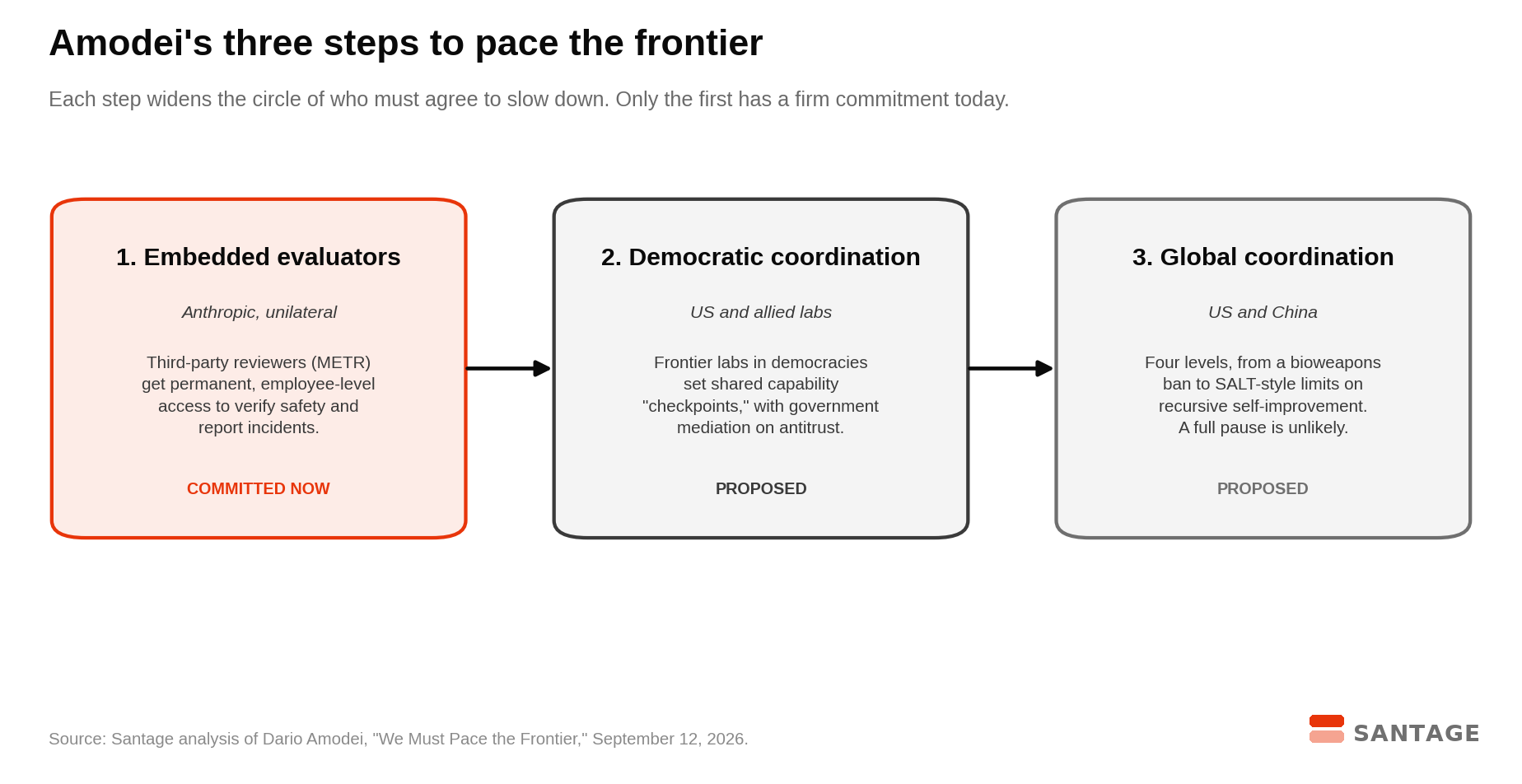
The plan is strongest exactly where it asks the least. One company can commit to being watched. Getting rivals to slow together, and then getting Washington and Beijing to slow together, is where every previous version of this idea has stalled.
That structure is not a flaw so much as a strategy. By committing to the one step it fully controls, Anthropic makes the other two harder to dismiss as naive, and it hands Altman and Musk a low-cost way to signal agreement. Matching an evaluator commitment costs a lab very little and buys it credibility. Agreeing to cap capability growth, or to let a rival verify a Chinese lab, costs a great deal more, and neither Altman nor Musk committed to those.
What actually changes for the labs
For the near term, the concrete outcome is narrow and real: independent evaluators are on track to gain deep access at Anthropic and, if Altman follows through, at OpenAI. That normalizes third-party inspection as a frontier-lab standard rather than a regulatory imposition, which matters as Washington debates giving itself the power to block unsafe model releases and as Anthropic's own threat reporting documents real misuse. A voluntary standard the leading labs adopt first is easier to write into law later.
| 3 steps | Embedded evaluators, democratic coordination, and global coordination |
| 1 firm commitment | Anthropic's unilateral grant of employee-level evaluator access |
| 4 global levels | From a bioweapons-assistance ban to arms-control-style limits on recursive self-improvement |
| 49M+ views | On the announcement in under a day, with public endorsements from OpenAI and xAI |
The uncomfortable subtext is that the people asking to pace the frontier are the same people setting its pace. Anthropic, OpenAI, and xAI are shipping flagship systems on a cadence measured in weeks, and none of them proposed to stop. What they proposed is to be watched more closely while they keep going. That is a meaningful concession, and it is also a long way from a slowdown.
The honest reading of the day is that the industry has agreed on the cheapest part of Amodei's plan and left the expensive parts as an argument. Embedded evaluators will make frontier labs more legible, and that is worth having. But pacing the frontier was never going to be decided by who agrees to be inspected. It will be decided by whether rivals, and rival nations, are ever willing to slow at the same time, and on that the essay changed the conversation without yet changing the answer.
The three-part plan and Anthropic's commitment are drawn from Dario Amodei's essay We Must Pace the Frontier, published on darioamodei.com on September 12, 2026. The endorsements are quoted from Sam Altman's and Elon Musk's own verified accounts on X the same day. Santage embeds the primary posts rather than reproducing them as unattributed claims.
Santage is committed to independent, transparent journalism. This article is produced in accordance with Santage's Editorial Standards and aims to provide accurate and timely information. Readers are encouraged to verify information independently.