

- METR estimates Anthropic's capability growth on well-specified tasks has run at about 2x its earlier rate since October 2025, with 1.9x on Anthropic's internal capabilities index (95% confidence interval 1.5x to 2.8x).
- METR's best guess is that about 80% of the acceleration comes from AI-assisted research, that training compute did not drive it, and that no convincing bottleneck appears over the next 12 months.
- Anthropic held unilateral redaction rights, removed a majority of the most informative evidence, and cancelled a planned check of how its compute splits between capabilities and safety work.
An outside evaluator that spent eleven weeks inside Anthropic's research data estimates that the Claude developer is now improving its models about twice as fast as it did between March 2024 and October 2025, and that roughly 80% of that speed-up comes from Anthropic using AI to do its own research. METR, a nonprofit that tests frontier AI systems for catastrophic risk, published the assessment on November 5 with wide error bars and a plain warning that Anthropic redacted most of the evidence METR considered decisive.
METR measured Anthropic's progress at roughly twice its 2024 to 2025 rate
The assessment ran from August 12 to October 29, 2026, with about 2.5 full-time METR staff. Anthropic shared internal data on pretraining, reinforcement learning, training compute and internal benchmark scores, along with AECI, its own version of the Epoch Capabilities Index, plus speed-up analyses, forecasts and about 15 staff interviews. METR did not get query access to unreleased models, worked on Anthropic devices and took no payment, according to its published report.
The central number comes from AECI. Since October 2025, Anthropic's benchmark-based capability index has grown at 1.9 times its historical rate, which amounts to two years of earlier progress compressed into one. Robustness checks moved that figure anywhere from 1.1x to 2.9x, and METR says it would not be surprised if the true acceleration sat nearer 1.3x or 3x. Anthropic's own Claude Haiku 5.5 system card had reported 1.7x, and METR attributes most of the gap to its inclusion of internal-only models.
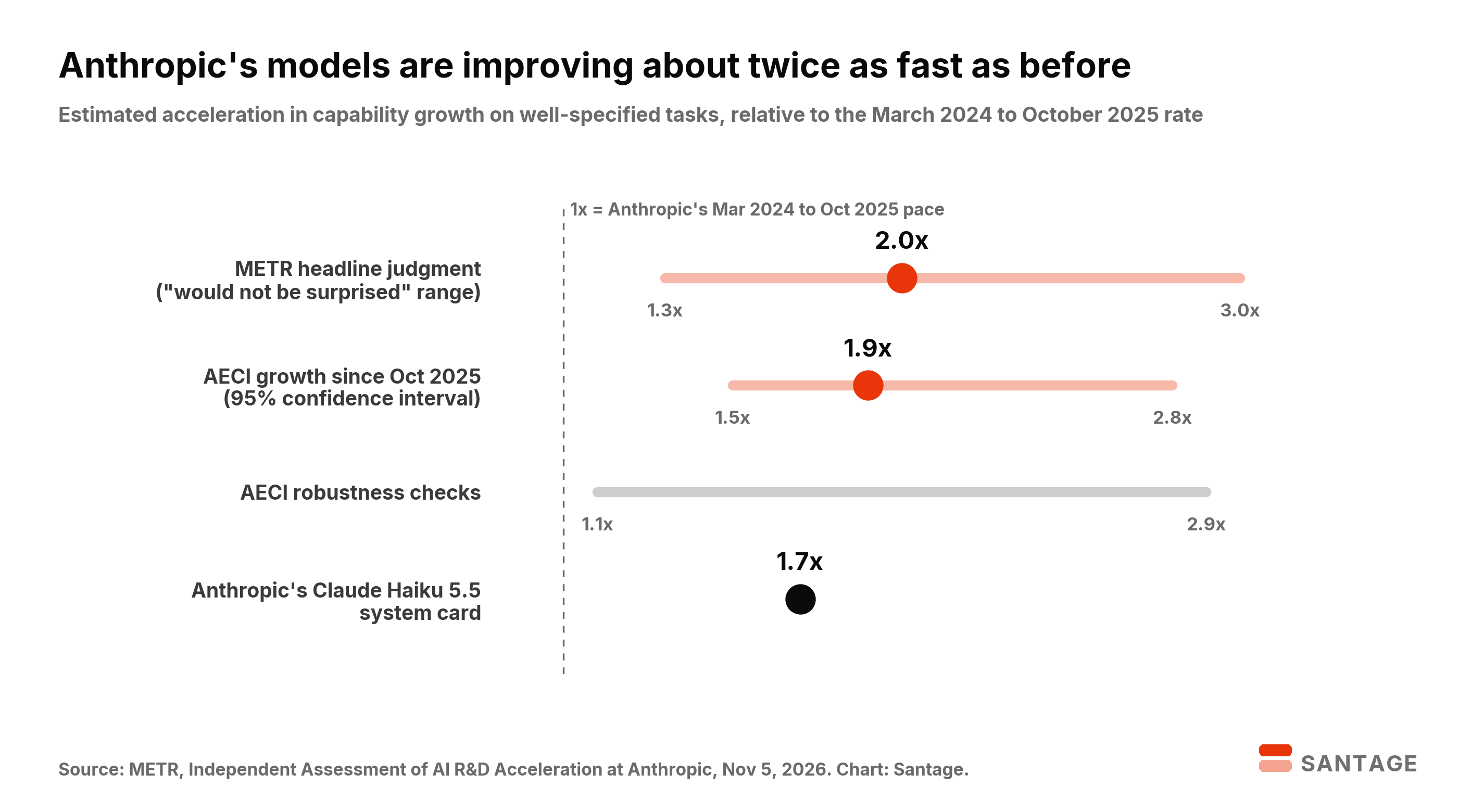
METR is confident the speed-up did not come from faster growth in training compute. Its best guess assigns about 80% of the current acceleration to AI, with substantial uncertainty, and it judges that non-AI factors explained more of the shift in late 2025. Informal internal Slack polls put self-reported uplift from Anthropic's most capable internal model at about 12x, a figure METR treats as very loose evidence.
AI-assisted research, not autonomous AI, accounts for the speed-up
The acceleration METR describes comes from researchers working alongside Claude rather than from models training their successors. METR found that AI is not yet making highly significant, fully autonomous contributions to the most important parts of model training, although researchers described early indications that this could change soon, at different speeds across research areas. That fits Anthropic's own disclosures in its listing documents, which put Claude's share of the company's code at around 90%.
The finding with the longest reach concerns limits. METR found no convincing bottleneck in algorithmic progress, training compute, experiment compute or data over the next 12 months, while noting that its own view shifted several times during the work. Without a binding constraint, gains from AI-assisted research can feed the next round of research, which is the compounding dynamic that frontier AI safety frameworks are built to detect.
The first independent measurement of AI accelerating AI research inside a frontier lab came back at roughly 2x, and the public can verify almost none of it.
Anthropic's redactions leave the public relying on METR's judgment
The agreement gave Anthropic unilateral rights to redact the published report, and it used them heavily. Anthropic said the cuts were aimed at removing confidential information that could help other developers move faster. It also tightened its redaction guidance between October 27 and 29, which pushed publication back by about five days, and it cancelled the compute allocation check, including the split between capabilities and safety work, partway through, saying it would revisit that later. METR reports finding no evidence that Anthropic tried to mislead it.
"Anthropic redacted a majority of the evidence we found most informative."
METR, in Independent Assessment of AI R&D Acceleration at Anthropic, November 5, 2026
| What METR published | What Anthropic redacted or withheld |
|---|---|
| Overall acceleration estimate and range (about 2x, 1.3x to 3x) | Acceleration and attribution estimates by pipeline stage |
| AECI growth of 1.9x with confidence interval | Cumulative and instantaneous effects of AI on progress |
| About 80% of acceleration attributed to AI | Algorithmic progress estimates |
| No convincing bottleneck over 12 months | Detail on each potential bottleneck |
| Mixed staff views centred near 2x | Forecasts for future models and some interview quotes |
| Planned compute allocation check | Cancelled midway by Anthropic |
METR is direct about what that means. The report does not achieve transparency about evidence, and readers have to lean on METR's judgment far more than would be ideal. The evaluator has taken on a similar role at other labs, including a red-team of OpenAI's internal misalignment monitor published last month, which makes the terms of access as important as the findings.
The 2x estimate cuts both ways for regulators and investors
METR lists reasons its figure could be too high. Non-AI factors may explain more of the gains, progress may be concentrated on well-specified, easily graded tasks, and Anthropic's growth rate before late 2025 was unusually slow, which inflates any ratio built on it. The most capable internal model also scores above 50% on all 15 benchmarks behind AECI, a saturation that weakens the measurement. In the other direction, growth could already be accelerating further, and a benchmark index can understate real-world impact where capabilities cross thresholds.
Those caveats land at a sensitive moment. Anthropic is preparing to price its IPO, and buyers now have an outside estimate that the company's research engine is running about twice as fast as a year ago, mostly on its own models. For policymakers, the same number marks the first time an independent body has put a figure on AI speeding up AI development inside a leading lab.
METR's assessment establishes that measuring AI-accelerated AI research is possible with enough access, and that the measured rate at one frontier lab has roughly doubled. Whether that number can anchor oversight depends on the next assessment: if labs keep the right to redact the evidence, outside evaluators can report a speed but cannot show the public how they measured it.
Santage is committed to independent, transparent journalism. This article is produced in accordance with Santage's Editorial Standards and aims to provide accurate and timely information. Readers are encouraged to verify information independently.