
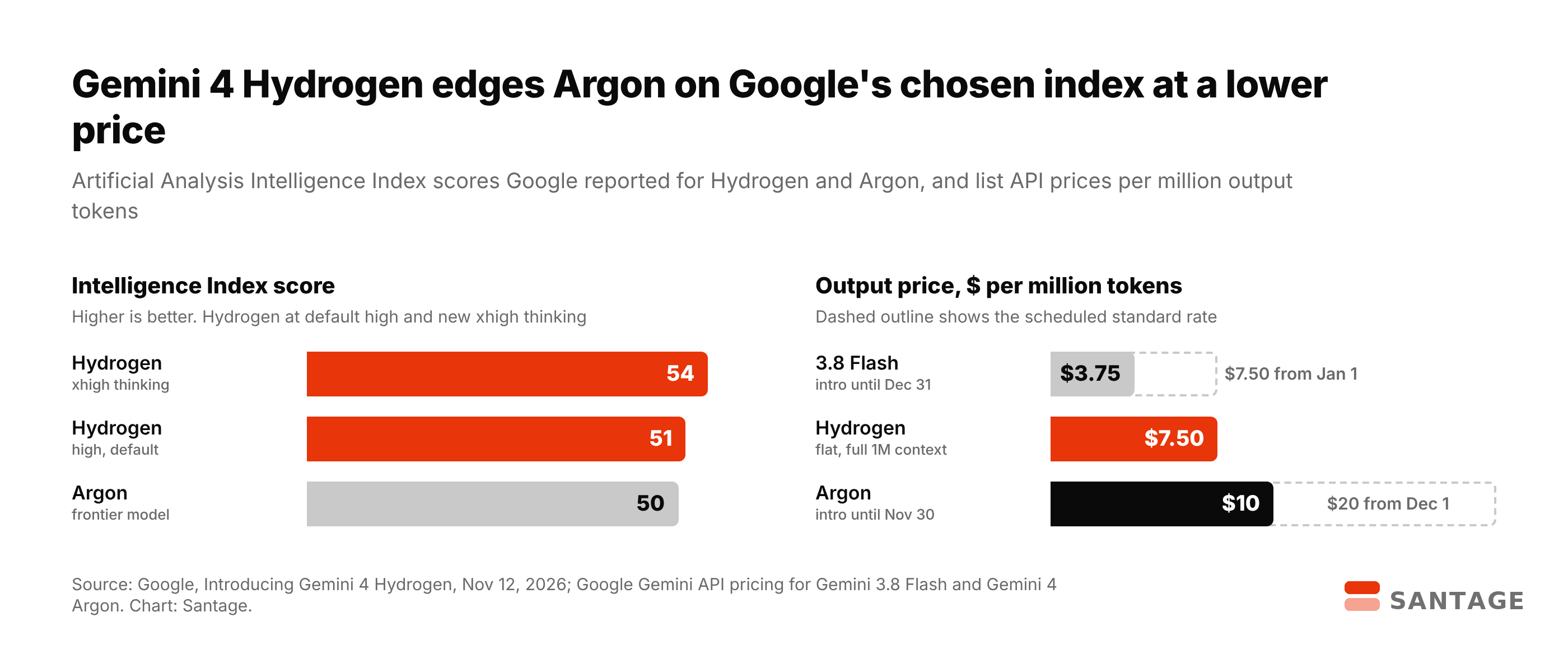
- Hydrogen scores 51 on the Artificial Analysis Intelligence Index at its default setting against Argon's 50, and 54 with a new xhigh thinking level, according to Google.
- API pricing is $1.50 per million input tokens and $7.50 per million output tokens across the full 1 million-token context window.
- Google says Hydrogen finishes tasks 2.5 times faster than Gemini 3.8 Flash and scores 57% on Terminal-Bench 4.1, up from 18.2%.
Google released Gemini 4 Hydrogen on November 12, a fast, lower-priced member of its Gemini 4 family that Google says beats its own frontier model, Gemini 4 Argon, on the Artificial Analysis Intelligence Index, and it made Hydrogen the model behind Google Search and the free Gemini app on day one.
Gemini 4 Hydrogen replaces 3.8 Flash across Search, the Gemini app and the API
Koray Kavukcuoglu, Google's chief AI architect, announced the model in a Google blog post that positions Hydrogen as the everyday engine for coding and agentic work, while Carbon and Argon handle long, hard reasoning. Hydrogen accepts text, image, audio and video, offers four thinking levels from low to a new xhigh, and reads up to 1 million tokens of input.
Distribution is the bigger change. Hydrogen is rolling out to all Google Search users worldwide, in AI Mode and for harder questions in AI Overviews, and free Gemini app users receive it whenever automatic model selection judges a prompt suits it. Developers get it in the Gemini API, AI Studio and Android Studio, and paid AI Pro and Ultra subscribers can use it in Google's Antigravity coding tool, where a new Orchestrator feature lets Carbon direct Hydrogen worker agents. Google says that pairing reached near-Carbon success on Terminal-Bench 4.0 while using 24% less quota.
Hydrogen sets Google's real price floor for 2027
The pricing carries a message that the benchmark headline hides. Hydrogen's $1.50 and $7.50 per million tokens match exactly the standard rate Gemini 3.8 Flash moves to on January 1, when its introductory $0.75 and $3.75 pricing ends. Developers who built on Flash were always heading to Hydrogen's price; Google has now attached a much stronger model to it.
At the top of the range the gap grows. Argon's introductory API rate of $2 and $10 runs to November 30, then doubles to $4 and $20. From December, a developer can buy the model Google ranks above Argon on its chosen benchmark for 37.5% of Argon's output price. Google's numbers are self-reported, and a one-point lead on a single composite index is thin; Argon and Carbon still lead on long-horizon work, which is why Google sells all three.
Google also lists Hydrogen as a short-term general availability release with a minimum 45-day retirement notice, and gives it a March 2026 knowledge cutoff. Three Gemini 4 models have now shipped since the start of October, and the notice period tells enterprise buyers to expect the next one soon.
Hydrogen puts Google's Gemini 4 generation in front of billions of Search users within six weeks of the first Gemini 4 release, priced at the level Flash customers were already scheduled to pay. Rivals now have to match a Search-default model that scores at the frontier on Google's chosen index for $7.50 per million output tokens.
Santage is committed to independent, transparent journalism. This article is produced in accordance with Santage's Editorial Standards and aims to provide accurate and timely information. Readers are encouraged to verify information independently.