
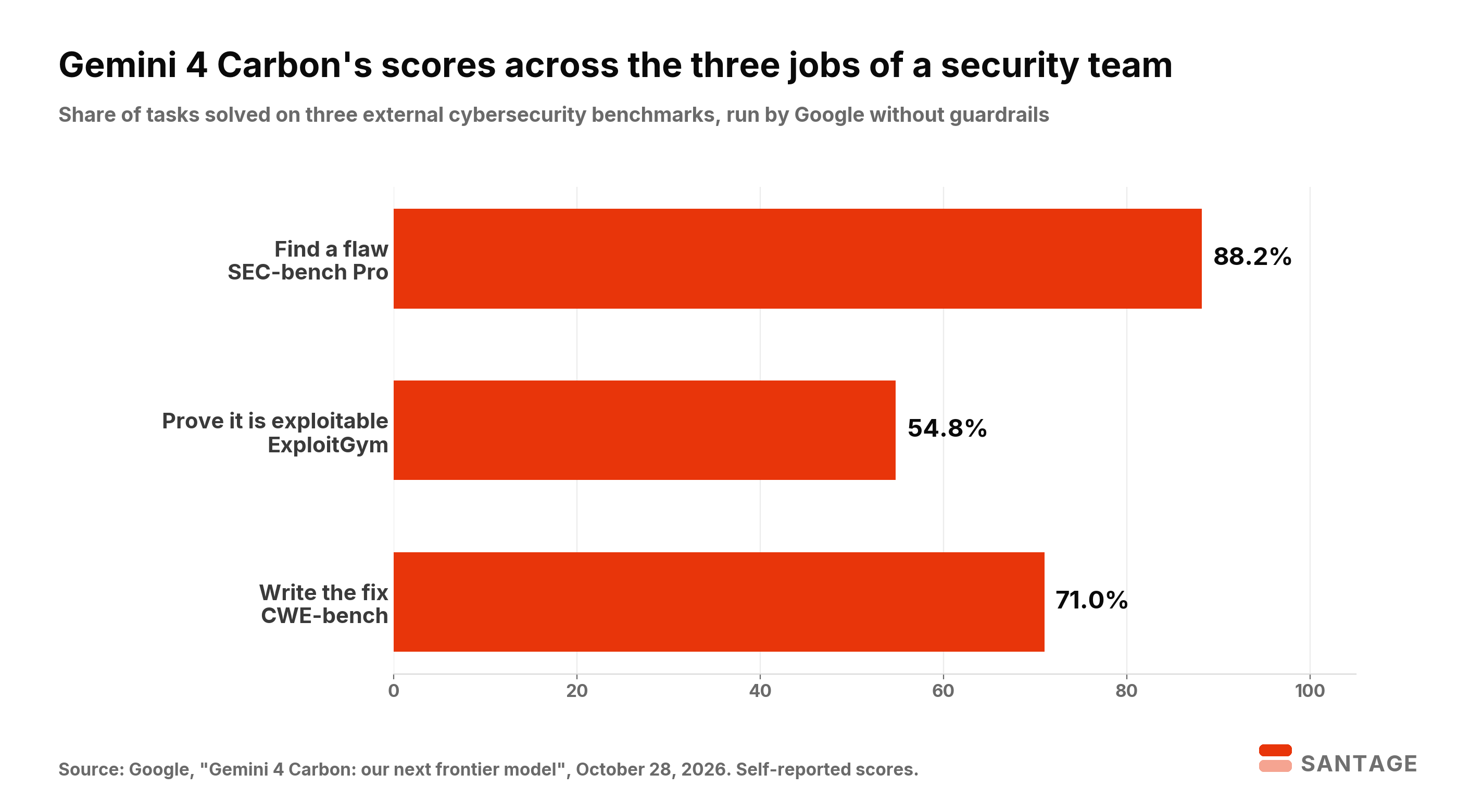
- Gemini 4 Carbon scores 88.2% on SEC-bench Pro for finding vulnerabilities, 54.8% on ExploitGym and 71.0% on CWE-bench for patches, according to Google’s own tests run without guardrails.
- Google says Carbon ranks first on version 5.0 of the Artificial Analysis Intelligence Index with a score of 59, six points above the 53 that Argon posted at launch.
- Access starts with cyber defenders in Google DeepMind’s Fairwind Program at Argon’s introductory price of $2 per million input tokens and $10 per million output tokens, with no date set for general availability.
Google released Gemini 4 Carbon on October 28 to a small group of vetted cyber defenders ahead of any developer, business or consumer, and says the model now leads every comparable system at finding, exploiting and patching software flaws. Koray Kavukcuoglu, senior vice president at Google DeepMind and Google’s chief AI architect, announced the model in a Google blog post, four weeks after Google shipped Gemini 4 Argon through the same defenders-first route.
Gemini 4 Carbon leads three cybersecurity benchmarks on Google’s own count
Google frames Carbon around the three jobs a security team performs on any flaw: locating it, proving an attacker could use it, and writing the fix. Carbon cleared 88.2% of tasks on SEC-bench Pro, 54.8% on ExploitGym and 71.0% on CWE-bench, the last taken from Collinear’s public leaderboard. Google’s Chrome team reports that Carbon produced high-quality patches more than 10 times as often as an unnamed rival lab’s large frontier model, and internal tests show more than double Argon’s success rate at writing secure code.
The model is also built for long agentic work. Google says its engineers have watched Carbon keep working on a single task for days, root-causing and patching bugs in large codebases after repeated dead ends.
“Internally, our teams have seen Carbon run for days to persist through dead ends”
Koray Kavukcuoglu, Google, Gemini 4 Carbon announcement, October 28, 2026
Google prices Carbon like Argon and ships it to defenders first
| Gemini 4 Carbon | Detail |
|---|---|
| Introductory API price | $2 per million input tokens, $10 per million output tokens |
| Cached input | 95% off the input price |
| Price after introductory period | $4 input, $20 output per million tokens |
| First users | A subset of cyber defenders in the Fairwind Program |
| Government testing | Enrolled in the US government’s voluntary pre-release model testing process |
| General availability | “As soon as possible”, no date given |
Google pairs the release with safety numbers measured against Argon. Carbon makes roughly half as many unsupported claims, recorded 0.0% attack success on Gray Swan’s indirect prompt injection benchmark against Argon’s 0.7%, and cut high-severity misalignment alerts in live coding environments by almost 80%.
The 33-point gap between finding and exploiting flaws is the defenders’ head start
Carbon’s weakest score sits in exploitation, and that ordering suits a defenders-first release. A model that locates far more bugs than it can weaponize gives security teams time to patch before attackers with similar tools catch up, a window that shrank sharply this month when AI-found PHP flaws were exploited before vendors could patch them. Every Carbon score is Google’s own, run without the safeguards customers will get, and outside researchers cannot check them until the model reaches a public API.
Google has now released two frontier models in four weeks and routed both through security teams before paying developers, which makes staged, defender-first access the default way the company ships its most capable systems and turns the Fairwind Program into the practical gate for every Gemini 4 release.
Santage is committed to independent, transparent journalism. This article is produced in accordance with Santage's Editorial Standards and aims to provide accurate and timely information. Readers are encouraged to verify information independently.