
- Microsoft declined to renew a 2023 contract to rent Oracle GPU capacity for Bing and has been turning it off in recent months because the older Nvidia hardware no longer matched its specifications, according to Bloomberg.
- Oracle says GPU capacity that came up for renewal last quarter was renewed or resold at a 20% premium, even though most of those chips were four years old or more.
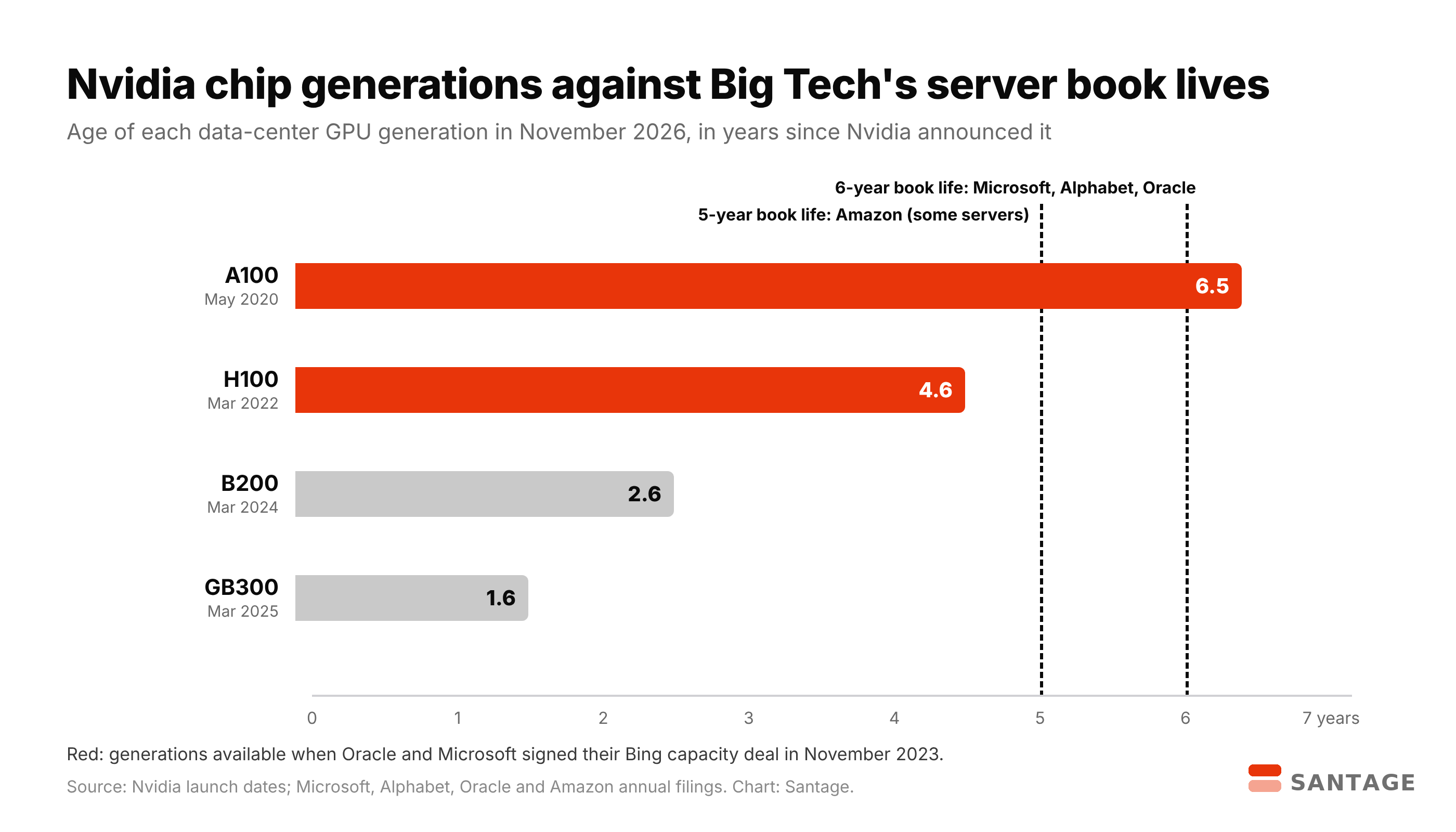
- Microsoft, Alphabet and Oracle depreciate servers over six years and Amazon has cut some to five, so the question is who holds a chip in years four to six, and renting lets the biggest buyers hand that risk back.
Microsoft is switching off the AI servers it rented from Oracle under a deal announced three years ago today, after deciding the older Nvidia chips inside no longer fit its needs. The exit is the clearest real-world test yet of an assumption buried in Big Tech's accounts: that an AI server earns its keep for five to six years. Microsoft's answer, as a tenant, was about three, and the cost of the remaining years now sits with the company that owns the hardware.
Microsoft lets a 2023 Oracle GPU deal lapse after three years
On November 7, 2023, Oracle announced a multi-year agreement under which Microsoft would use Oracle Cloud Infrastructure, alongside Azure, to run inference for Bing's conversational search. Oracle's superclusters at the time scaled to 32,768 Nvidia A100 GPUs or 16,384 H100s, the two generations then available. Three years later, Microsoft has been turning that capacity off after declining to renew, according to Bloomberg, which reported that the hardware had become less useful because it no longer fit Microsoft's specifications. The full size of the deal was never disclosed, and Oracle shares fell about 4% on the report.
The same report places the exit inside a wider review. Microsoft has committed more than $80 billion to rent AI infrastructure from outside providers including CoreWeave, Nscale and Nebius, and it is reassessing those contracts after frustration over cost and delays, having turned down an option this week to expand an Nscale deal in Texas.
Oracle says four-year-old GPUs now rent for 20% more
Oracle answered within hours, and its statement is the strongest evidence that old chips still have buyers.
Both facts can hold at once, and together they describe how an AI chip actually ages. A frontier buyer such as Microsoft wants the newest silicon for its own flagship workloads, because each Nvidia generation delivers far more inference per watt and per rack. Once that buyer moves on, the same hardware can still find a second tenant who values price or availability over peak performance. Oracle's 20% premium shows that second market is paying well today, in a year when compute is scarce and Oracle reported $664 billion in remaining performance obligations in September.
Six-year depreciation assumes a second tenant always appears
The accounting clock runs longer than the chip clock. Microsoft raised the estimated useful life of its servers from four years to six effective fiscal 2023, a change it said would add $3.7 billion to that year's operating income. Alphabet and Oracle also use six years. Meta moved most servers to 5.5 years in 2025, while Amazon went the other way and cut a subset of servers from six years to five, citing the faster pace of AI and machine learning development.
| Company | Server book life | Latest change |
|---|---|---|
| Microsoft | Up to 6 years | Raised from 4 to 6, fiscal 2023 |
| Alphabet | 6 years | Raised from 4 to 6, 2023 |
| Oracle | 6 years | Raised from 5 to 6, fiscal 2025 |
| Meta | 5.5 years | Raised for most servers, 2025 |
| Amazon | 5 years (subset) | Cut from 6 to 5, 2025 |
A six-year schedule works if the second life lasts. Gartner warned on October 14 that more than $3.5 trillion of AI infrastructure spending could be exposed to impairment by the end of 2030, because owners would need $8.5 trillion in cumulative revenue to cover their plans while attributable AI revenue reaches no more than $3.6 trillion. The research firm expects 80% of neocloud providers, the companies that mainly rent out GPUs, to cease independent operations by 2030.
| Microsoft's use of the 2023 Oracle Bing capacity | About 3 years |
| Server book life at Microsoft, Alphabet and Oracle | 6 years |
| Premium Oracle says it won renewing mostly 4-year-old GPUs | 20% |
| AI infrastructure spend Gartner says could face write-downs by 2030 | More than $3.5 trillion |
Renters can walk away from old chips while owners carry them
The Oracle exit shows the real advantage of renting. Microsoft took three years of A100 and H100 capacity when Nvidia supply was tight, then declined to renew once newer chips were available, and the remaining depreciation stayed on Oracle's books. The same option sits inside the $80 billion of neocloud contracts Microsoft is now reviewing, which is why Gartner singles out GPU lessors as the most exposed part of the market and why Oracle moved fast to defend its pricing.
The useful life of an AI chip is set by its second customer, and the first customer gets to decide when that test begins.
That dynamic connects several recent stories. Big Tech's $557 billion AI spending run already exceeds its cash flow, Oracle signed Tencent to a $7 billion lease of 100,000 chips, and a week of falling AI chip stocks has made investors price obsolescence more carefully. Nvidia's results on November 17 and CoreWeave's on November 10 will show whether demand for older generations is holding.
Read together, Microsoft's exit and Oracle's premium leave the value of old GPUs an open question and settle a different one, which is where the risk lands. The largest AI buyers increasingly rent, they upgrade on Nvidia's cadence rather than their accountants', and every lease they decline to renew passes a depreciating asset back to a landlord whose margin depends on finding the next tenant at a good price. In a tight market that tenant appears, and the moment supply loosens, the six-year assumption will be tested on the owners' books first.
Santage is committed to independent, transparent journalism. This article is produced in accordance with Santage's Editorial Standards and aims to provide accurate and timely information. Readers are encouraged to verify information independently.