
- Tencent's five-year lease covers about 100,000 AI chips in Oracle's Southeast Asian facilities, valued at roughly $7 billion with 30% paid upfront, according to the Financial Times.
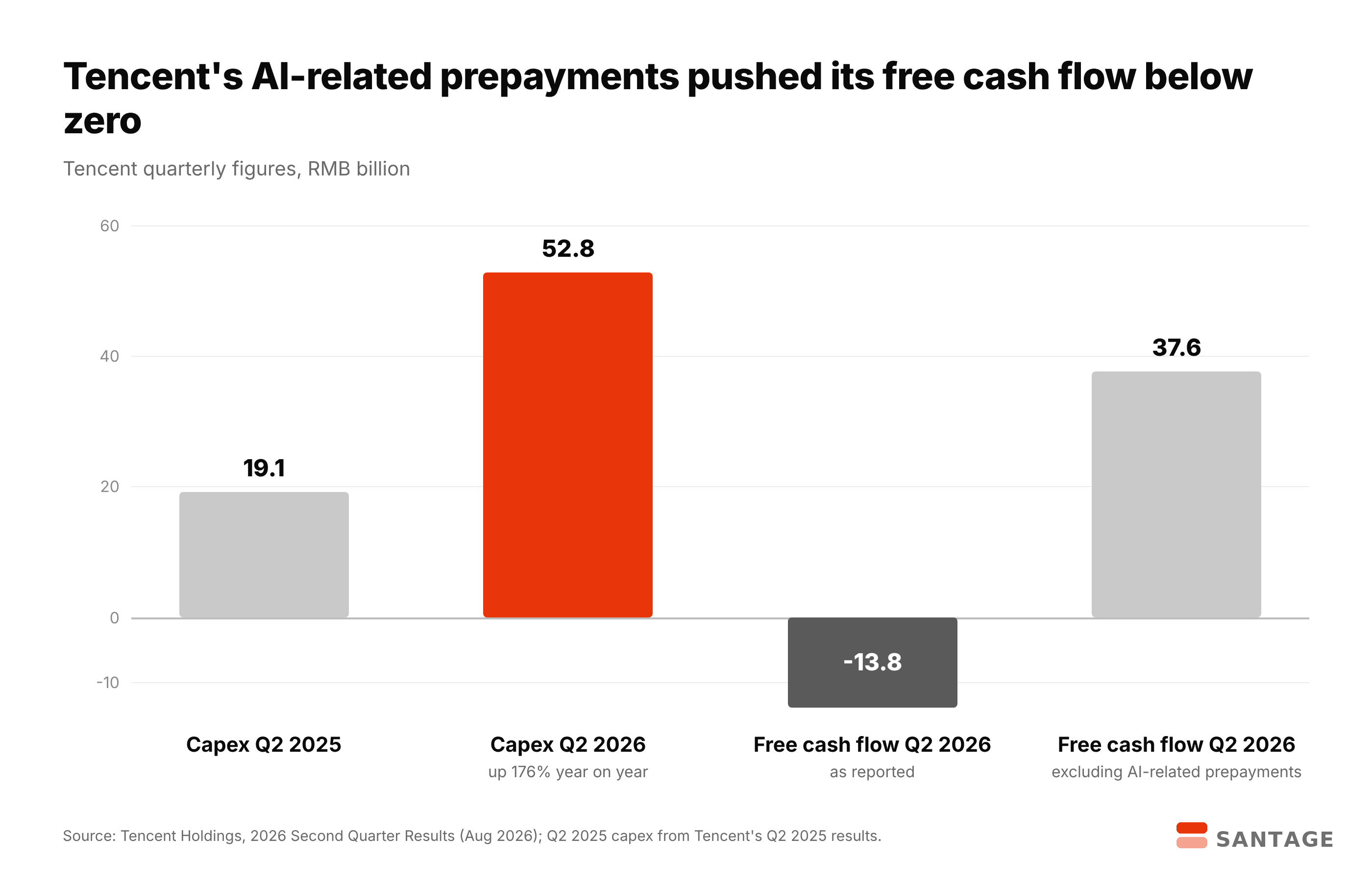
- Tencent's capital expenditure hit RMB 52.8 billion in the second quarter, up 176% from RMB 19.1 billion a year earlier, and AI-related prepayments turned its free cash flow negative at minus RMB 13.8 billion.
- A House bill to extend export controls to remote cloud access passed 369 to 22 in January 2026, but its Senate companion has not received a vote, leaving offshore leasing legal.
Tencent has signed a five-year lease for about 100,000 advanced AI chips housed in Oracle data centers across Southeast Asia, a deal worth roughly $7 billion that gives China's largest social media company access to US hardware it cannot legally import, and does so through a channel that current US export rules still allow.
Tencent's $7 billion Oracle lease takes offshore compute rental to frontier scale
The Financial Times reported the agreement on October 1. Tencent will pay about 30% of the contract value upfront, roughly $2.1 billion, and the chips will sit in several Oracle facilities in Southeast Asia. US rules bar the export of top-tier accelerators to China, while renting access to the same hardware in a third country remains permitted. Neither company has announced the contract.
| Chips leased | About 100,000 advanced AI chips |
| Contract value | About $7 billion over five years |
| Paid upfront | About 30%, roughly $2.1 billion |
| Location | Multiple Oracle data centers in Southeast Asia |
| Oracle contracted backlog | $664 billion after its September quarter |
Scale is what separates this from earlier workarounds. Chinese labs have rented smaller GPU clusters abroad for years, and US enforcement has focused on smuggled servers. A 100,000-chip block, paid largely in advance and locked in for five years, is frontier-class AI infrastructure contracted on balance sheet terms a Western hyperscaler would recognize.
Tencent's own numbers show compute has become its largest single bet
Tencent signaled the shift in August. Its second-quarter results showed capital expenditure of RMB 52.8 billion, up 176% from a year earlier, and free cash flow that swung to minus RMB 13.8 billion. Strip out AI-related prepayments and free cash flow would have been a positive RMB 37.6 billion, so the prepayments alone account for a swing of more than RMB 51 billion in one quarter.
The company explained where that money is going.
“We are making substantial progress towards building a new, AI-empowered Tencent in terms of intelligence, applications, and infrastructure.”
Ma Huateng, Chairman and CEO, Tencent 2026 Second Quarter Results, August 2026
The same release said Tencent had “substantially stepped up” its procurement of compute and that its Hy3 model, launched in production in July, ranks among the top three globally by token consumption. Serving that demand inside WeChat, its CodeBuddy coding tool and an agent prototype in Weixin requires inference capacity that domestic chip supply has struggled to match. Santage has tracked that supply gap through Enflame's Shanghai listing and other Chinese accelerator makers, whose output still trails Nvidia-class hardware.
Oracle's prepayment model makes China a low-risk customer on paper
The deal also fits how Oracle now finances its growth. Oracle reported $664 billion in remaining performance obligations for its fiscal first quarter, up $209 billion from a year earlier, and cloud infrastructure revenue of $7.4 billion, up 121%. On its September earnings call, CFO Hilary Maxson said the “vast majority” of new contracts that quarter came through prepay, bring-your-own-hardware or similar arrangements that “won’t require incremental capital from Oracle.”
A 30% upfront payment from a customer with Tencent's cash reserves is that model at work. Oracle gets committed revenue without adding to the debt load that has made investors wary of its build-out, a concern Santage examined in its look at off-balance-sheet AI infrastructure debt. Tencent gets capacity on a faster timeline than domestic chipmakers can offer.
For Oracle the contract is small in proportion and large in signal. Spread over five years, $7 billion is about $1.4 billion a year, roughly a fifth of one quarter's cloud infrastructure revenue, and about 1% of its $664 billion backlog. The weight lies in who is paying: a Chinese platform giant committing capital to a US cloud provider at the same time Washington is trying to slow China's AI progress.
| Party | What it gives | What it gets |
|---|---|---|
| Tencent | About $2.1 billion upfront, about $7 billion over five years | About 100,000 advanced chips it cannot import to China |
| Oracle | Data center space and hardware in Southeast Asia | Prepaid backlog without new borrowing |
| US government | No approval required under current rules | No direct control over how the compute is used |
Source: Santage analysis of Financial Times reporting and Oracle and Tencent disclosures.
The rule that would end this deal has stalled in the Senate
Washington has a bill aimed squarely at this arrangement. The Remote Access Security Act extends export-control authority to cloud access, so renting controlled chips to a Chinese company abroad would need the same license as shipping them. It passed the House 369 to 22 on January 12, 2026. Its Senate companion, S. 3519, sits with the Banking Committee without a vote, and the most likely route to law is an amendment to the annual defense authorization bill.
Export controls were written for chips crossing borders, and a five-year lease with a $2 billion deposit delivers the same computing power to Tencent without a single chip entering China.
That timing matters for the contract. A five-year lease signed now runs to 2031, and both companies will be pricing the risk that a law passed in 2027 forces renegotiation or termination. The 30% upfront payment reads partly as Oracle's protection against exactly that outcome.
The deal sets a benchmark that other Chinese platforms, including Alibaba, ByteDance and Baidu, can now point to when negotiating their own offshore capacity, and it hands US lawmakers the clearest example yet of the gap their bill targets.
Until Congress finishes the Remote Access Security Act, the effective limit on China's access to US AI hardware is set by Oracle's data center capacity in Southeast Asia, and Tencent has just reserved 100,000 chips of it.
Santage is committed to independent, transparent journalism. This article is produced in accordance with Santage's Editorial Standards and aims to provide accurate and timely information. Readers are encouraged to verify information independently.