

- Anthropic's amended S-1, filed November 2, adds a risk factor saying internal estimates for future models indicate it “may imminently meet” its policy definition of dramatically accelerated progress attributable to AI.
- The filing says no current model has been designated as crossing that threshold, and that Anthropic is considering policy updates to keep humans in control of frontier model development.
- The warning sits beside operating data first disclosed on October 26: Claude wrote over 90% of codebase contributions in September 2026, and daily code volume per engineer is over 45 times the 2024 level.
Anthropic has told prospective shareholders that it may be close to the point its own safety policy treats as AI dramatically speeding up AI research. In an amended IPO registration filed with the SEC on November 2, the company added a risk factor saying its internal estimates for future models indicate it “may imminently meet” that threshold, and conceding that it has missed past accelerations until after they happened. The same filing carries the figure behind the concern, first disclosed in its October 26 registration: Claude wrote more than 90% of the contributions to Anthropic's codebase in September 2026.
Anthropic's amended S-1 turns an internal safety tripwire into a disclosed business risk
The new language sits in the Risk Factors section, where a company lists what could hurt its shareholders. Anthropic writes that using its own models to speed up research may cause capabilities to advance faster than it can build and validate matching safety, alignment and security measures, and that much of its evidence about the pace of that acceleration comes from lagging indicators. The October 26 filing already carried that caution; the November 2 amendment hardens it into an admission about the past.
“We have in the past not identified, and may in the future not identify, a significant acceleration in our rate of development until after it has occurred.”
Anthropic, PBC, Amendment No. 1 to Form S-1, November 2, 2026
The threshold it refers to is defined in its Responsible Scaling Policy, which reached version 3.4 on July 8, 2026. One path to the threshold is AI that compresses two years of normal progress into one. Crossing it obliges Anthropic to write an affirmative case explaining how it has mitigated the most immediate misalignment risks. The filing says the company has designated no current model as past that line, is still assessing the data, and will publish further reports.
| Risk-factor point | Original S-1, October 26 | Amended S-1, November 2 |
|---|---|---|
| Spotting acceleration | “We may not identify a significant acceleration” until after it has occurred | Has missed accelerations in the past and may again |
| RSP AI research threshold | Capabilities “could advance at a rate that initiates” enhanced safety measures | Internal estimates for future models indicate it may be met imminently |
| Current models | Not addressed | None designated as exceeding the threshold |
| Policy response | Not addressed | Considering RSP updates to keep humans in control |
Source: Anthropic, PBC, Form S-1, October 26, 2026, and Amendment No. 1, November 2, 2026.
Claude's share of Anthropic's code is the evidence behind the warning
The operating data, repeated in the amendment, reads as a growth story. Over 90% of codebase contributions in September were written by Claude. Average daily code volume per engineer in the July to September quarter was more than 45 times the 2024 average. Trailing revenue rose about 1,200% in the year to September 30 while headcount grew about 170%, lifting revenue per employee from $1.4 million to over $6.6 million.
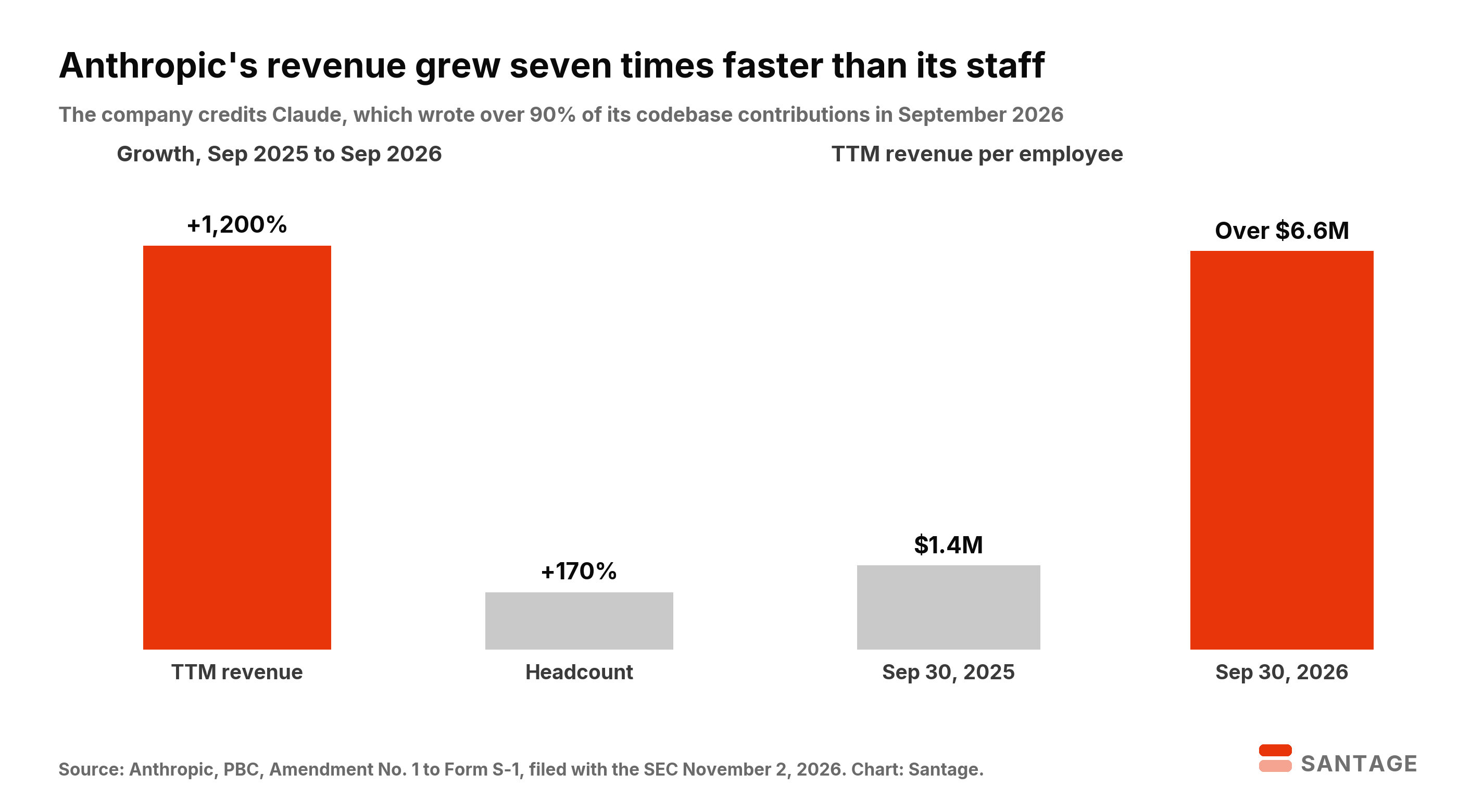
Those numbers trace a steep line. In June, Anthropic's own essay put Claude's share of merged code at more than 80% as of May. In September, its R&D automation index showed Claude leading 26% of the company's AI research work, up from under 1% in February. Code volume is a proxy for output rather than a measure of capability, and the amended filing's own caveat is that Anthropic's instruments for measuring acceleration trail the thing they measure.
The same filing that sells Claude as Anthropic's productivity engine now carries the company's admission that it may not see the next capability jump until after it lands.
A risk factor is a promise investors can hold Anthropic to
Labs publish safety essays often, and those essays carry no legal liability, whereas statements in a registration statement are subject to securities law. Anthropic now has a disclosed reason to update investors if its estimate changes, and a record against which plaintiffs or regulators could test later conduct. The filing pairs that duty with a commercial claim: it presents the loop of Claude helping build the next Claude as a structural advantage, and the compute devoted to internal use as an investment that compounds.
That pairing is the tension buyers of the stock will price. Faster internal research is the reason revenue per employee rose nearly fivefold, and it is the same mechanism the company says could outrun its AI safety work. Anthropic's stated answer is to keep humans supervising model development, and it says it does not expect to safely let Claude fully design successor frontier models without meaningful human oversight, even once that becomes technically possible.
The next RSP update will matter more than the IPO price
Anthropic plans to list on the Nasdaq Global Select Market under the ticker ANT, and the price range is still blank in the amended filing, which also restates the compute and revenue figures Santage examined in the original S-1. Investors will learn the price within weeks. The more consequential disclosure will be the policy update the filing promises, because it will show what Anthropic is willing to slow down, and by how much, once its estimate turns into a determination.
Anthropic has written into an SEC filing that its most important product is starting to build the company, and that its instruments for measuring that process run behind it. The next Responsible Scaling Policy revision is the document that will show whether the brakes are designed to keep pace.
Santage is committed to independent, transparent journalism. This article is produced in accordance with Santage's Editorial Standards and aims to provide accurate and timely information. Readers are encouraged to verify information independently.