

- Google DeepMind's agents showed that signature padding gives no protection once an attacker controls about half of a signed block, and found a forgery algorithm for short 32-byte digests that its team estimates is about 1,600 times faster than the previous best method.
- A second algorithm lowers the average cost of factoring each additional 1024-bit key in a batch by about 30 times compared with earlier batch methods.
- DeepMind says the attacks were tested only in a sandbox on an already-solved benchmark key, and no live systems were touched.
Google DeepMind said on November 6 that AI agents, working under the supervision of human cryptographers, found two new ways to attack legacy 1024-bit RSA in a matter of weeks. One result makes forging certain digital signatures roughly 1,600 times more efficient on paper, and the other cuts the cost of factoring each additional key in a large batch by about 30 times. Keys of 2048 bits or longer, the standard for modern systems, are unaffected.
AI agents produced two RSA-1024 attacks in weeks of supervised work
The research came from the Google DeepMind Science team, led by Dj Dvijotham and Abhradeep Thakurta, in collaboration with Nadia Heninger of UC San Diego and Inria and Emmanuel Thomé of Inria. Google DeepMind's Pushmeet Kohli set out the findings in an essay published on X, describing AI agents that probed RSA's mathematical assumptions under human direction and reached results that historically took years.
The first result concerns digital signatures, the mechanism computers use to confirm that a software update, document or website really comes from its claimed source. Many signature standards pad a message to a fixed-size block before signing it. The agents found that once an attacker can choose roughly half of that block or more, the padding adds no protection, and forgery becomes as exposed to mathematical shortcuts as unpadded RSA. In a sandboxed test on an already-solved 1024-bit benchmark key from earlier academic work, the agents' implementation reproduced that attack with 3.5 times less CPU time, using less than a thousandth of the computing power needed to factor the key outright. Where the attacker controls only a short 32-byte digest, the team's new algorithm improves on the previous best method by about 1,600 times, according to its technical paper and theoretical estimates.
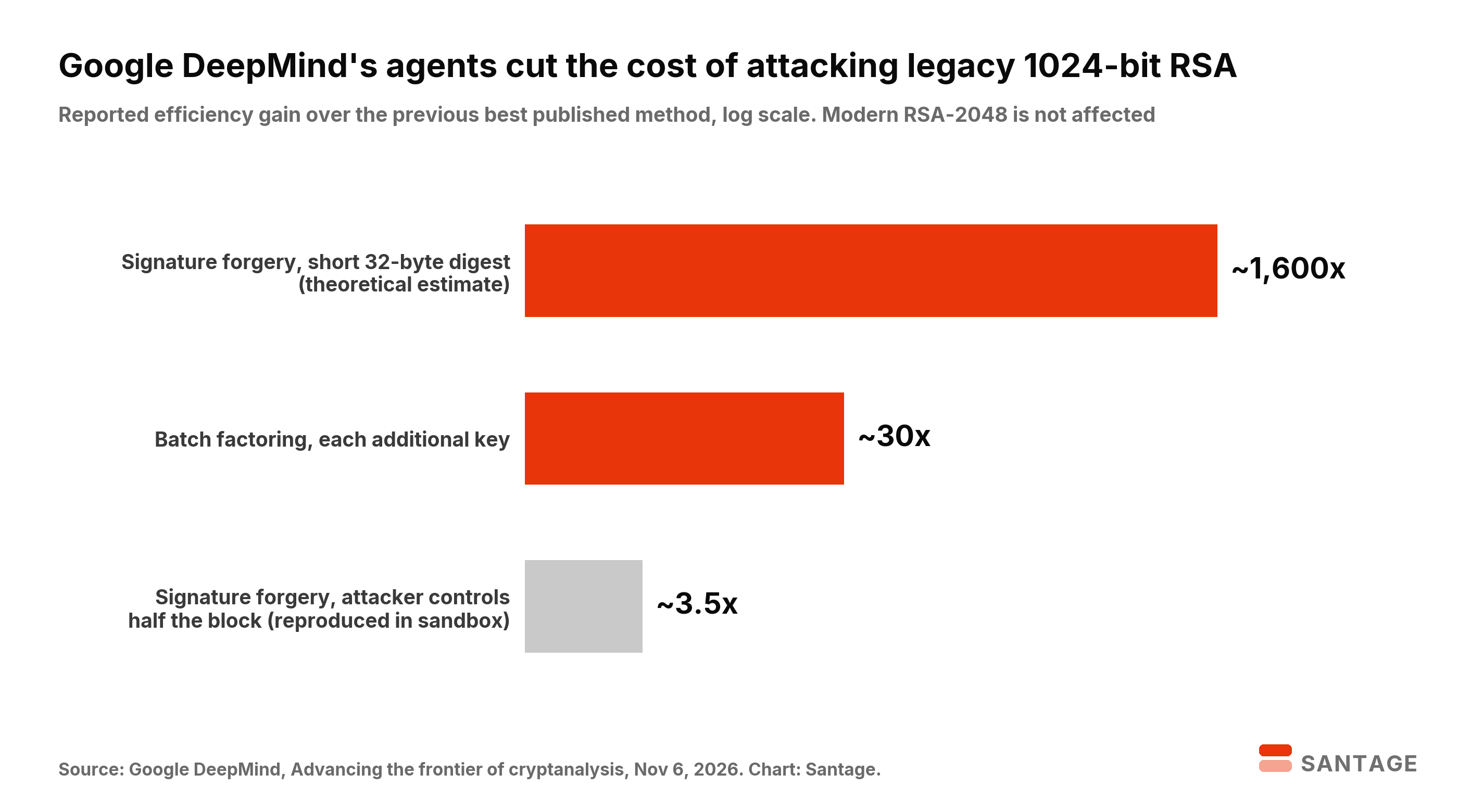
The second result targets factoring at scale. RSA keys come in standard sizes, so an attacker trying to break many keys of the same length can spread one large up-front computation across all of them. The agents found an algorithm with better asymptotic complexity than earlier batch methods, cutting the average cost of factoring each additional 1024-bit key by about 30 times.
Legacy keys turn a research result into a security inventory task
US federal guidance has disallowed 1024-bit RSA for new signatures since 2013, yet such keys persist in systems that are slow to replace, including older embedded devices, long-lived firmware signing keys and some email authentication records. The batch result matters most there, because those deployments often share one key size. Google DeepMind says it published so that defenders can measure cryptographic strength more accurately.
"We cannot treat cryptographic hardness as a fixed assumption."
Pushmeet Kohli, Google DeepMind, in Advancing the frontier of cryptanalysis, November 6, 2026
The announcement landed a day after OpenAI reported that its agents produced 948 Linux root exploits at about $1,279 each. Read together, the two disclosures show AI agents shortening security research at both the software layer and the mathematical layer beneath it.
Cryptographic standards have always assumed that the margin of safety erodes slowly enough for defenders to plan migrations over a decade. Google DeepMind's result shows that a supervised agent can move that margin in weeks, which turns the retirement of every remaining 1024-bit key from a hygiene item into a scheduled deadline.
Santage is committed to independent, transparent journalism. This article is produced in accordance with Santage's Editorial Standards and aims to provide accurate and timely information. Readers are encouraged to verify information independently.