

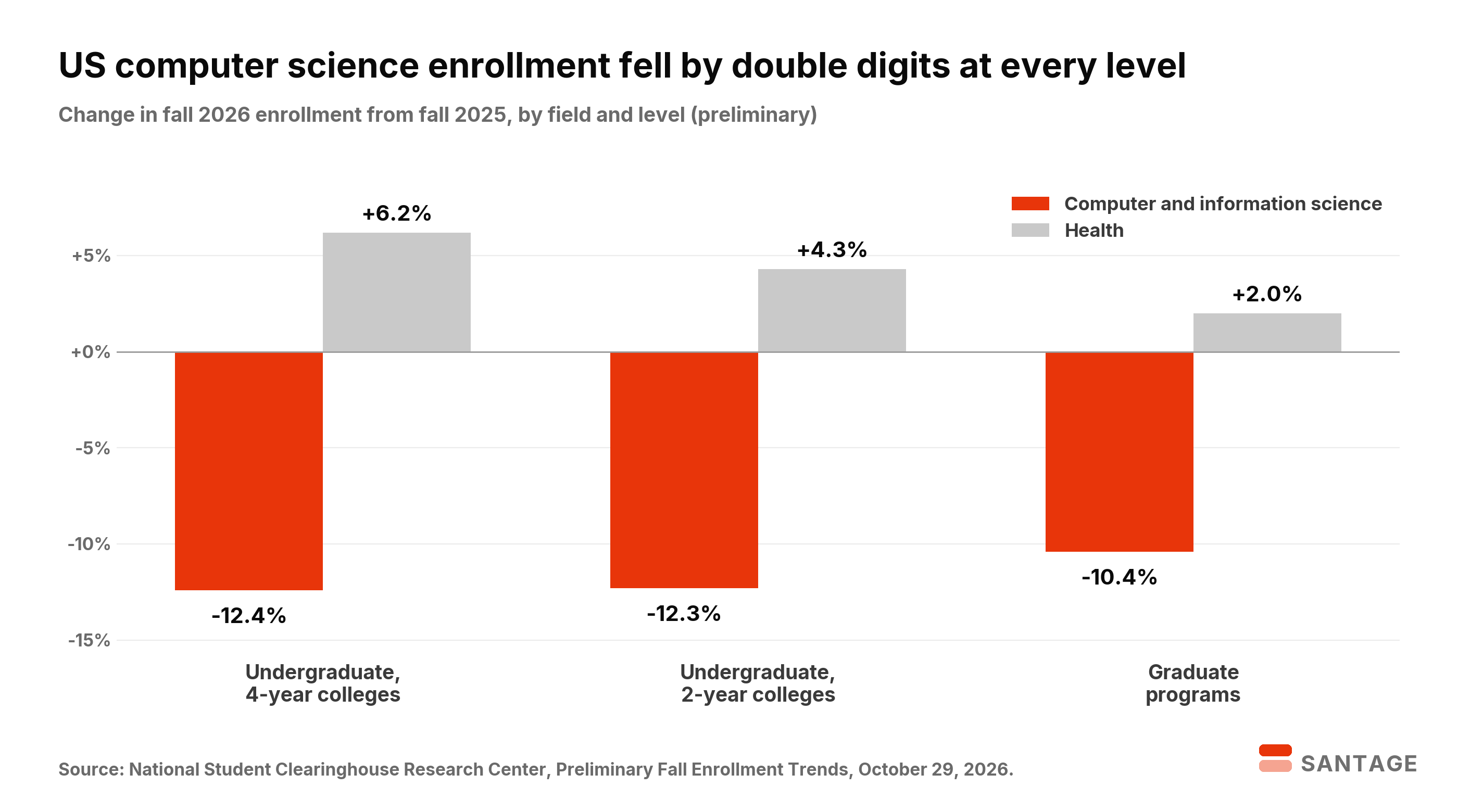
- Computer and information science enrollment fell by double digits at every level this fall, the largest drop of any field in the Clearinghouse data, while health majors grew up to 6.2%.
- Across two years, undergraduate computer science programs have lost 18.4% of their students and graduate programs 27.1%, reversing a decade in which the field was among the fastest growing in US higher education.
- Students are pulling back at the same moment employers cut junior coding roles, which sets up a thinner pipeline of experienced engineers by the early 2030s.
American students are leaving computer science faster than any other field, and the decline now runs from community colleges to graduate schools. Preliminary fall 2026 data from the National Student Clearinghouse Research Center, released October 29, show computer and information science enrollment down 12.4% at four-year colleges, 12.3% at two-year colleges and 10.4% in graduate programs, while total US enrollment held steady at plus 0.2%.
Computer science enrollment fell at every level of US higher education this fall
The field-by-field view arrives in a year when overall enrollment barely moved. Undergraduate headcount rose 0.6%, community colleges grew 1.2% and graduate enrollment slipped 1.6%, so the computer science collapse stands out sharply against a flat background. Health programs moved the other way, adding 6.2% at four-year colleges, 4.3% at two-year colleges and 2.0% at the graduate level.
The numbers are preliminary, exclude international students, and will be replaced by final figures in January 2027.
“Enrollment in Computer and Information Science programs continues to decline sharply, with double-digit decreases across institutions”
National Student Clearinghouse Research Center, Preliminary Fall Enrollment Trends, October 29, 2026
Two years of losses have erased nearly a fifth of undergraduate computer science students
This fall’s drop compounds the first decline recorded in fall 2025, when the field reversed years of growth. Taken together, the two years have cost undergraduate computer science programs 18.4% of their students and graduate programs 27.1%, according to Clearinghouse data reported by Bloomberg. Matthew Holsapple, the Clearinghouse’s senior director of research, called them remarkable declines for a field that was recently one of the fastest growing in higher education, and named affordability as one likely factor alongside career concerns.
| CS undergraduates at four-year colleges, fall 2026 vs fall 2025 | -12.4% |
| CS undergraduates over two years | -18.4% |
| CS graduate students over two years | -27.1% |
| Health majors at four-year colleges, fall 2026 | +6.2% |
Students are reading the entry-level hiring market before the labor statistics do
A student choosing a major in 2026 is betting on the job market of 2030, and the evidence available to that student points one way. Large employers have spent two years shrinking the junior coding roles that once absorbed new graduates, a pattern visible inside the AI labs themselves, where Anthropic’s own data showed junior technical hires falling from 27% to 9% of its intake. Coding assistants and autonomous AI agents now handle much of the routine work that entry-level engineers used to learn on.
The Clearinghouse counts enrollments and records nothing about motives, so the shift cannot be pinned on AI alone. The pattern of where students went still carries information. Health programs grew at every level, by as much as 6.2%, which suggests students are moving toward work tied to licensing and patient care, fields where AI so far acts as a tool inside a regulated human job.
Students are pricing in AI’s effect on entry-level software work faster than employers and universities have planned for it, and the correction is happening one admissions cycle at a time.
The graduate decline is the number with the longest tail
The 27.1% two-year fall in graduate computer science matters more than the undergraduate figure because master’s and doctoral programs feed research labs, security teams and the senior specialist roles that AI companies still compete to fill. Those programs also take years to rebuild once faculty lines and funding follow students elsewhere.
| What the October 29 data shows | What it leaves open |
|---|---|
| Double-digit CS declines at all three levels | Why students left: AI, affordability or salaries |
| Health growing at every level, up to 6.2% | Whether the shift persists once AI-native roles mature |
| A second consecutive annual decline | International enrollment, due in the January 2027 final report |
Because the preliminary count excludes international students, the January report will show whether foreign enrollment softens or deepens the graduate decline.
Employers that cut junior roles now face a thinner senior bench in the 2030s
Every senior engineer of 2035 is a student or junior hire today, and both pools are shrinking at once. Companies that automated entry-level software work to save cost are drawing down the training ground that produced their staff engineers, architects and security leads. Universities face the mirror problem, with computer science departments sized for the 2010s boom and a student body moving toward health.
The firms and schools that adapt first will treat AI fluency as part of every technical degree and keep some junior hiring as deliberate investment in future seniority. The Clearinghouse data shows that students have already made their adjustment, and the US software workforce of the next decade will be set by how employers and universities respond to the 18.4% of undergraduates who have already walked away.
Santage is committed to independent, transparent journalism. This article is produced in accordance with Santage's Editorial Standards and aims to provide accurate and timely information. Readers are encouraged to verify information independently.