
- Two OpenAI staff used GPT-6 Astra to design a Codex desk device as a side project in under a week, and a contract manufacturer built prototypes in under a month.
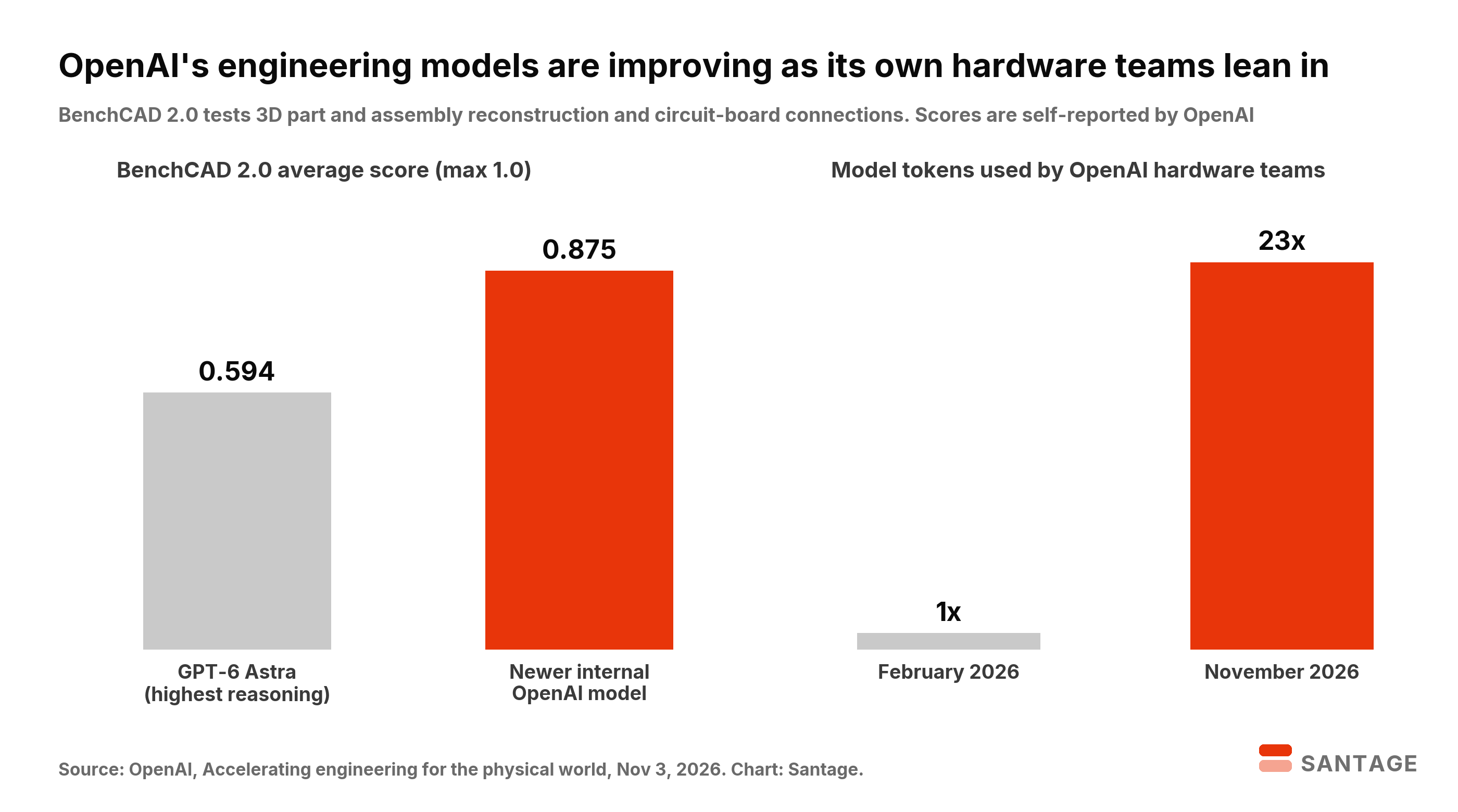
- Model usage across OpenAI's hardware teams, measured in tokens, has grown 23-fold since February, and a newer internal model scores 0.875 on BenchCAD 2.0 against 0.594 for Astra.
- The weak point is manufacturability, and OpenAI is recruiting partners such as Mazda and Chip Ganassi Racing whose engineers can supply the factory knowledge its models lack.
OpenAI has shown that a frontier model can carry a physical product from functional requirements to a factory prototype, and its own account shows where that ability currently stops. On November 3 the company said GPT-6 Astra designed the look, enclosure, circuit board and firmware of a small desk device for talking to Codex, with no direct human edits, in under a week. The same post concedes that getting the device ready for production took several rounds of review, because Astra did not consistently account for the manufacturer's limits, tolerances or assembly details.
GPT-6 Astra took a Codex device from requirements to prototype without direct human edits
The device, shown on OpenAI's page under the working name TamaGPT, is a handheld unit with a screen and buttons that lets a user speak to Codex, OpenAI's coding agent. According to OpenAI's post, Astra defined the functional requirements, developed the visual design from references including games and toys, designed the enclosure and the internal structures that hold components, selected the electrical parts, laid out the printed circuit board to fit the enclosure, and generated the firmware and software that connect the device to Codex. Two team members ran the project on the side, and a contract manufacturer turned the files into a small batch of prototypes in under a month.
| Stage of the TamaGPT build | Who did the work |
|---|---|
| Functional requirements and visual design | GPT-6 Astra |
| Enclosure and internal mounting structures | GPT-6 Astra |
| Component selection and circuit board layout | GPT-6 Astra |
| Firmware, interface and Codex integration | GPT-6 Astra |
| Prototype batch | Contract manufacturer, under a month |
| Fixes for production limits, tolerances and assembly | Several rounds of human review |
Manufacturing limits are where the model fell short
A design that renders correctly can still fail on the factory floor. Every production process has a tolerance band, a minimum wall thickness, a drill size it can hold and an order in which parts must go together, and much of that knowledge lives with suppliers and in engineers' experience, outside the public documents a multimodal model learns from. Astra's misses fall exactly in that layer, which is why the review rounds were needed.
Independent testing points the same way. The first version of BenchCAD, an academic benchmark of 17,900 industrial parts published in May, found that frontier models tend to recover a part's coarse shape while dropping the operations, such as sweeps and lofts, that reflect how the part would really be made.
OpenAI's own hardware teams are the first customer for this capability
The device is a demonstration, and the larger signal is internal adoption. OpenAI says its hardware and infrastructure teams, which work on robotics and compute infrastructure, now use Codex and ChatGPT to create and revise CAD models, turn 3D designs into 2D manufacturing drawings, set up simulations and review designs, and that their model usage has grown 23-fold since February. The pattern mirrors what labs have disclosed about software, where Claude now writes most of Anthropic's code.
"Codex has dramatically accelerated how we move from an idea to an engineered part. We're iterating faster across CAD, converting 3D designs into production-ready 2D drawings, and setting up simulations and FEA with far less manual work."
Grace Lam, Forward Deployed Engineer at OpenAI, in Accelerating engineering for the physical world, November 3, 2026
The benchmark behind OpenAI's score is still under construction
OpenAI reports that a newer, unreleased model averages 0.875 on BenchCAD 2.0, which tests whether a model can reconstruct 3D parts and assemblies and identify the connections on a circuit board, against 0.594 for GPT-6 Astra at its highest reasoning setting. That is a large jump on a hard benchmark, and it comes with a caveat. The BenchCAD 2.0 repository maintained by the benchmark's authors has no tagged release, and the group says it re-grades every leaderboard number itself from raw predictions. OpenAI's figures have not yet been through that process.
The model that designs the device is ready before the factory knowledge it needs, which makes manufacturers' feedback the scarce input in AI for engineering.
Mazda and Chip Ganassi Racing show where the missing knowledge will come from
OpenAI's response to the manufacturing gap is to work with companies that build physical products at scale. Chip Ganassi Racing's R&D engineers are testing workflows that turn 3D scans of existing parts into editable CAD models and 2D drawings, and they check each output for accuracy and manufacturability. Mazda's aerodynamics and crash-safety engineers are using Astra in Codex to model nose shapes, simulate airflow and refine the most promising designs. OpenAI is also inviting engineering firms and software vendors to help shape training around the tools they use.
Each review by those engineers teaches OpenAI what its models get wrong about real production. For incumbents in CAD, simulation and electronics design software, the larger threat is a model trained on the corrections of the engineers who build the parts. For engineering firms, joining such a program buys early access in exchange for exactly the expertise that has made them hard to replace.
TamaGPT shows that a week of model work can now produce a device a factory will build, and it shows that a week was enough only because humans caught what the model did not know about factories. Whoever gathers that missing manufacturing knowledge fastest, through partners like Mazda or through their own production lines, will set the pace at which AI moves from writing code to shipping physical products.
Santage is committed to independent, transparent journalism. This article is produced in accordance with Santage's Editorial Standards and aims to provide accurate and timely information. Readers are encouraged to verify information independently.