
- Marvell will pay 4.5 of its shares per Lumentum share, an implied $115 billion enterprise value, leaving Lumentum holders with about 33% of the combined company.
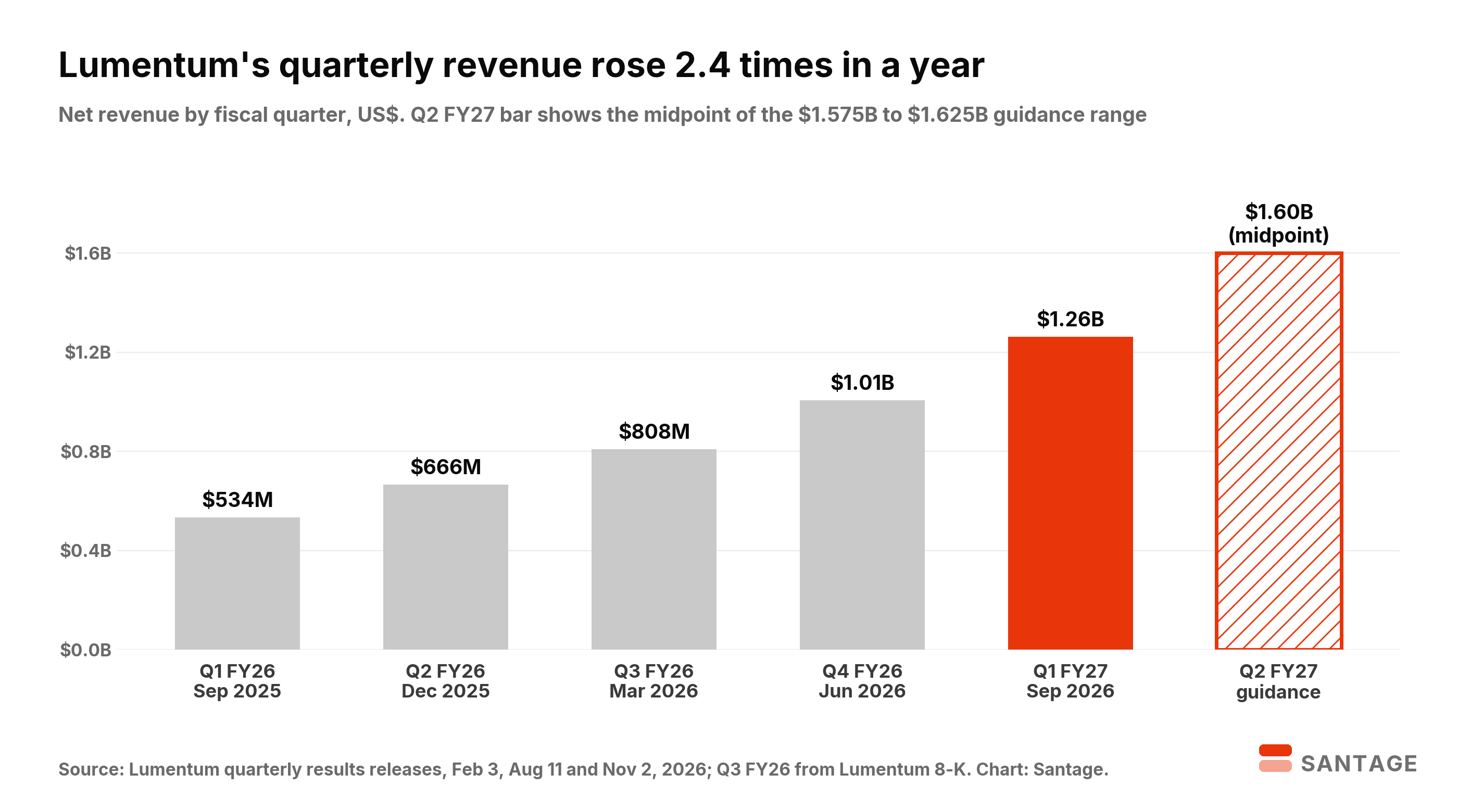
- Lumentum's revenue reached $1.26 billion in the quarter to September, up 137% from a year earlier, and it guides to $1.575 billion to $1.625 billion next quarter.
- The companies claim a $550 billion addressable market and more than $1 billion in annual cost synergies, with closing expected in the first half of 2028.
Marvell Technology has agreed to buy Lumentum in an all-stock deal that values the maker of lasers and optical components for AI data centers at $115 billion including debt, the largest acquisition in either company's history and one of the biggest semiconductor deals ever signed. The companies announced the agreement on November 2, pricing Lumentum at about $1,132 a share, a 23.9% premium to its October 28 close, according to Marvell's filing with the SEC. The bet underneath the price is that the wiring between AI chips is moving from copper to light, and that one company should own both the electrical and the optical side of that link.
Marvell pays about 18 times Lumentum's forward revenue for a laser supply it already depends on
Lumentum sells the lasers, optical transceivers and optical circuit switches that move data between racks of AI accelerators. Marvell designs the electrical side: interconnect chips, network switches and custom accelerators that hyperscalers build to reduce their reliance on Nvidia. Under the agreement, three Lumentum directors, including chief executive Michael Hurlston, join Marvell's seven-member board, and Marvell chief executive Matt Murphy keeps both his roles.
| Implied enterprise value for Lumentum | $115 billion |
| Exchange ratio | 4.500 Marvell shares per Lumentum share, about $1,132 |
| Premium to unaffected October 28 close | About 23.9% |
| Ownership after closing | Marvell holders about 67%, Lumentum holders about 33% |
| Targeted cost synergies | More than $1 billion a year at run rate |
| Expected close | First half of calendar 2028 |
The price reflects how quickly Lumentum's business has grown. It reported $1,262.6 million of revenue for its fiscal first quarter, against $533.8 million a year earlier, and guided to roughly $1.6 billion at the midpoint for the current quarter, according to its first-quarter results released the same day. Annualizing that guidance gives about $6.4 billion of revenue, so Marvell is paying around 18 times forward sales for a company whose non-GAAP operating margin reached 42.3% last quarter.
Optical links inside the rack are the next constraint on AI clusters
As AI clusters grow from thousands of accelerators to hundreds of thousands, the copper cables that connect chips inside a rack run into limits on distance, power and bandwidth. Optics already carry traffic between racks; the next step is moving light closer to the chip itself, through near-packaged and co-packaged optics. Lumentum said that in the September quarter it won its second major order for those products, backed by purchase commitments above $5 billion. That is the market Marvell is buying into, and it is why both chief executives describe the deal in generational terms.
“AI infrastructure is undergoing a fundamental architectural shift toward optical connectivity, creating an opportunity that comes along once in a generation.”
Matt Murphy, Chairman and CEO of Marvell, joint press release, November 2, 2026
The deal also reshapes Marvell's position against Broadcom, the largest supplier of custom AI chips to hyperscalers and a company that already sells both networking silicon and optical components. Marvell's earlier optical purchases, Inphi for $10 billion in 2021 and photonics startup Celestial AI this year, built its electrical and silicon photonics base. Lumentum adds lasers and compound semiconductor manufacturing, the parts that are hardest to source when demand spikes. This puts Marvell closer to selling a pre-validated link from the chip to the fiber, which is the product hyperscaler AI infrastructure teams increasingly want to buy as one unit.
| Marvell | Lumentum | |
|---|---|---|
| Core products | Interconnect DSPs, Ethernet switches, custom AI accelerators | Lasers, optical transceivers, optical circuit switches |
| Manufacturing model | Fabless, relies on foundry partners | Specialized optical and compound semiconductor manufacturing |
| Role in an AI link | Electrical signal and switching | Light source and optical transmission |
| Post-deal ownership | About 67% | About 33% |
Source: Marvell Technology and Lumentum joint announcement, November 2, 2026.
Marvell is paying in its own shares for the one input the AI buildout cannot conjure quickly: laser manufacturing capacity, which is now as scarce as the accelerators it connects.
A 2028 close leaves 18 months for the optics market to move
The companies expect to close in the first half of 2028, after shareholder votes and regulatory reviews, and Lumentum told customers it expects 12 to 18 months. That is a long time in a market where Lumentum's quarterly revenue more than doubled in a year. Because the consideration is all stock, Lumentum holders take on Marvell's share price risk throughout that wait, and the 23.9% premium can widen or shrink with every swing in AI chip stocks.
For the rest of the optics supply chain, the deal resets the reference price. Independent laser and transceiver makers, and the startups building co-packaged optics engines, will now be valued against a $115 billion benchmark for a business with about $6 billion of forward revenue. That gives hyperscalers a reason to lock in second sources before a combined Marvell and Lumentum controls more of the bill of materials, and it gives Broadcom a reason to respond with its own optics capacity. Regulators reviewing the merger will look at the same question from the buyer's side, since a handful of cloud companies purchase most of these components and will want assurance that a merged supplier keeps selling lasers to rival chip designers on equal terms.
The spending that funds this market is still rising: the largest cloud companies are on track to spend more on AI infrastructure than their operations generate in cash this year, and Google reported 103% growth in TPU sales last week. Every new accelerator cluster needs more optical links, and every optical link needs a laser.
Marvell's $115 billion offer puts a public-market price on the idea that the links between AI chips have become a bottleneck as serious as the chips. If Lumentum hits its $1.6 billion guidance and its co-packaged optics orders convert on schedule, the multiple will look reasonable by closing day; if hyperscaler capex slows before 2028, Marvell will have issued a third of its company for capacity it no longer needs.
Santage is committed to independent, transparent journalism. This article is produced in accordance with Santage's Editorial Standards and aims to provide accurate and timely information. Readers are encouraged to verify information independently.