

- OpenAI lowered its round target to up to $20 billion from $30 billion, at a $1.25 trillion post-money valuation, after some investors trimmed their allocations ahead of an October 30 commitment deadline.
- About $11 billion was committed as of the deadline, roughly 37% of the original goal, and OpenAI told shareholders it will court family offices and wealthy individuals in the coming weeks.
- At a run rate near $50 billion, the new price still values OpenAI at about 25 times annualized revenue and 47% above its $852 billion March valuation.
OpenAI is now seeking up to $20 billion in its latest funding round, a third less than the $30 billion it set out to raise in September, and the round is pricing the company at a $1.25 trillion post-money valuation instead of the $1.4 trillion figure attached to the original talks. CNBC confirmed the reduced target on October 31, after the Financial Times first reported the cut, and a person familiar with the deal said the round has not closed and the numbers could still move.
OpenAI's round shrinks by $10 billion after a Friday deadline
OpenAI gave investors until Friday, October 30, to commit, and several reduced the size of their checks, according to the Financial Times. The Wall Street Journal reported that the company had raised less than half of the original $30 billion, with commitments at roughly $11 billion, and that OpenAI told shareholders it would approach family offices and high-net-worth individuals to close the gap. Investors from the United Arab Emirates are leading the round alongside Coatue. OpenAI did not respond to CNBC's request for comment.
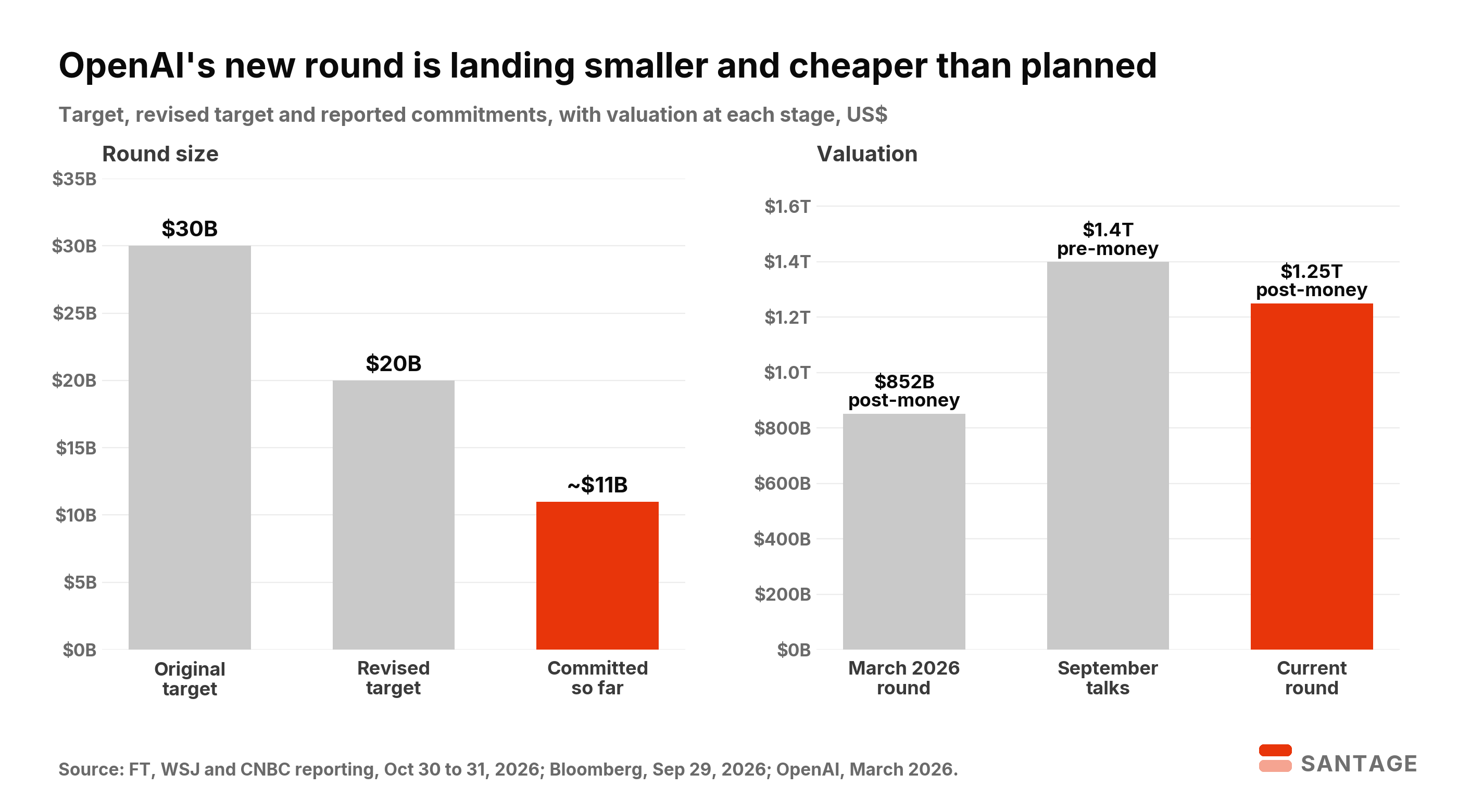
The valuation moved as well. Bloomberg's September report described a target of at least $30 billion at about $1.4 trillion before the new money, which would have put the company near $1.43 trillion after it. The FT now puts the round at $1.25 trillion after the new money, about 13% lower on a like-for-like post-money basis.
| Revised round target | $20 billion, down from $30 billion |
| Committed at the October 30 deadline | About $11 billion |
| Post-money valuation | $1.25 trillion |
| Valuation over revenue run rate | About 25 times a run rate near $50 billion |
OpenAI's deadline landed in a week of steep AI stock losses
The deadline fell at the end of a week in which the market questioned whether hyperscaler spending will earn its return. Intel fell 25% on Friday after weak guidance, Nvidia dropped 4%, and Alphabet had its worst trading day on record on Thursday after search revenue missed estimates. That backdrop matches Santage's reading of the Big Tech capex data: the five largest US AI spenders now outspend their own operating cash flow, which leaves outside investors such as OpenAI's backers carrying more of the buildout's risk.
| Round | Date | Amount | Valuation |
|---|---|---|---|
| March 2026 close | March 2026 | $122 billion | $852 billion post-money |
| Bridge round talks | September 29, 2026 | At least $30 billion sought | About $1.4 trillion pre-money |
| Revised round | October 30 to 31, 2026 | Up to $20 billion sought, about $11 billion committed | $1.25 trillion post-money |
The revenue math explains the pushback. OpenAI told investors in October that its annualized revenue was approaching $50 billion, well below the $70 billion estimate that circulated when the $1.4 trillion figure first appeared. A $1.25 trillion price is still roughly 25 times that run rate, rich by any public-market standard, yet investors who had signed up for a larger multiple chose to commit less money at a lower one.
OpenAI will still finish this round with one of the largest private raises on record, and a $1.25 trillion valuation that only a handful of listed companies exceed. What changed this week is who sets the terms: investors met an OpenAI deadline with smaller checks than the company asked for, and OpenAI is turning to private wealth to fill a round its March raise had oversubscribed with institutional money.
Santage is committed to independent, transparent journalism. This article is produced in accordance with Santage's Editorial Standards and aims to provide accurate and timely information. Readers are encouraged to verify information independently.