

- OpenAI's run rate was close to $50 billion at the end of September, according to investor documents reported by the Financial Times, against roughly $70 billion widely cited since late September.
- The Nasdaq 100 fell 1.4% and a chip-stock index dropped 3.4% on October 8 as investors repriced the companies that depend on OpenAI's spending.
- At a reported $1.4 trillion pre-money valuation, OpenAI is priced at about 28 times its annualized revenue, up from the 20 times implied by the $70 billion figure.
OpenAI told investors its annualized revenue was approaching $50 billion at the end of September, roughly $20 billion below the figure that had circulated across the industry for two weeks. The gap traces to how outsiders calculated the higher number, and it still wiped more than 1% off the Nasdaq 100 on October 8 and changes the arithmetic behind OpenAI's reported $1.4 trillion fundraising target.
OpenAI's real September run rate sits near $50 billion
The number OpenAI gave investors was “approaching $50bn,” with revenue growth of more than 70% over the period, according to the Financial Times, which reviewed the documents. The $70 billion figure that spread from late September, and which Santage used in its coverage of OpenAI's $30 billion fundraising talks, came from investors, who built it by taking an August base of roughly $40 billion and applying the growth rate, measured the way Anthropic measures revenue.
OpenAI has since told investors it expects to reach $70 billion or more in annualized revenue by the end of 2026, driven mainly by enterprise sales, Bloomberg reported. The company declined to comment publicly on either figure. The business is still growing at a pace with few precedents: OpenAI's chief financial officer wrote in January that annualized revenue had passed $20 billion in 2025, so the September figure is about two and a half times that level nine months later.
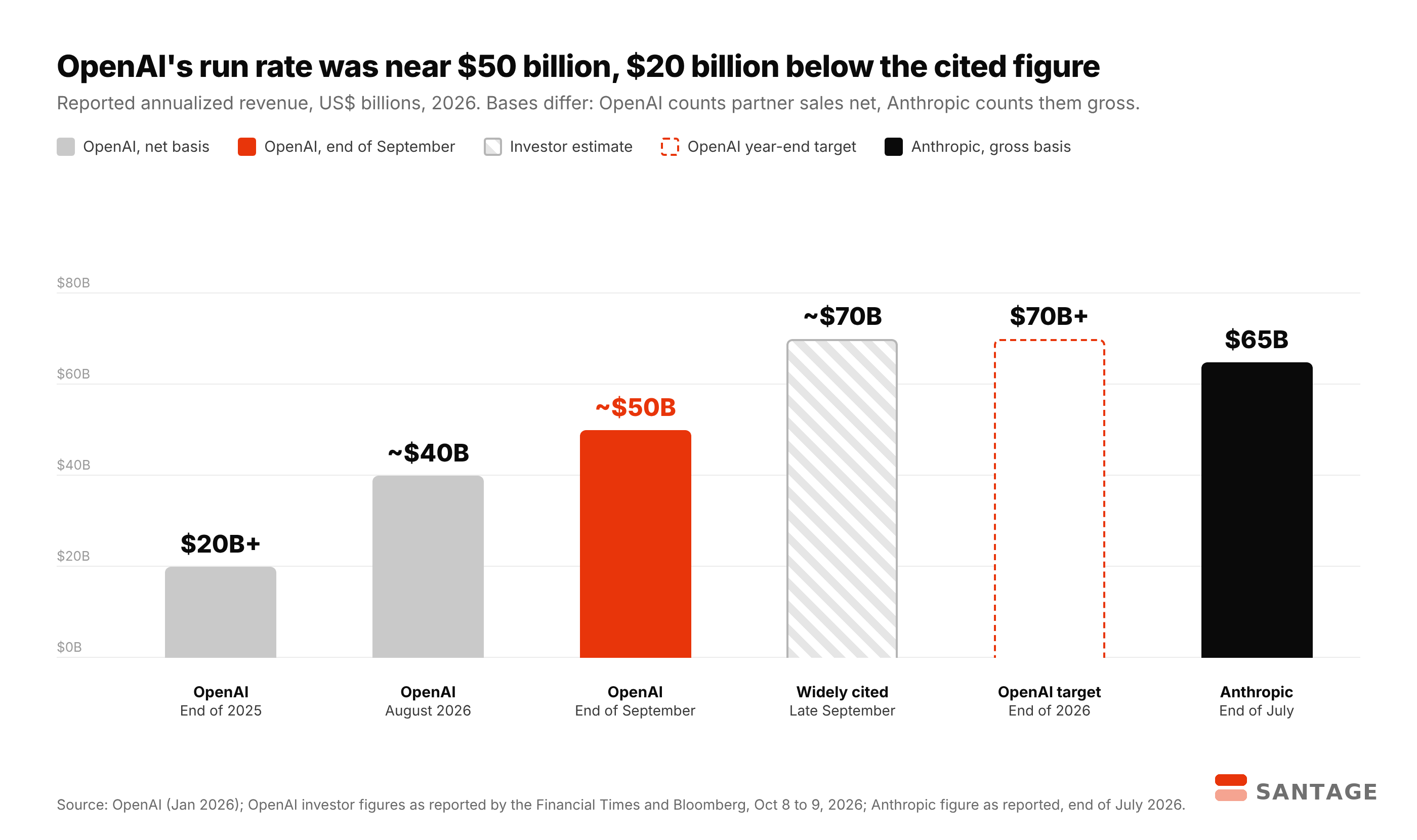
Two labs, two ways of counting the same customer dollar
The confusion comes from how each lab books sales made through cloud partners. Anthropic records the full price a customer pays for Claude through Amazon Web Services or Google Cloud as revenue, then lists the cloud provider's share as a cost. OpenAI counts only the portion it receives on sales routed through partners such as Microsoft. Annualized revenue has no standard accounting definition, so both approaches are legitimate, and neither company publishes audited quarterly figures yet.
| Company | Annualized revenue | Date | Partner sales counted |
|---|---|---|---|
| OpenAI | Above $20 billion | End of 2025 | Net |
| OpenAI | About $40 billion | August 2026 | Net |
| OpenAI | Approaching $50 billion | End of September 2026 | Net |
| OpenAI (investor estimate) | About $70 billion | Cited from late September | Gross method applied by investors |
| OpenAI (company target) | $70 billion or more | End of 2026 | Net |
| Anthropic | $65 billion | End of July 2026 | Gross |
Source: OpenAI (January 2026); figures as reported by the Financial Times and Bloomberg, September to October 2026. Table: Santage.
The comparison that mattered most to investors was the leaderboard. Anthropic reported $65 billion at the end of July on its gross basis. A person familiar with Anthropic's finances has estimated that switching to net reporting would cut its figure by about 6% to 10%, which still leaves it at roughly $58 billion to $61 billion, ahead of OpenAI's $50 billion on the same footing.
On a like-for-like basis, Anthropic has likely out-earned OpenAI since the summer, and the market only learned how wide the gap was when OpenAI's own number surfaced.
A $20 billion gap reprices the companies that sell to OpenAI
Markets reacted to the size of the correction because so much spending is planned against OpenAI's growth. Tech stocks led the S&P 500 lower on October 8, with the Nasdaq 100 down 1.4% and a chip-stock gauge down 3.4%, as shares of Nvidia, Oracle and CoreWeave fell. Equities opened higher on Friday after the year-end target emerged, which suggests investors came to see the episode mainly as a disclosure problem.
| OpenAI annualized revenue, end of September | Approaching $50 billion |
| Gap to the widely cited estimate | About $20 billion |
| Nasdaq 100, October 8 | Down 1.4% |
| Chip-stock gauge, October 8 | Down 3.4% |
The suppliers carry the risk most directly. OpenAI's compute commitments run into the hundreds of billions of dollars, and the debt packages being assembled to pay for AI chips, including the $40 billion SpaceX is seeking for Nvidia hardware, are underwritten partly on the assumption that the largest buyers keep compounding revenue. A run rate that is $20 billion lower at the same growth rate pushes every repayment schedule further out.
The valuation multiple is the number most coverage skipped
OpenAI is reportedly seeking at least $30 billion at a pre-money valuation of about $1.4 trillion. Against $70 billion of revenue, that price was roughly 20 times sales. Against the $50 billion OpenAI actually reported, it is 28 times, a 40% higher multiple for the same valuation. If OpenAI reaches its year-end target, the multiple falls back to 20 times by December, so the round effectively asks investors to pay today for growth OpenAI says it will deliver within three months.
That is a large bet on a short horizon, and the outcome will be visible quickly. Anthropic's IPO filing, expected within weeks, will put audited revenue for one leading lab into the public record, and OpenAI's December run rate will show whether the $70 billion figure was simply early.
OpenAI's $20 billion revision leaves demand for its products intact while resetting how investors compare AI labs, and it leaves a $1.4 trillion valuation resting on 28 times current revenue and on a growth target OpenAI has set for itself.
Santage is committed to independent, transparent journalism. This article is produced in accordance with Santage's Editorial Standards and aims to provide accurate and timely information. Readers are encouraged to verify information independently.