

- Anthropic acquired Mithril Medicine, whose founder used Claude to coordinate 11 external labs and took a muscular dystrophy treatment from idea to promising mouse results in under 18 months.
- At six partners, Claude generated about 35,000 antibody designs in a month, proposed a CAR T-cell component 70% shorter than the standard, and cut manufacturing document review time by 89%.
- Almost all of the work is preclinical, and the largest measured time savings came from paperwork and coordination rather than molecule design.
Anthropic has started developing medicines of its own. In a progress report published on October 27, the company said it acquired Mithril Medicine, a one-person startup working on two rare childhood forms of muscular dystrophy, and expects a drug candidate from that program to be ready for human clinical trials as soon as late 2028, according to Anthropic’s post. The same report gives the first measured results from Claude inside six outside drug developers, including Bristol Myers Squibb.
Claude produced measurable results at six drug developers in a few months
Anthropic placed each partner at a different stage of drug development, which turns the post into a map of where a large language model helps and by how much. The partners report the figures below themselves, mostly from early lab work.
| Partner | Stage | What Claude did | Reported result |
|---|---|---|---|
| Generate Biomedicines | Modality engineering | Proposed shorter genetic instructions for a CAR T-cell therapy | One design 70% shorter, with about 10x more cancer-spotting receptors in lab tests |
| Divergence Labs | Hit generation | Generated antibody designs for a food-allergy drug | About 35,000 designs in a month; 3 outperformed the standard medication |
| BigHat Biosciences | Lead optimization | Proposed changes to two antibody fragments, tested as about 1,010 variants in 10 weeks | Binding more than 10x tighter; clumping more than 100x slower |
| Enveda | Manufacturing and filings | Reviewed 1,061 pages of batch records | Caught all 11 human-found issues plus 7 missed ones; review time down 89% |
| The Column Group | Company creation | First Claude skill for new company Pleiades screens drug targets | Evaluated on 45 target-disease pairs |
| Bristol Myers Squibb | Clinical trial planning | Assessed an early-stage trial plan and estimated its odds of success | Expansion planned for 2027 |
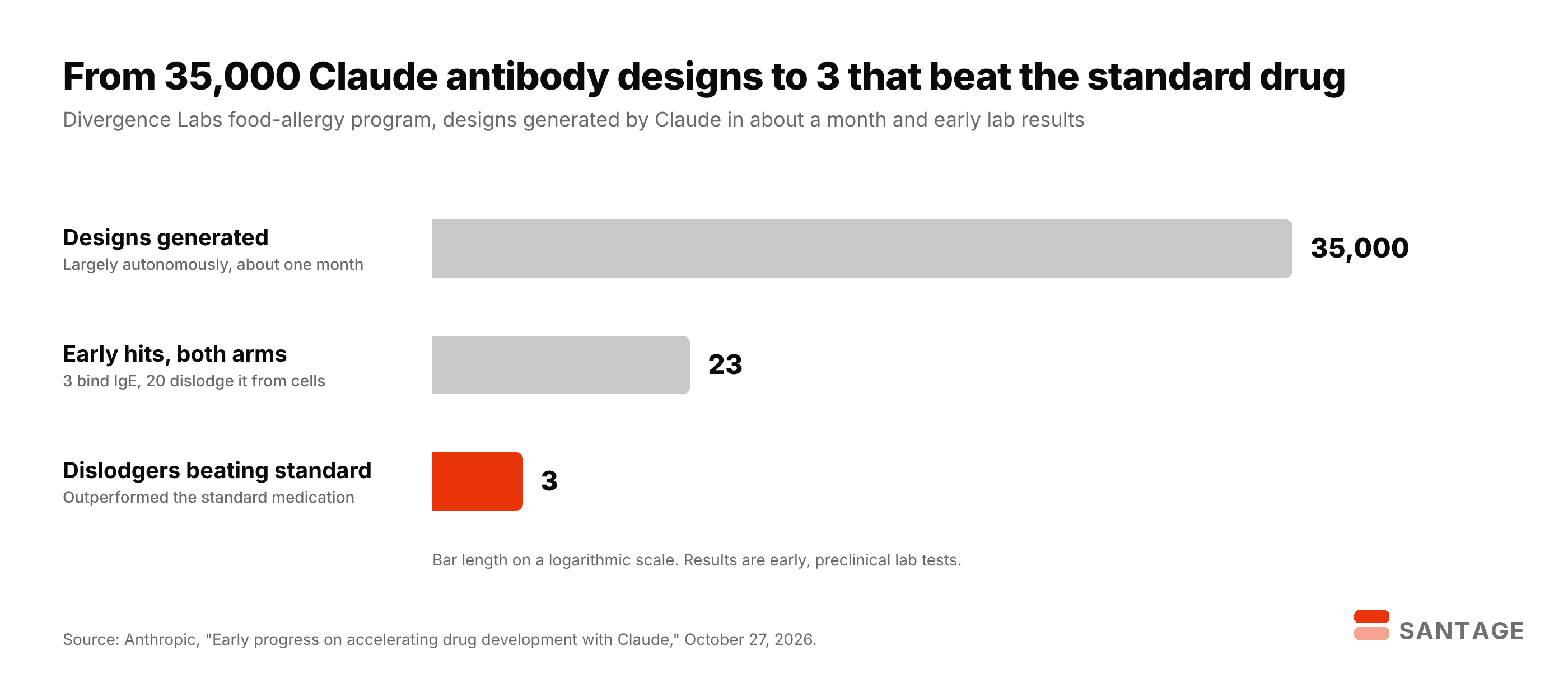
The Divergence program shows the scale of what Claude can generate when left to work largely on its own. It turned the company’s goals into a design plan and then produced roughly 35,000 candidate antibodies for a two-armed molecule that would pull IgE, the trigger of food allergies, off immune cells entirely. Lab tests found three designs that bind IgE and 20 that dislodge it, and three of those 20 beat the standard drug.
The biggest time savings came from paperwork, with molecule design second
Molecule design gets the attention, yet the most dramatic numbers in Anthropic’s report come from the administrative work that surrounds it. Enveda’s manufacturing chemists had been spending up to 75% of their time on documentation. With its records connected to Claude, a review that took human staff more than 25 hours fell to under three, and Claude drafted one regulatory document in four hours that would have taken about three months by hand.
| Enveda batch-record review time | Down 89%, from 25+ hours to under 3 |
| Regulatory document first draft | 4 hours, against about 3 months by hand |
| External labs run by Mithril’s single founder | 11, coordinated through Claude |
| Earliest expected human trials for Mithril’s candidate | Late 2028 |
Mithril makes the same point at company scale. Founder Cody Tranbarger used Claude to run contracts, logistics and experiments across 11 outside labs and delegated much of the rest of the operation, which is how a single person moved a muscular dystrophy treatment to promising mouse data in under 18 months. Anthropic describes its strategy in those terms, arguing that the bottlenecks are spread across the whole development chain and that AI agents have to take on all of them.
“From a single prompt, Claude generated a robust initial analysis that helped inform our assessment of different development options, which would otherwise take days to complete.”
Michael Pourdehnad, MD, Senior Vice President, Head of Early Clinical Development, Bristol Myers Squibb, via Anthropic, October 27, 2026
Anthropic is now both a model supplier and a drug developer
Owning Mithril changes Anthropic’s position in the industry it sells to. Until now its life sciences work looked like that of a vendor, offering the Claude Science workbench, research credits and a verification program that relaxes safeguards for trusted labs. A drug program with a trial target date makes it a participant whose own results will be judged by regulators, in the same market as the biotech firms paying for Claude.
The Column Group’s Pleiades venture points to the business model behind that move. If a small team running Claude can manage many more programs than usual, investors can afford to back riskier targets, and Anthropic’s model becomes the cheapest input in drug discovery after the scientists themselves. Pleiades has so far shown a single Claude skill for screening targets, tested on 45 target-disease pairs, so that model of a lean, many-program biotech remains a plan with one working part.
The strongest evidence in Anthropic’s report is administrative: a filing review cut from 25 hours to 3 and a one-person company running 11 labs. Speed in paperwork is easier to verify than a new molecule, and it compounds across every program a biotech runs.
Preclinical caveats set the limits on what these numbers prove
Anthropic says plainly that the work is early and mostly preclinical, meaning almost none of it has reached human testing. Antibody hits and mouse results fail at high rates on the way to approval, and every figure here comes from the partners and Anthropic, with technical reports and preprints still to be scrutinised by outside scientists. The comparison with Claude’s CRISPR-like enzyme discovery in September holds: speed of generation is proven, and clinical value remains open.
Anthropic now has its own clock to beat. A muscular dystrophy candidate entering human trials in late 2028 would make Claude’s contribution measurable on the industry’s hardest test, and a miss would show how much of drug development still moves at the pace of biology, however fast the software around it becomes.
Santage is committed to independent, transparent journalism. This article is produced in accordance with Santage's Editorial Standards and aims to provide accurate and timely information. Readers are encouraged to verify information independently.