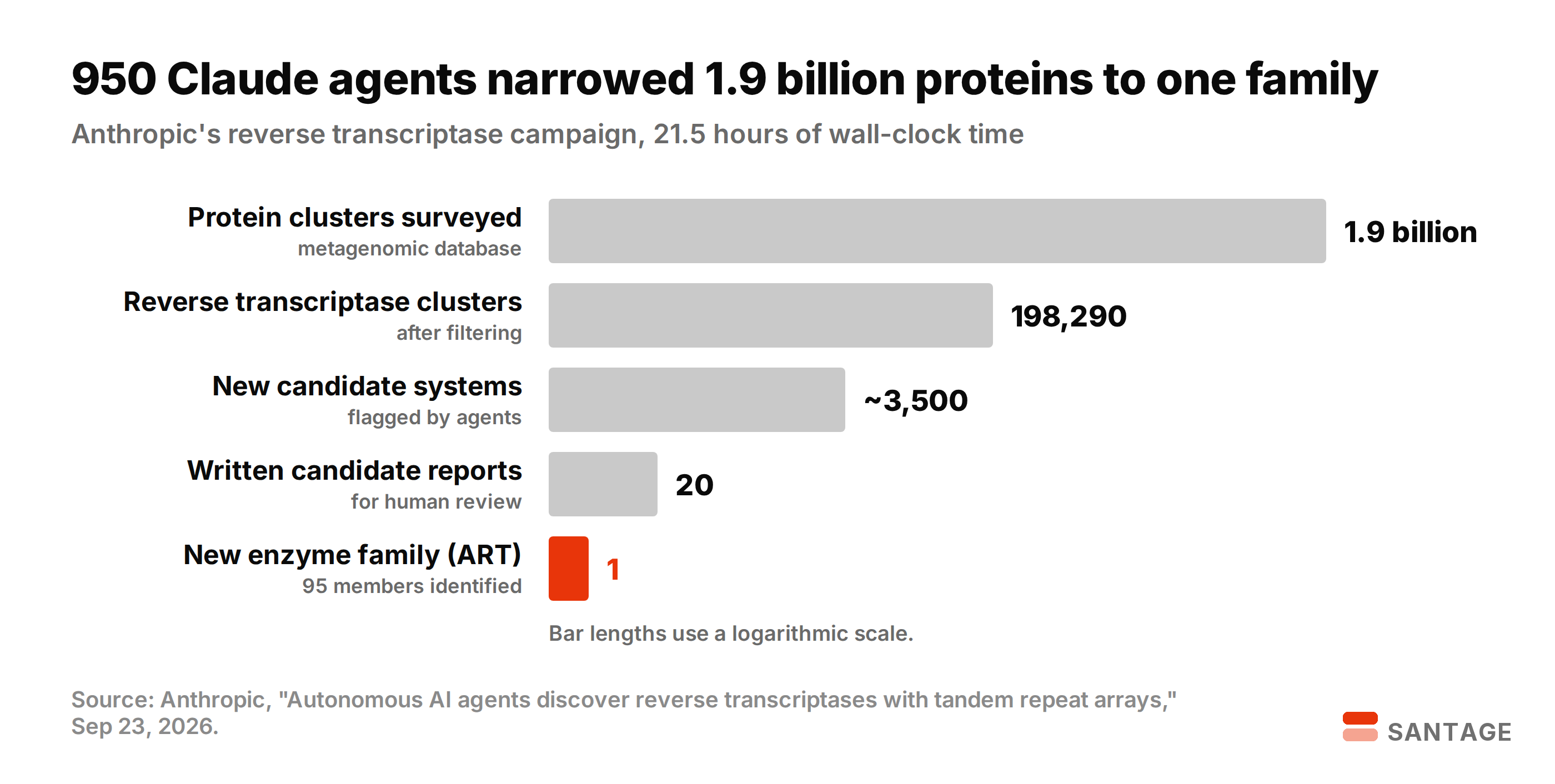
- About 950 Claude agent sessions ran for 21.5 hours and 215.6 million tokens, narrowing 198,290 reverse transcriptase clusters to one new family, array-associated reverse transcriptases (ART), with 95 members.
- Human scientists in Anthropic's new Bay Area lab confirmed the repeat arrays are made into short RNAs during infection, but the team has not shown the enzyme is active or what the system does.
- The find depended on the model reading raw DNA, and the same campaign missed it in 10 re-runs, which makes verification capacity the constraint on AI-led biology.
Anthropic says a swarm of Claude agents searched 1.9 billion protein clusters and found a previously undescribed family of bacterial-virus enzymes paired with CRISPR-like DNA repeats, and the most useful part of its report is the candid account of how fragile that discovery was.
Claude agents found the ART family by reading raw DNA sequence
The campaign targeted reverse transcriptases, enzymes that copy RNA into DNA and that bacteria and their viruses repurpose for defense and gene editing. According to Anthropic's technical report, agents built profiles, searched a metagenomic database of 1.9 billion protein clusters, filtered 198,290 reverse transcriptase clusters into nine classes and ran 119 tasks, from census work to deep dives on unusual genomic neighborhoods. The public announcement describes roughly 3,500 new candidate systems cut to 20 written reports for human review.
One agent, looking at the DNA beside a known reverse transcriptase, noticed a repeating pattern that earlier surveys had passed over. It counted the repeats, measured their spacing, compared the layout with known systems and searched the literature for prior reports. The resulting family pairs a reverse transcriptase with an unusually long front section, a dedicated partner protein and an upstream array of 3 to 21 repeated units, a layout that resembles the repeat arrays at the heart of CRISPR.
“[The DNA next to the RT] is spectacular: I can see by eye a tandem repeat array … that’s a CRISPR-like … repeat array?!”
Claude agent transcript, quoted in Anthropic’s announcement, September 23, 2026
The discovery depended on the model reading at least 200 DNA letters
Anthropic's own tests show why this result came from a frontier model and would likely have been missed by a scripted pipeline. Only its most capable systems, Opus 5.5, Mythos 5.1, Mythos 5 and Opus 5, recognized ART arrays, and only when at least 200 nucleotides of contiguous sequence sat in the context window. Recognition dropped when the agents relied on tools to summarize the sequence. Using interpretability methods, the researchers also located two internal signals in Mythos 5 that respond to repeated DNA, strengthen with each successive copy and go quiet when the sequence is shuffled.
That finding changes where the value sits in these systems. Classic genome mining runs predefined detectors and hands the survivors to a human expert, whose attention does not scale. The Claude campaign put an expert-like reader at every step, which is how an anomaly outside the detector set got flagged at all. It also means the capability is tied to specific frontier models and to how much raw data the harness feeds them.
| 1.9B | Protein clusters surveyed |
| 949 | Agent sessions across 119 tasks |
| 215.6M | Tokens consumed |
| 21.5 hours | Wall-clock time, 77 agent-hours |
The same campaign missed the array in 10 re-runs
The report's limitations section deserves as much attention as the headline. When Anthropic re-ran the campaign 10 times, the agents did not find the ART array again, which the authors attribute to the broad search space and the non-deterministic behavior of the harness. A discovery engine that surfaces a result once in 11 attempts is a powerful scout and an unreliable census.
| Claim | Status in Anthropic's report |
|---|---|
| ART is a distinct reverse transcriptase family with 95 members | Established from sequence and phylogenetic analysis |
| Repeat arrays are transcribed into discrete short RNAs | Shown by RNA sequencing; array RNAs ranked 4th most abundant 15 minutes into phage SA1 infection |
| The reverse transcriptase is active on those RNAs | Not shown |
| The system cuts, copies or edits DNA like CRISPR tools | Unknown |
| The search reliably finds ART on repeat runs | Missed in 10 of 10 re-runs |
Source: Anthropic technical report, September 23, 2026.
Claude found the enzyme in a day, and the question of what it does now waits on the pace of human bench work.Santage analysis
Anthropic now runs its own wet lab to close the verification gap
The announcement also introduced a life sciences research group and a Bay Area laboratory working at biosafety levels 1 and 2, with no human pathogens. Claude generates hypotheses and helps interpret data through Claude Science and Claude Code, and human scientists perform all of the lab work. That setup follows Anthropic's protein binder results in August, where outside labs validated Claude designs, and Novo Nordisk's move to run Claude Science across its R&D last week. Owning the bench lets Anthropic test its own leads instead of waiting on partners, and it turns discovery claims into something the company can check before publishing.
“This is an exciting example of how AI agents can contribute to biological discovery.”
Feng Zhang, Broad Institute and MIT, quoted in Anthropic’s announcement, September 23, 2026
The competitive frame is shifting from benchmark scores to verified findings, a trend visible in OpenAI's claim of 100 resolved math problems this week and the objections it drew. Biology sets a harder standard than math because no proof checker exists for a living cell. Every candidate an agent surfaces still needs cloning, expression and assays, and those steps move at human speed.
ART may prove to be a useful new molecular tool or an evolutionary curiosity, and Anthropic says plainly that it does not yet know which. The lasting result is the measurement: a frontier model can now read genomes closely enough to find what a specialist would flag, at a scale no specialist can cover, and the scarce resource in AI-driven biology has become the lab time needed to confirm what the agents find.
Santage is committed to independent, transparent journalism. This article is produced in accordance with Santage's Editorial Standards and aims to provide accurate and timely information. Readers are encouraged to verify information independently.