
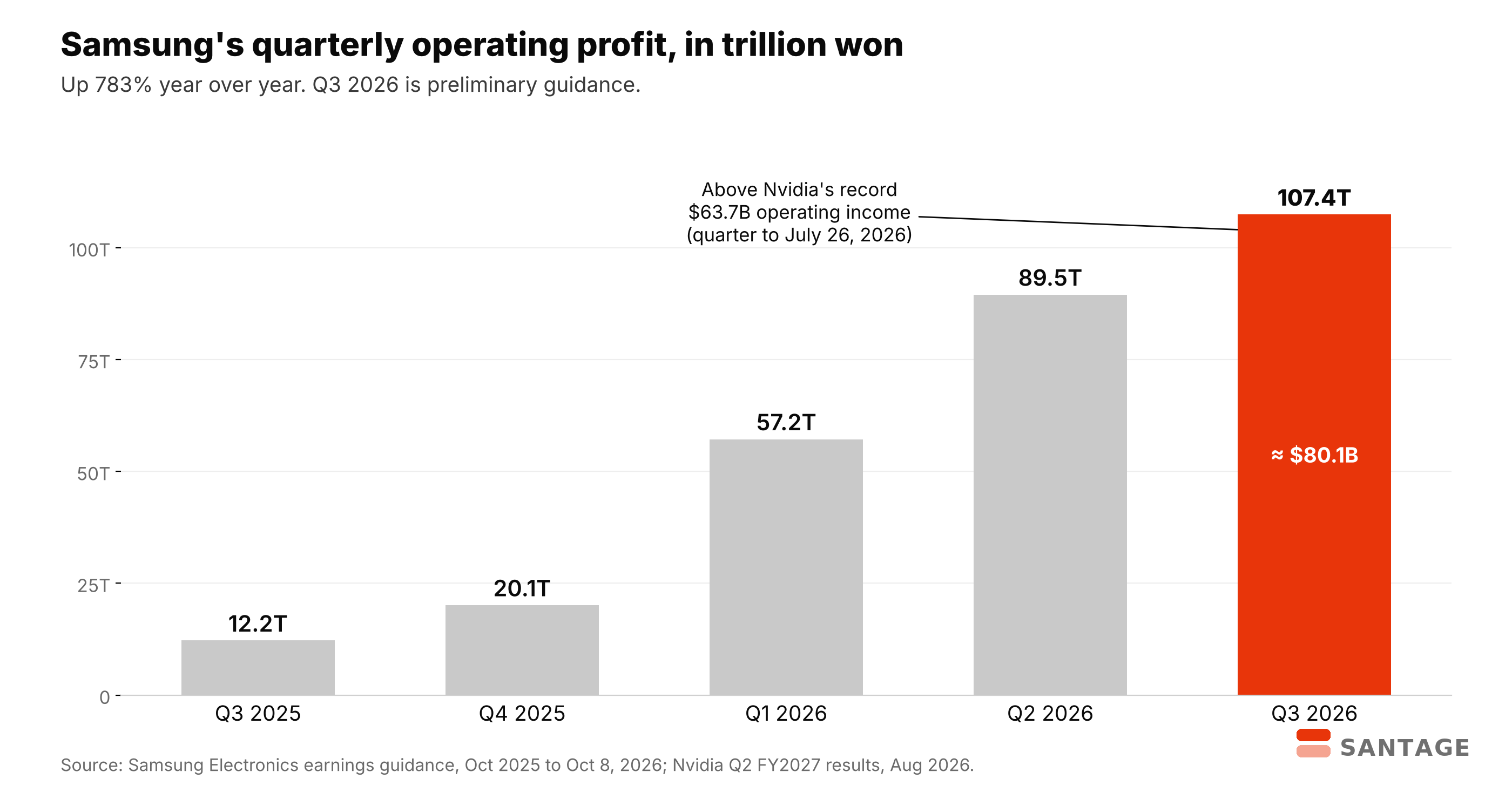
- Samsung guided Q3 2026 operating profit to 107.4 trillion won (about $80.1 billion), up about 783% from 12.17 trillion won a year earlier, on sales of 195 trillion won.
- That exceeds Nvidia's record quarterly operating income of $63.7 billion, reported for the three months to July 26, 2026.
- The same memory shortage is pushing costs onto devices: IDC counts a near 60% drop in sub-$100 smartphone shipments and forecasts a record 16.7% fall in 2026.
Samsung Electronics expects to report 107.4 trillion won in operating profit for July to September, about $80.1 billion, which is more than any quarter Nvidia has ever booked. The figure, released as preliminary guidance on October 8, shows where the money in the AI build-out is now collecting: with the memory makers that supply every accelerator, at a moment when memory is the component the industry can least easily buy more of.
Samsung guides to 107.4 trillion won, its fourth straight record quarter
Samsung's third-quarter guidance puts consolidated sales at about 195 trillion won, up 127% from 86.06 trillion won a year earlier and about 14% from the second quarter's 171.5 trillion won. Operating profit rose 20% on the quarter from 89.49 trillion won. It is the company's first quarter above 100 trillion won and its fourth record in a row. In the whole of 2025 Samsung earned about 44 trillion won in operating profit, so the third quarter alone came in at roughly two and a half times that annual total.
| Operating profit | About 107.4 trillion won (about $80.1 billion) |
| Year-over-year profit growth | About 783%, from 12.17 trillion won |
| Consolidated sales | About 195 trillion won, up 127% |
| Nvidia's record quarterly operating income | $63.7 billion (quarter to July 26, 2026) |
The Nvidia comparison deserves its date. Nvidia's fiscal second-quarter results showed $63.7 billion in operating income on $96.2 billion of revenue for the quarter ending July 26, and Nvidia guided its current quarter to about $108 billion in revenue, so the ranking may reverse when it reports in November. What matters is that a memory supplier earned more than the company whose chips it supplies, for at least one quarter.
Memory prices, more than volume, carried the quarter
Samsung's chip division is estimated to have earned roughly all of the company's profit, while its phone and consumer electronics arm is estimated to have lost about 2 trillion won, according to Korean industry estimates ahead of the full results later this month. Two forces drove the chip side. High-bandwidth memory, the stacked DRAM packed beside every AI accelerator, is moving into its HBM4 generation for Nvidia's Vera Rubin systems. Conventional memory, which data center operators now buy in bulk for inference servers, rose in price alongside it: DRAMeXchange data cited in Korean reporting put a DDR4 8Gb chip at about $26 at the end of September, against $6.30 a year earlier.
Three companies, Samsung, SK Hynix and Micron, make most of the world's DRAM, and none can add a fabrication line quickly. When AI demand absorbs their output, prices climb across every grade of memory, and the supplier collects the difference with almost no added cost. That is why Samsung's profit rose about 783% while its sales rose 127%.
The AI boom pays most to whoever owns the slowest-moving bottleneck, and in late 2026 that bottleneck is memory.
Samsung's phone business is paying part of its own memory bill
The less obvious consequence sits inside Samsung itself. Its mobile division buys the same DRAM and NAND that its chip division is now selling at four times last year's price, and analysts estimate that division lost money in the quarter. Across the industry, IDC says NAND and DRAM costs are up more than 300% from a year ago, and it expects memory prices to keep rising until at least 2028.
“The era of the cheap smartphone has ended.”
Francisco Jeronimo, VP, Worldwide Client Devices, IDC, August 26, 2026
IDC counts shipments of phones under $100 down almost 60% in the second quarter and forecasts a 16.7% fall in total smartphone shipments for 2026, the steepest on record, with average selling prices up 27.6% to $581. The same squeeze has reached AI hardware sold to individuals, as Santage reported in its coverage of the $6,950 Nvidia DGX Spark and rising memory prices.
AI labs and device makers now budget around memory contracts
For AI developers, memory has become a cost line negotiated in its own right. Every accelerator order carries an HBM allocation, and inference fleets that serve models such as Claude Haiku 5.5 at $0.10 per million tokens depend on large pools of conventional DRAM whose price has quadrupled. The steep cuts in model prices this autumn are being made while one of the main hardware inputs gets more expensive, which leaves the labs' margins exposed to the memory makers' pricing.
Investors had priced much of this in. Samsung shares slipped 0.7% on Thursday morning after a result close to the LSEG consensus of about 106 trillion won, and analysts now expect around 375 trillion won in operating profit for 2026 and about 550 trillion won for 2027. SK Hynix reports later this month and will show whether the gains extend to the other half of the HBM market.
Samsung's quarter shows that the largest single profit in the AI economy can come from a supplier of memory chips rather than from the companies designing accelerators or the labs building models, and that consumers buying an ordinary phone are now paying part of that bill.
Santage is committed to independent, transparent journalism. This article is produced in accordance with Santage's Editorial Standards and aims to provide accurate and timely information. Readers are encouraged to verify information independently.