

- Claude Sonnet 5.5 costs $2 / $10 per million input and output tokens, down from $3 / $15 for Sonnet 5 and half the $4 / $20 price of Opus 5.5.
- It scores 70.6% on Terminal-Bench 4.0, up from 10.3% for Sonnet 5, and 80.1% on the OSWorld 2.1 computer-use test against 81.8% for Opus 5.5.
- Anthropic says the model runs more than 30% faster and costs up to 30% less per task than Sonnet 5, and a new Haiku is due in the coming weeks.
Anthropic released Claude Sonnet 5.5 on September 28 at $2 per million input tokens and $10 per million output tokens, a third below Sonnet 5's standard rate and the exact price OpenAI set for GPT-6 Sol five days earlier, with benchmark scores that land within a few points of Anthropic's own flagship.
Sonnet 5.5 beats Opus 5.5 on terminal coding and trails it narrowly elsewhere
The new model is available through the Claude API as claude-sonnet-5-5 and on AWS, Google Cloud and Microsoft Azure, with a one-million-token context window. On the launch page, Anthropic reports that Sonnet 5.5 beats Opus 5.5 on Terminal-Bench 4.0, a test of AI agents completing coding work in a command line, and trails its larger sibling by 1.7 points on OSWorld 2.1 and 2.3 points on CursorBench 4.0. The widest gap is on FrontierCode 1.1, where Sonnet 5.5 scores 46.2% to Opus 5.5's 54.4%.
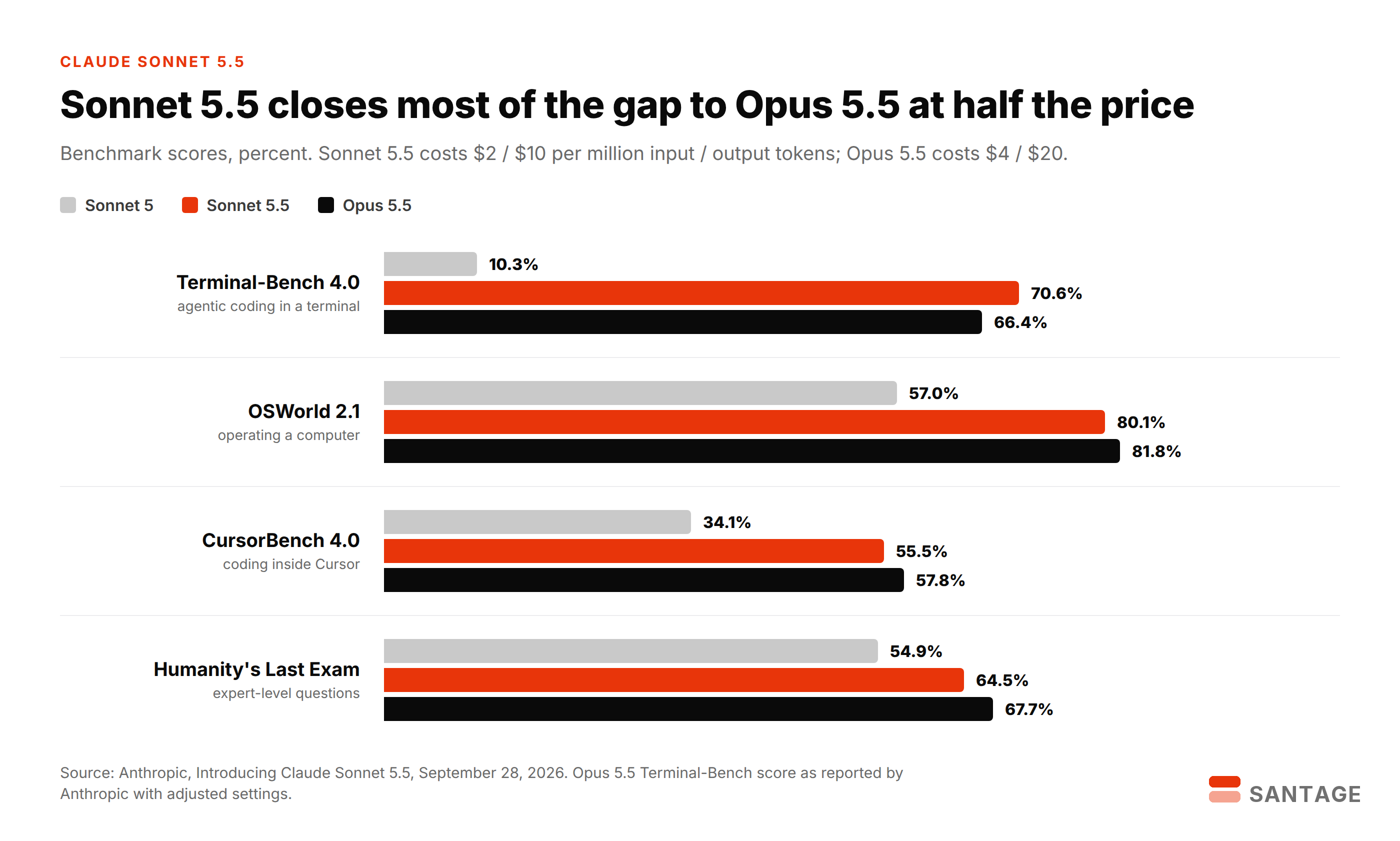
Most of the saving comes from how much work each answer takes. Anthropic says Sonnet 5.5 generates outputs more than 30% faster than Sonnet 5 and reaches answers with fewer tool calls and tokens, and one early customer's figures show the scale of that change.
“On our private suite of 2,441 finance tasks covering Q&A, extraction, analysis, and forecasting, Claude Sonnet 5.5 scored ahead of Sonnet 5 and used about 121k tokens per answer, where Sonnet 5 used 497k.”
Joe Poirier, Senior AI Engineer, Balyasny Asset Management, quoted in Introducing Claude Sonnet 5.5, Anthropic, September 28, 2026
| Claude Sonnet 5.5 | $2 input / $10 output |
| Claude Sonnet 5 (standard price since September 1) | $3 input / $15 output |
| Claude Opus 5.5 | $4 input / $20 output |
| OpenAI GPT-6 Sol (since September 23) | $2 input / $10 output |
| Sonnet 5.5 context window | 1 million tokens |
Anthropic priced its mid-tier model against OpenAI's
When Opus 5.5 launched on September 23, OpenAI responded within hours by halving GPT-6 Sol to $2 / $10. Sonnet 5.5 now meets Sol at that price. In Anthropic's comparison it leads Sol on knowledge-work and chart-reading tests, 1844 to 1487 on GDPval-AA and 61.6% to 53.6% on Chartography, and trails it on FrontierCode, 46.2% to 49.3%. Matching the list price shifts the comparison enterprise buyers make from list price to tokens spent per finished task. A model that answers in a quarter of the tokens, as Balyasny measured, costs roughly a quarter as much at the same rate.
Anthropic applied the same cybersecurity safeguards it uses on Opus 5.5, routing higher-risk security requests back to Sonnet 5, and added classifiers designed to stop other labs from extracting the model's reasoning for distillation.
Sonnet is the Claude model most developers run by default, as it has been since Sonnet 5 took that role in July. By pricing it at OpenAI's level with near-flagship results, Anthropic has made the everyday agent workload the place where the two labs now compete most directly, on the same day its draft IPO prospectus showed how much that compute costs to supply.
Santage is committed to independent, transparent journalism. This article is produced in accordance with Santage's Editorial Standards and aims to provide accurate and timely information. Readers are encouraged to verify information independently.