
- Nvidia and SK Group unveiled an initiative worth more than $500 billion that secures long-term SK Hynix high-bandwidth memory supply and co-develops next-generation memory.
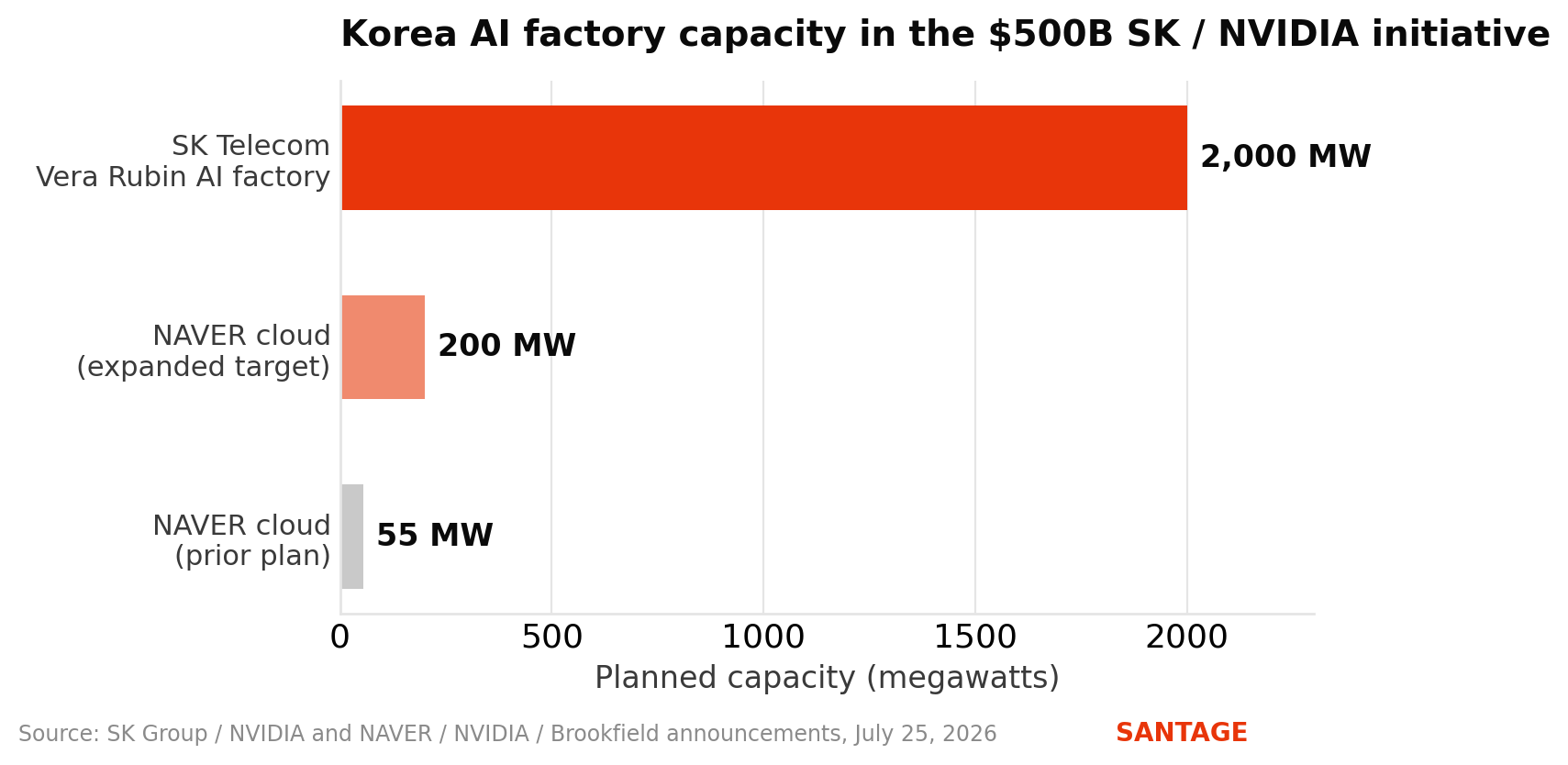
- SK Telecom will build a 2 gigawatt data center running Nvidia Vera Rubin systems and SK Hynix HBM4, with the first factory due online in 2027.
- Nvidia is investing $1 billion in Naver to more than triple a data center from 55 to 200 megawatts, with Brookfield weighing up to $9 billion in project funding.
Nvidia and SK Group commit over $500 billion to Korean AI factories
Nvidia and South Korea's SK Group announced an AI initiative worth more than $500 billion at an AI summit in San Francisco attended by South Korean President Lee Jae Myung. The two sides signed letters of intent covering everything from AI factory construction to memory supply, framed publicly as a national AI buildout for Korea.
| Total initiative | More than $500 billion |
| SK Telecom AI factory | 2 gigawatts on Vera Rubin and HBM4, live 2027 |
| Nvidia investment in Naver | $1 billion, expanding 55 MW to 200 MW |
| Brookfield funding weighed | Up to $9 billion for the Naver project |
The visible components are the data centers. SK Telecom will build a 2 gigawatt facility powered by Nvidia's Vera Rubin systems and SK Hynix HBM4 memory, coming online in phases from 2027. Nvidia is putting $1 billion into Naver, the Korean cloud operator, funding that lets Naver expand a planned facility from 55 megawatts to 200 megawatts, with Brookfield weighing a term sheet worth up to $9 billion.
HBM, not GPUs, is the scarcest input in the AI supply chain
Strip away the data center headline and the load-bearing clause sits in the memory agreement. A modern AI accelerator is useless without high-bandwidth memory stacked beside the logic die, and HBM is the component that has been rationed hardest through this cycle. SK Hynix is the dominant HBM supplier, and its capacity has been sold out well in advance for multiple generations. Nvidia stated the purpose of the memory pact plainly.
"This agreement allows NVIDIA to secure a stable supply of next-generation AI memory, while enabling SK hynix to expand the foundation for growth. The two companies will codevelop and optimize next-generation AI memory solutions, including HBM."SK Group and Nvidia, joint announcement, July 25, 2026
This is why the deal reads differently once you invert it. Nvidia is not buying data centers. It is buying certainty that the one input it cannot substitute will be there when its next chip generation ships. The Vera Rubin systems in the SK Telecom facility only become sellable products if the HBM4 to feed them exists first.
The vertical integration most coverage is filing under data centers
The Naver and SK Telecom commitments are the demand side that makes the memory side rational. Guaranteed offtake at gigawatt scale gives SK Hynix the confidence to pour capital into HBM capacity, and that capacity is precisely what Nvidia needs secured.
The money flowing into Korean data centers is, in effect, Nvidia underwriting its own supply chain by manufacturing the demand that justifies the memory investment. That structure locks a competitive advantage in place. AMD, custom silicon programs at the large clouds, and every startup designing an accelerator all draw from the same narrow pool of HBM suppliers. When the leading buyer signs long-term supply and joint development with the leading memory maker, rivals do not just face a faster chip. They face a tighter market for the component their chips cannot run without.
What a locked memory supply means for everyone else building frontier compute
For competitors, the deal raises the cost of parity. Securing enough HBM was already the hardest part of standing up frontier training clusters, and a multi-year Nvidia commitment tightens that further. For Korea, it converts SK Hynix's memory lead into national infrastructure and pulls a sovereign compute base onshore, an ambition its chairman named directly.
"By leveraging SK hynix's AI memory and SK Telecom's AI infrastructure capabilities, SK will collaborate with NVIDIA to build a world-class AI factory, helping Korea transcend its role as a leading adopter of AI and become a global hub that drives AI innovation."Chey Tae-won, Chairman, SK Group, July 25, 2026
The GPU shortage was always partly a memory shortage wearing a more famous name. Nvidia just spent $500 billion making sure that when the next shortage comes, it will not be the one left waiting.
Santage is committed to independent, transparent journalism. This article is produced in accordance with Santage's Editorial Standards and aims to provide accurate and timely information. Readers are encouraged to verify information independently.