
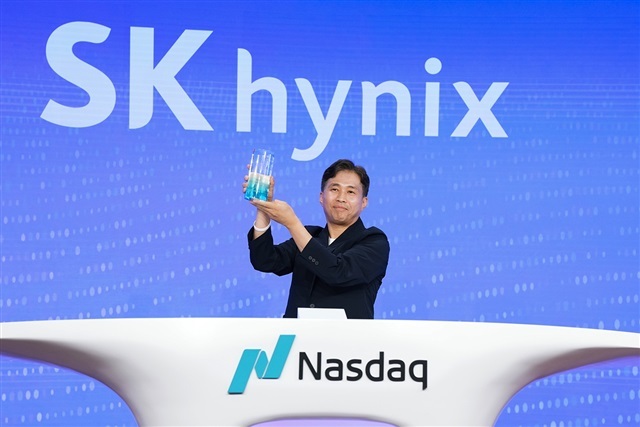
- SK Hynix raised about $26.5 billion in its Nasdaq debut on July 10, the largest US listing ever by a foreign company, surpassing Alibaba's $25 billion in 2014 and trailing only SpaceX's $86 billion offering among all US share sales.
- On the same day, CEO Kwak Noh-jung warned that the memory industry faces its worst-ever supply shortage in 2027, with demand set to outstrip capacity beyond 2030.
- SK Hynix booked record operating profit of 47 trillion won, about $31 billion, in 2025, double the prior year, driven by the high-bandwidth memory that sits next to Nvidia's AI accelerators.
The AI boom just repriced its least glamorous input
The largest foreign IPO in US history is not an AI model or a chip designer. It is a memory maker. SK Hynix priced 177.9 million American depositary shares at $149 each and raised roughly $26.5 billion on July 10, a book that ran more than seven times oversubscribed. The listing surpasses Alibaba's $25 billion debut from 2014 as the biggest ever by a foreign company on a US exchange, and ranks as the second-largest US share sale of any kind, behind only last month's SpaceX offering.
That ranking is the signal. Capital is now willing to pay frontier-scale prices for the plumbing of AI, not just its brains. High-bandwidth memory, the stacked DRAM that feeds Nvidia's accelerators, has moved from a commodity line item to a strategic chokepoint, and the market just said so with $26.5 billion.
| Metric | Figure |
|---|---|
| Amount raised | Approximately $26.5 billion, at $149 per ADS on 177.9 million shares |
| Record set | Largest US IPO ever by a foreign company, passing Alibaba's $25 billion (2014) |
| All-in ranking | Second-largest US share sale in history, behind SpaceX's $86 billion |
| Demand | Order book more than 7 times oversubscribed |
| 2025 operating profit | 47 trillion won, about $31 billion, double 2024 and up from an operating loss in 2023 |
| Use of proceeds | New fabrication and packaging facilities in Korea, plus EUV scanner procurement |
The CEO used his own IPO to warn of scarcity
Most executives spend their listing day selling growth. Kwak Noh-jung spent his warning about a ceiling. He told the market that the memory industry is heading into its worst-ever supply shortage in 2027, and that customer demand will keep running ahead of what SK Hynix can produce even beyond 2030.
Our customer demand continues to go up, while our capacity has limitations.Kwak Noh-jung, CEO of SK Hynix, July 10, 2026
It is an unusual thing to raise $26.5 billion and simultaneously tell investors you cannot make enough of your product. But it is also the most honest description of the AI supply chain available right now. Building a new memory fab takes years and tens of billions of dollars. Demand from data center operators is compounding on the timescale of quarters. Customers are already reserving supply years ahead, and Samsung has echoed the same warning. The gap between those two clocks is the shortage, and no amount of IPO capital closes it quickly.
Why memory, and why now
For most of the AI story, the scarce resource everyone named was the GPU. That framing is incomplete. A modern accelerator is only as useful as the memory bandwidth feeding it, and high-bandwidth memory has become the harder part of the equation to scale. It requires advanced packaging, precise stacking, and EUV capacity that only a handful of companies command. SK Hynix took an early lead supplying HBM for Nvidia's chips, and that lead is what turned a cyclical commodity business into a $31 billion profit engine and a record listing.
The market spent two years betting on the companies that design AI chips. SK Hynix just proved the bigger constraint is the company that remembers what those chips compute.Santage analysis
The proceeds tell you where the bottleneck is. SK Hynix earmarked the money for new fabrication and packaging plants and for EUV scanners, the exact links in the chain that limit HBM output. It is also facing pressure to build fabs on US soil, a reminder that memory has become a matter of industrial policy as much as corporate strategy. Where the chip is physically made now carries the same weight that model access and export controls carried a year ago.
What it means for everyone downstream
For the frontier labs and the neo-clouds building out capacity, the SK Hynix debut is a two-sided message. The bullish read is that the money to expand memory supply is now flowing at record scale, and more capacity is coming. The sobering read is that the company best positioned to supply it just told the world the shortage runs through 2027 and beyond. That translates into higher memory costs baked into every training run and every inference cluster, and into a hard physical limit on how fast compute can actually scale, regardless of how much capital chases it.
The lesson for anyone tracking where AI value accrues is that it does not all pool at the model layer. A memory maker just pulled off the biggest foreign listing in US history by owning a component most of the industry treated as a commodity. When the input is scarce and the demand is inelastic, pricing power moves to whoever controls the input. For the next several years, on the evidence of its own CEO, that is SK Hynix. The AI race is still run on intelligence. It is increasingly bounded by memory.
Santage is committed to independent, transparent journalism. This article is produced in accordance with Santage's Editorial Standards and aims to provide accurate and timely information. Readers are encouraged to verify information independently.