

- The Third Circuit affirmed the District of Delaware in Thomson Reuters v. Ross Intelligence, docket No. 25-2153, six years after the complaint was filed.
- Judge Bibas had found 2,243 Westlaw headnotes infringed in February 2025 and rejected fair use on summary judgment, holding that Ross built a market substitute rather than something transformative.
- The panel's opinion, authored by Judge Montgomery-Reeves, was entered under seal for ten days pending redaction, so the precedent exists without its reasoning being readable.
A federal appeals court has held for the first time that copying copyrighted material to train an artificial intelligence system is not fair use, affirming on September 29 that Ross Intelligence infringed when it used 2,243 Westlaw headnotes to build a rival legal research tool. The reasoning that produced that holding is sealed for ten days, and until it is public, nobody litigating the dozens of pending generative AI copyright cases knows how much of it applies to them.
The panel affirmed without publishing its reasoning
Thomson Reuters sued Ross in Delaware in May 2020, alleging that Ross had used Westlaw headnotes, the short editorial summaries of legal propositions that anchor West's Key Number System, to train a competing legal search product after being denied a licence. Judge Stephanos Bibas, sitting by designation, initially let fair use go to a jury, then reversed himself on renewed briefing and granted Thomson Reuters summary judgment on both direct infringement and the fair use defence in February 2025. Two months later he certified the question for interlocutory appeal.
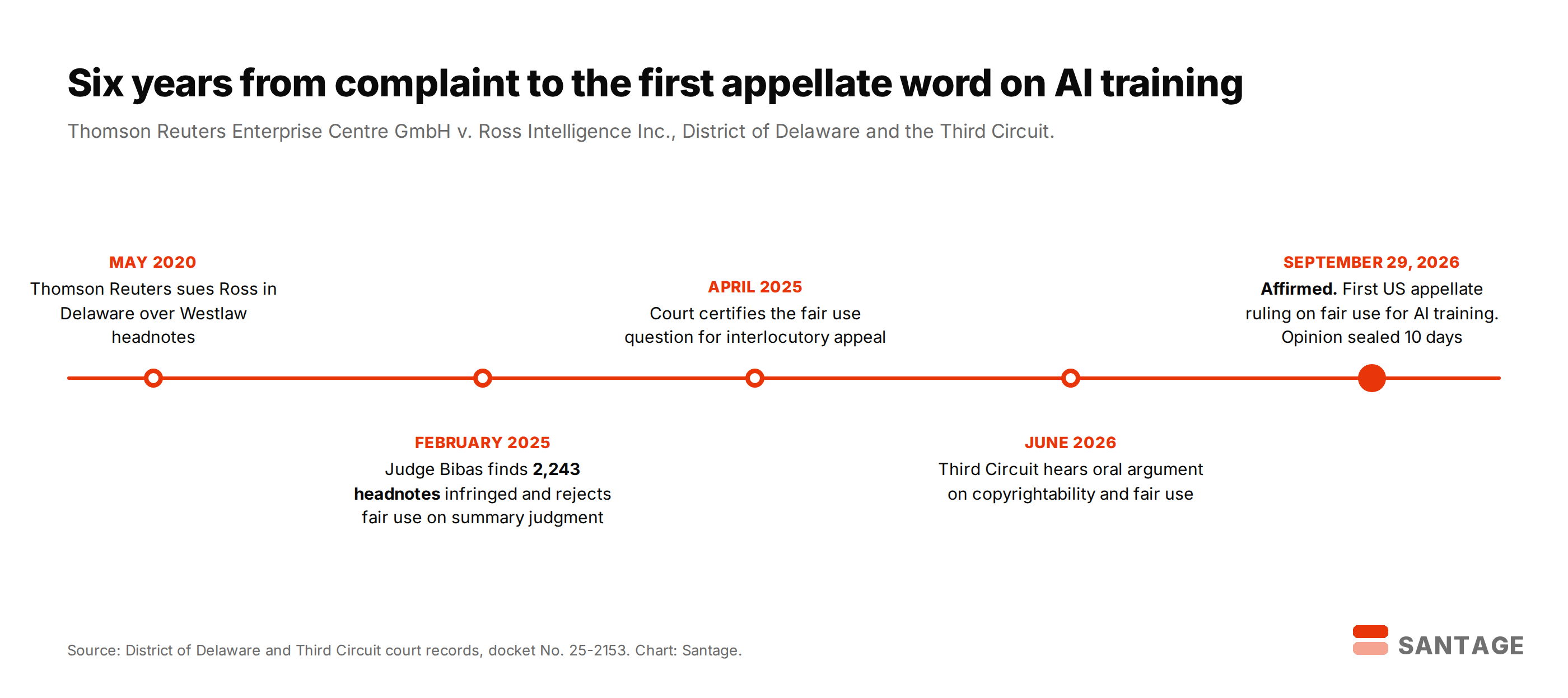
What the Third Circuit filed on September 29, according to the case docket, was a one-page judgment reading “AFFIRMED,” with the opinion entered under seal for ten days so the parties can propose redactions. The record below contained sealed headnotes, and the appeal inherited that problem. Courts rarely seal the reasoning of a precedential opinion, and doing so here means the holding is on the books while the analysis that generates its precedential weight sits unavailable.
| Headnotes found infringed | 2,243 |
| Complaint to appellate judgment | Six years, May 2020 to September 2026 |
| Docket | No. 25-2153, Third Circuit |
| Opinion author | Judge Tamika Montgomery-Reeves |
| Seal on the opinion | Ten days, pending proposed redactions |
Ross lost on market substitution, the ground generative AI defendants will try to distinguish
The district court's rationale was narrow and specific. Ross had wanted a Westlaw licence, been refused, and obtained the material anyway through an intermediary, then used it to build a product that competed directly with Westlaw in the same market.
“Ross took the headnotes to make it easier to develop a competing legal search tool. So Ross's use is not transformative.”
Judge Stephanos Bibas, Thomson Reuters Enterprise Centre GmbH v. Ross Intelligence Inc., District of Delaware, February 2025
Every structural feature of that fact pattern cuts against the defendant, and each one is a feature that lawyers for OpenAI, Anthropic, Meta and Stability will argue their own cases lack. Ross built a search tool that retrieved legal propositions, which is the function Westlaw sells, so the substitution was immediate and measurable. A foundation model trained on millions of books does not return those books, and its outputs compete with the source material only at several removes. Ross also used a non-generative system, which makes the copying look more like wholesale ingestion of a rival's product and less like statistical learning across a corpus.
| Factor | Ross Intelligence | Typical generative AI defendant |
|---|---|---|
| Source of material | A direct competitor's product, after a licence was refused | Broad web corpora, licensed sets and scraped text |
| Output | Retrieved legal propositions, the function Westlaw sells | Generated text, images or code |
| Market harm | Direct substitution in the same product market | Contested, often argued as indirect or speculative |
| System type | Non-generative retrieval and ranking | Generative foundation models |
Comparison: Santage analysis of the district court record and pending generative AI copyright litigation.
The sealed portion is what decides the other cases
Three questions in this appeal reach well past legal publishing, and the answers are all inside the redacted text. The first is whether Westlaw headnotes are copyrightable in the first place, a question about thin copyright in factual and law-adjacent material that would govern anything built on databases, indexes and metadata. The second is how the panel defined the relevant market under the fourth fair use factor, and in particular whether a licensing market that a plaintiff has not yet built counts as one the defendant harmed. That single question shapes the economics of every training-data dispute now pending. The third is whether the intermediate copying doctrine, which has protected reverse engineering of software since the 1990s, extends to ingesting text for training.
A precedent that everyone must follow and nobody can read is worth less to the industry than a clear loss would have been.
What actually changes for the pending generative AI suits
The practical effect is narrower than the headline implies and larger than the defendants would like. Ross is now binding authority in the Third Circuit for the proposition that training on copyrighted material can fail fair use, which gives plaintiffs a citation where they previously had only district court rulings pointing in several directions at once. Courts in other circuits are free to distinguish it, and the narrow facts hand them an easy way to do so.
The more immediate effect runs through settlement pricing. AI companies have been negotiating licensing deals and settlements against a background where no appellate court had spoken, which let both sides hold their valuations. A defendant weighing whether to settle now has an appellate loss to reckon with, even a distinguishable one, and plaintiffs' counsel will price accordingly. The Justice Department's support for OpenAI's fair use position earlier this month sits awkwardly beside it.
Ross itself shut down in 2021, two years into the litigation and long before it won or lost anything. The company that established the first appellate precedent on AI training no longer exists, and the ruling that bears its name will be read for years by companies with valuations it never approached. Whether that reading favours them depends entirely on ten days of redaction negotiation over an opinion none of them has seen.
Santage is committed to independent, transparent journalism. This article is produced in accordance with Santage's Editorial Standards and aims to provide accurate and timely information. Readers are encouraged to verify information independently.