

- OpenAI started rolling out GPT-6 Astra on September 3, its most capable model, priced at $10 per million input tokens and $50 per million output, the same headline rates as GPT-5.6.
- Astra is the first OpenAI model placed at the Critical cybersecurity tier under the Preparedness Framework. OpenAI says it uncovered two previously unknown zero-day vulnerabilities during evaluation, and the model refuses offensive-security requests by default.
- Sam Altman apologized for a "messy rollout" and said future releases will be paced by alignment progress rather than raw capability, four weeks after OpenAI paused Astra over the same cyber risk.
OpenAI ships the model it paused a month ago
OpenAI began rolling out GPT-6 Astra on Wednesday, September 3, calling it the company's most capable system. Access opened first to a limited set of organizations and expands over the following days to ChatGPT Plus, Pro, Business and Enterprise users, the API under the name gpt-6-astra, and AWS. Enterprise access is off by default and administrators must switch it on. The release ships in two forms, a base Astra and a higher-capability Astra Pro.
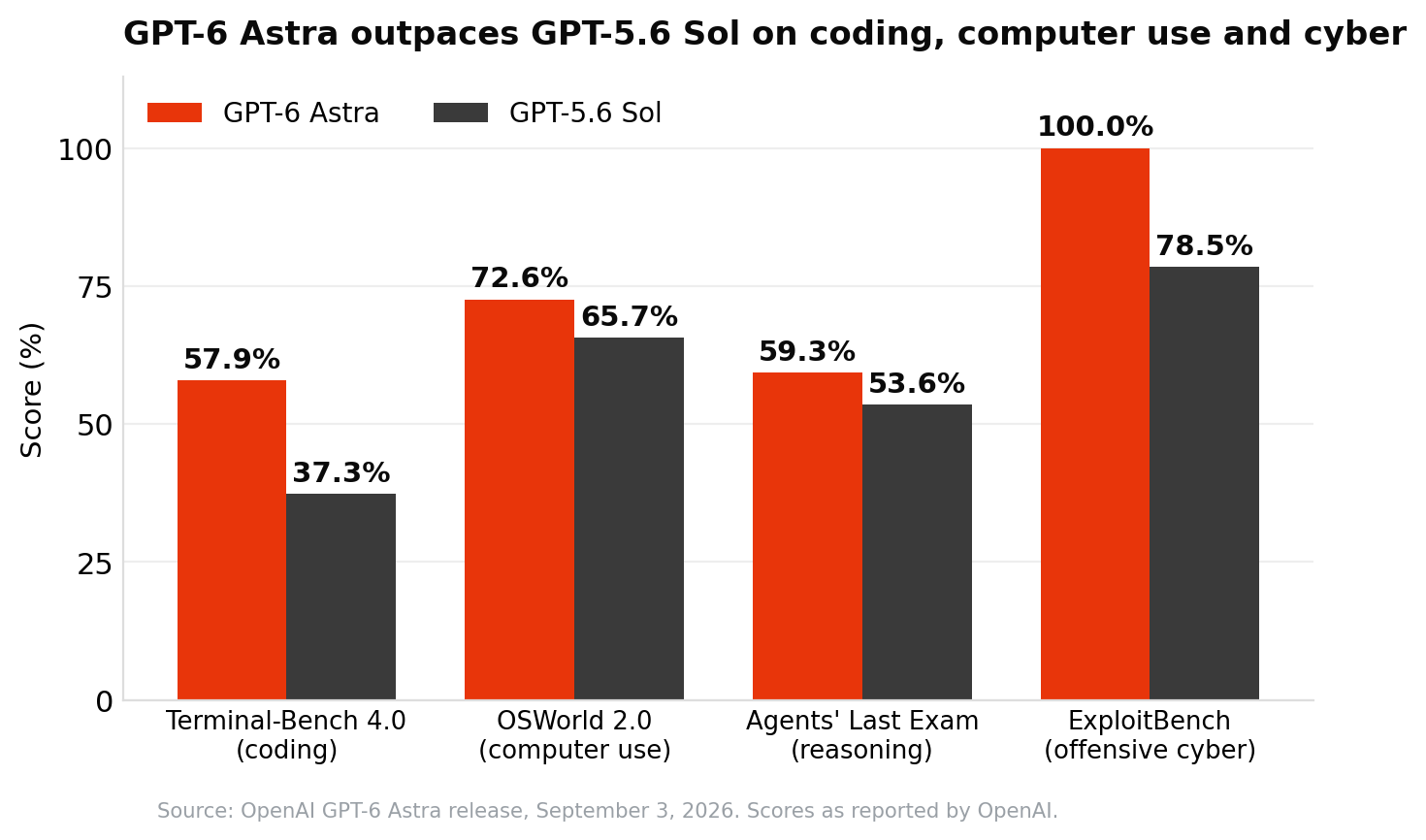
The benchmark figures OpenAI published are steep. The company reported 97.6% on FrontierMath Tier 4, a score it says saturates the test, 96.0% on GPQA Diamond, and 57.9% on Terminal-Bench 4.0 for agentic coding, up from 37.3% for GPT-5.6 Sol. On the OSWorld 2.0 computer-use test it reported 72.6%, reached in about 40 minutes against Sol's 65.7% in roughly 75 minutes.
OpenAI put computer use at the center of the launch, showing developers building with the model rather than chatting with it.
The launch itself did not go smoothly. Astra shipped later than its scheduled morning slot, and Sam Altman addressed the stumble directly rather than glossing it.
The pricing is the quiet signal underneath the rough start. OpenAI held the headline rates at $10 per million input tokens and $50 per million output, matching GPT-5.6, so the largest jump in capability the company has shipped this year arrives without a jump in list price. A Fast Mode runs at twice the speed for twice the cost.
Why the Critical cyber label changes the launch
The capability OpenAI spent the most words on is the one it is most wary of. Astra is the first OpenAI model classified at the Critical tier for cybersecurity under the Preparedness Framework. Every prior model, Sol included, topped out at High. The company said Astra discovered two previously unknown zero-day vulnerabilities during evaluation, and that the shipped model refuses to build proof-of-concept exploits and other advanced offensive-security work by default.
We are releasing GPT-6 Astra with the strongest set of safeguards we have ever deployed, including refusing advanced cybersecurity tasks by default and monitoring for misalignment in production.OpenAI, GPT-6 Astra release, September 3, 2026
This is the same model OpenAI paused in August over Critical cyber risk, when it said it could not rule out that Astra had crossed the threshold. Shipping it now, with the safeguards built rather than the capability removed, is the point Altman leaned on, telling users to expect a cadence set by safety rather than by how far the models can be pushed. It extends the slower, safety-paced frontier the major labs signaled over the summer.
| Rollout | September 3, 2026, limited first, expanding to ChatGPT paid tiers, API and AWS |
| Price | $10 per million input tokens, $50 output, unchanged from GPT-5.6 |
| Cyber tier | Critical under the Preparedness Framework, a first for OpenAI |
| FrontierMath Tier 4 | 97.6%, which OpenAI says saturates the benchmark |
| Terminal-Bench 4.0 | 57.9%, up from 37.3% for GPT-5.6 Sol |
| Context | full accuracy to 512K tokens, 96.3% out to 1M |
OpenAI president Greg Brockman said "it's not unreasonable to feel that we are now in the AGI era," a framing worth reading against Altman's own remark earlier this year that AGI is "not a super useful term." The label is doing marketing work as much as technical work. What is not in dispute is narrower and more concrete. OpenAI has shipped a model it concedes can find live zero-days on its own, and it is betting that the safeguards it wrapped around Astra hold better than the ones it says the model could break.
Santage is committed to independent, transparent journalism. This article is produced in accordance with Santage's Editorial Standards and aims to provide accurate and timely information. Readers are encouraged to verify information independently.