

- Specific Labs' new Real-SWE benchmark scores frontier models on private, licensed enterprise codebases rather than the public GitHub repositories most coding tests use.
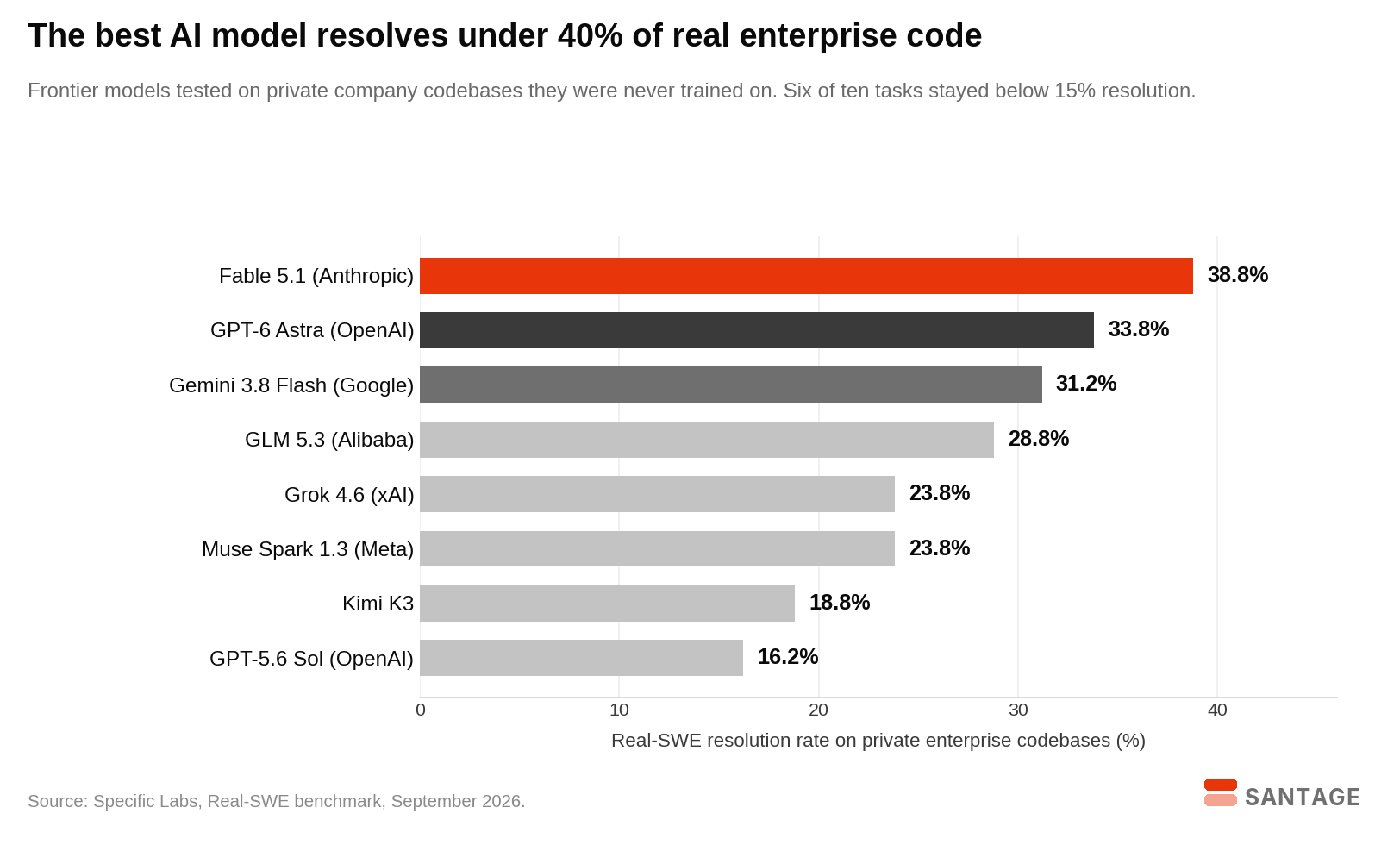
- Anthropic's Fable 5.1 led at 38.8% resolution, ahead of OpenAI's GPT-6 Astra at 33.8% and Google's Gemini 3.8 Flash at 31.2%, with six of ten tasks resolved below 15%.
- Cost did not track skill: Gemini 3.8 Flash reached 31.2% at $2.50 per rollout while pricier models scored lower, showing spend is not the constraint.
Real-SWE tests models on code they were never trained on
Specific Labs released Real-SWE, a benchmark built to answer a question public leaderboards cannot: how well do frontier models handle software work at real companies. Instead of drawing tasks from open-source projects that models have almost certainly seen during training, Real-SWE licenses private codebases from actual businesses and asks models to complete genuine engineering tasks in them, including billing logic, tax handling, and customer migrations across services.
The tasks are harder than the public equivalents by design. Changes span an average of 11 files against 6 in comparable benchmarks, and the instructions are deliberately underspecified, forcing an agent to discover how a proprietary system works before it can safely change it. Across 640 scored rollouts on eight model-harness configurations, the top score belonged to Anthropic's Fable 5.1 at 38.8%, according to Specific Labs. OpenAI's GPT-6 Astra followed at 33.8% and Google's Gemini 3.8 Flash at 31.2%.
Why 38.8% is the number that matters
On public benchmarks such as SWE-bench, the leading models now resolve well over two-thirds of tasks, and that figure has anchored a year of claims that AI can do much of a software engineer's job. Real-SWE cuts that number roughly in half by removing the one advantage those tests quietly give: familiarity. When the code is private and the model has never seen it, the best system in the world resolves fewer than four tasks in ten, and the median rollout that fails does so by missing requirements it was never explicitly given.
99% of tokens in real-world enterprises are hidden away from the frontier models.Specific Labs, on why private-codebase evaluation matters, September 2026
The cost data sharpens the point. Gemini 3.8 Flash matched far more expensive systems at $2.50 per rollout, and 71.4% of rollouts that ran under ten minutes failed, which says the gap is about reasoning through unfamiliar systems, not about spending more compute. The lesson for enterprises weighing a coding-agent rollout is not that these tools are weak. It is that a benchmark score earned on public code is a poor guide to how a model will perform inside a proprietary system it has never encountered. The frontier of coding ability is now measured less by what a model knows than by how well it can learn a codebase it was never trained on, and by that measure the leaders still have most of the work ahead of them.
Santage is committed to independent, transparent journalism. This article is produced in accordance with Santage's Editorial Standards and aims to provide accurate and timely information. Readers are encouraged to verify information independently.