
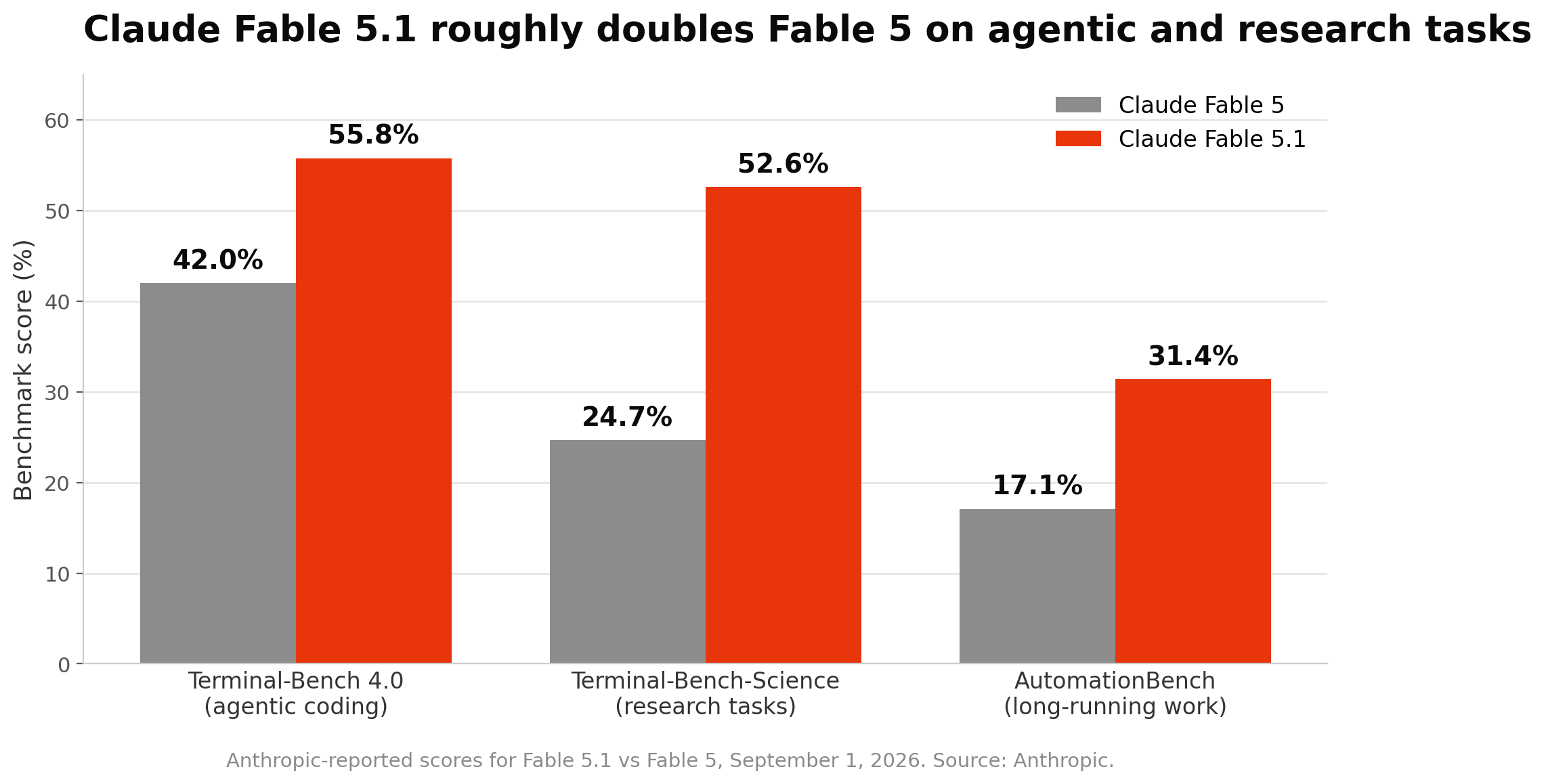
- Anthropic released Claude Fable 5.1 on September 1, raising its Terminal-Bench 4.0 agentic coding score to 55.8% from Fable 5's 42.0% and its Terminal-Bench-Science score to 52.6% from 24.7%.
- Cache read prices fall 75% to $0.25 per million tokens, making Fable 5.1 roughly 25% cheaper than Fable 5 for standard work and up to 45% cheaper for agent workloads, with base rates held at $10 input and $50 output per million tokens.
- Fable 5.1 and Mythos 5.1 are the same underlying model with different safeguards, and Mythos 5.1 is available only through trusted access programs for cybersecurity and the life sciences.
Fable 5.1 posts large benchmark gains while lowering the price
Anthropic released Claude Fable 5.1 on Tuesday, September 1, alongside a restricted version called Mythos 5.1. The company reported that Fable 5.1 scored 55.8% on Terminal-Bench 4.0, a test of agentic coding, up from the 42.0% Fable 5 recorded, and 52.6% on Terminal-Bench-Science, more than double Fable 5's 24.7%. On AutomationBench, a measure of long-running work, the score rose to 31.4% from 17.1%.
The pricing moved in the opposite direction. Base rates stayed at $10 per million input tokens and $50 per million output tokens, but the cost of a cache read, where the model reuses input it has already processed, dropped to $0.25 per million tokens from $1.00. That single change makes Fable 5.1 about 25% cheaper than Fable 5 for standard workloads and as much as 45% cheaper for agent tasks that reread large context repeatedly, extending the price pressure Anthropic began with its half-price Opus 5 release in July.
Anthropic framed the release around sustained, real-world tasks rather than single prompts.
Claude Fable 5.1 sets a new standard on coding, knowledge work, and long-running problem-solving tasks.Anthropic, Claude Fable 5.1 announcement
Why "same model, different safeguards" is the real story
The more consequential design choice sits in how Anthropic split the release. The company said Fable 5.1 and Mythos 5.1 are the same model carrying different levels of safeguards, with Mythos offered only through trusted access programs and tuned to support work in cybersecurity and the life sciences. That structure lets Anthropic ship a broadly available model with production guardrails while routing higher-capability, higher-risk use through a vetted channel, the same two-track logic behind the "Mythos-class" hardening described in its recent alignment and security overhaul.
| Terminal-Bench 4.0 | 55.8%, up from 42.0% for Fable 5 |
| Terminal-Bench-Science | 52.6%, up from 24.7% |
| AutomationBench | 31.4%, up from 17.1% |
| Cache reads | $0.25 per million tokens, a 75% cut, now 2.5% of the input price |
| Cyber safeguards | around 60% fewer interventions per Claude Code session than Fable 5 |
| Mythos 5.1 | same model, restricted to trusted access for cybersecurity and life sciences |
Anthropic also said the new safeguards produce roughly 60% fewer interruptions per Claude Code session, and pointed to a concrete result, crediting Fable 5.1 with finding the cause of a software crash at the trading firm Millennium that had defeated its engineers and other models for years. The combination is the point. A model that scores higher, costs less to run at scale, and interrupts developers less often is one built for the agent workloads Anthropic expects to sell, and the split with Mythos is how the company plans to keep the most capable version out of the wrong hands while still shipping it.
Santage is committed to independent, transparent journalism. This article is produced in accordance with Santage's Editorial Standards and aims to provide accurate and timely information. Readers are encouraged to verify information independently.