

- Insilico Medicine reported that Rentosertib cut patients' biological age by about 2.7 to 3.5 years at week four across six independently built aging clocks, with the company noting some clocks showed reductions as large as six years.
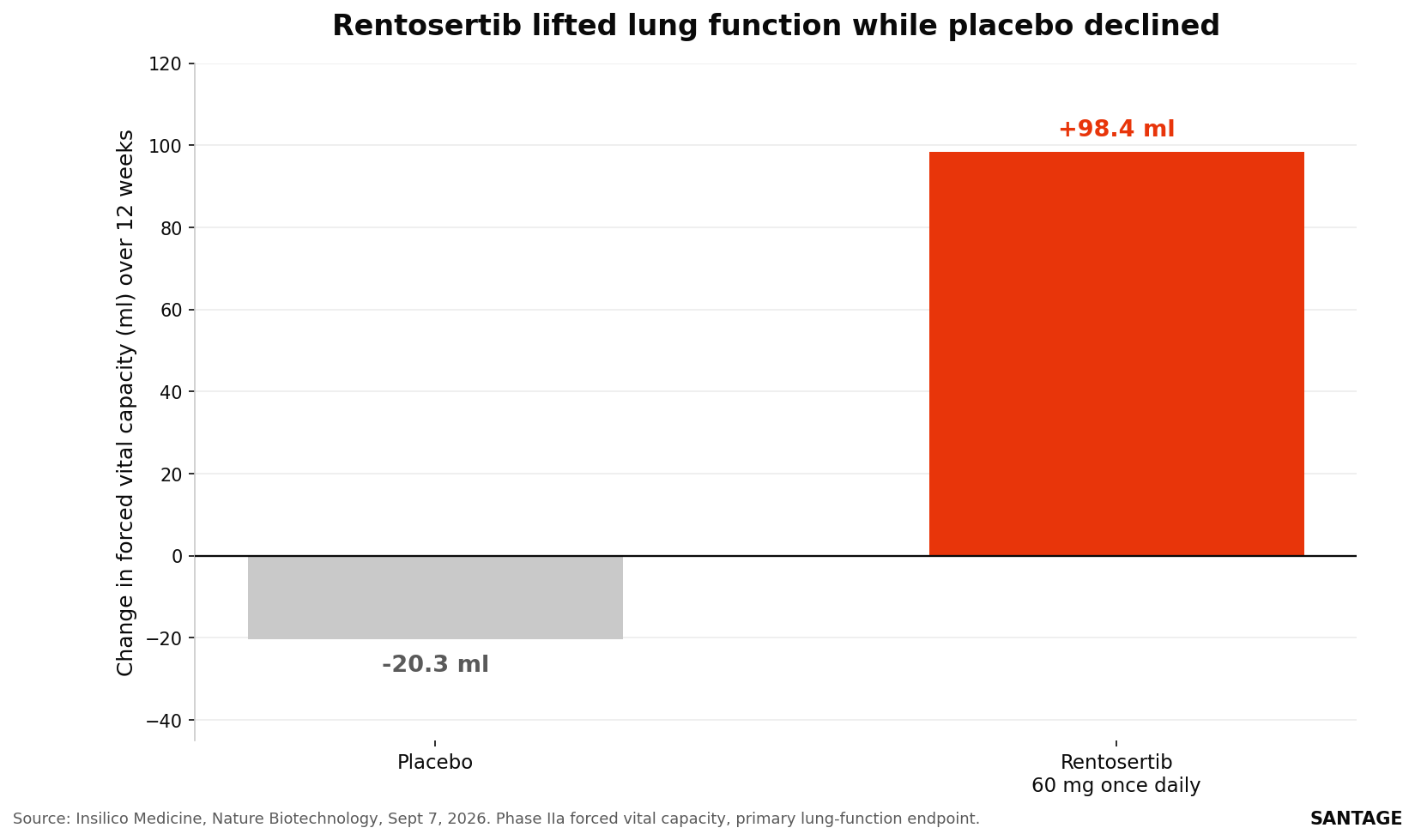
- The drug treats idiopathic pulmonary fibrosis, a fatal scarring lung disease, and lifted forced vital capacity by 98.4 ml in the 60 mg arm while placebo patients declined by 20.3 ml.
- Rentosertib is the first drug with an AI-discovered target and an AI-designed molecule, it has entered Phase III, and a Nobel laureate has publicly vouched for the strength of the aging signal.
From an AI pipeline to a Phase III candidate
Rentosertib, known in earlier trials as INS018_055, is the clearest test case the AI drug-discovery industry has. Insilico Medicine used its PandaOmics platform to identify the biological target, an enzyme called TNIK, and its Chemistry42 platform to generate the molecule that hits it. Both ends of the discovery came out of AI systems rather than a conventional medicinal-chemistry program, which is what lets Insilico call it the first drug candidate with an AI-discovered target and an AI-designed molecule, and it is now the furthest along in the clinic.
The founder framed the milestone in the context of the platform's wider output when the company reported its half-year results.
Why the aging signal is the surprising part
The most striking result came from the blood rather than the lungs. Insilico profiled 2,841 proteins in trial participants using the Olink panel and ran the results through six separate proteomic aging clocks, algorithms that estimate a person's biological age from molecular markers rather than their birth date, benchmarked against more than 55,000 UK Biobank profiles. Every one of the six clocks showed the treated patients aging backward relative to placebo, with the 30 mg twice-daily group registering reductions of roughly 2.7 to 3.5 years by week four, and Insilico noting some clocks moved as much as six years.
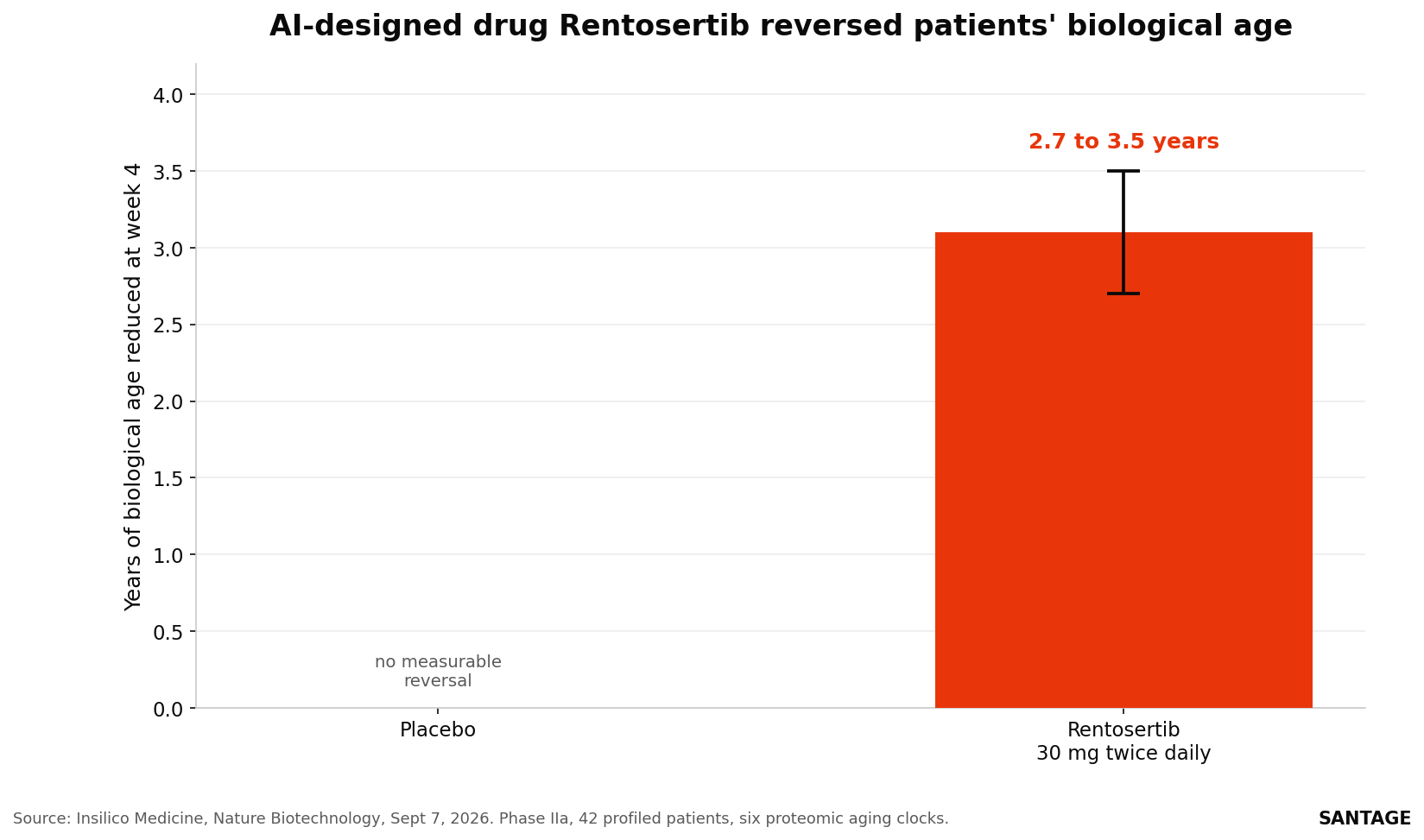
The consistency across six independent clocks is what gives the finding weight, and it convinced at least one prominent outside scientist. A single aging measure moving could be noise, yet six methods built on different assumptions pointing the same direction on the same patients is a harder result to dismiss.
What convinces me is not the size of the effect but the agreement, because these models share neither their features nor their training data.Michael Levitt, 2013 Nobel laureate in Chemistry, on the Rentosertib proteomic result
What the trial actually measured
The evidence sits on a genuine but early-stage foundation, and the specifics keep it honest. The proteomic analysis covered 42 of the 71 Phase IIa patients who consented to the deeper profiling, with a mean age of 67, across 21 sites in China, with blood drawn at baseline and weeks two, four and twelve. The aging readout was a secondary, exploratory endpoint rather than the outcome the trial was designed and powered to prove.
| Drug | Rentosertib (INS018_055), a TNIK inhibitor |
| Discovery | Target via PandaOmics, molecule via Chemistry42 |
| Indication | Idiopathic pulmonary fibrosis |
| Phase IIa design | Randomized, double-blind, placebo-controlled, 21 China sites |
| Patients profiled | 42 of 71, mean age 67, over 12 weeks |
| Dose arms | 30 mg twice daily and 60 mg once daily |
| Aging readout | 2,841 proteins, six proteomic aging clocks |
| Biological age result | 2.7 to 3.5 years reduction at week 4 (30 mg twice daily) |
| Lung function | +98.4 ml FVC on 60 mg once daily, versus -20.3 ml on placebo |
The lung data is the endpoint the trial was built to test, and it moved in the right direction. Patients on the 60 mg once-daily dose gained 98.4 ml of forced vital capacity over twelve weeks, while placebo patients lost 20.3 ml, a swing that matters in a disease defined by relentless loss of breathing capacity.
The caveats Insilico is not hiding
Longevity claims attract more hype than almost any category in biology, and the authors are candid about the limits. They acknowledge they cannot cleanly separate slower biological aging from improved lung function in an inflammatory disease, so the aging signal may partly reflect a sicker organ getting healthier rather than a body-wide reset. Seven patients discontinued because of liver toxicity, four of them also taking the existing IPF drug nintedanib, and the dose that produced the strongest aging signal was not the one with the best lung result. Insilico deposited the proteomic data and released its analysis pipelines as open source, which is the behavior of a company inviting scrutiny rather than dodging it.
The promise of AI in drug discovery was never faster slide decks. It was molecules that work in people. Rentosertib is the first to put a number on that promise and walk it into a Phase III trial.
Where this sits in the AI-for-biology race
The result lands in a field that has been accelerating all year. AI systems have moved from designing protein binders that hold up in the wet lab to generating phages that kill drug-resistant bacteria, and investors have poured capital into the category, including the $400 million raised by AI drug-design startup Chai Discovery. Most of those advances live in the lab or in silico. Rentosertib is notable because it has crossed into human data.
| First of its kind | the first drug candidate with both an AI-discovered target and an AI-designed molecule |
| 2.7 to 3.5 years | biological age reduction at week four, 30 mg twice-daily arm, with some clocks up to six years |
| Six for six | all six proteomic aging clocks showed reversal versus placebo |
| +98.4 ml | lung-function gain on 60 mg once daily, against a 20.3 ml decline on placebo |
| Phase III | the stage the drug entered in July 2026 for idiopathic pulmonary fibrosis |
| Published | Nature Biotechnology, September 7, 2026, with results due at a Sorbonne University conference on September 8 |
For the AI industry, the strategic read is that value in AI-designed medicine will be proven in clinics, not benchmarks. A model that proposes a plausible molecule is now common, while a molecule that survives a placebo-controlled human trial and earns a Phase III is rare, and it is the bar that separates a research demo from a drug. Rentosertib still has to prove itself in a larger, longer study, and the aging signal has to hold up when it is measured on purpose rather than found by accident. If it does, Insilico will have shown that the payoff from AI in biology is a different kind of medicine reaching patients, and the aging readout hints the reach may run wider than the one disease the drug was built to treat.
Reader poll
Will AI-designed drugs reach patients faster than traditionally discovered ones within five years?
Santage is committed to independent, transparent journalism. This article is produced in accordance with Santage's Editorial Standards and aims to provide accurate and timely information. Readers are encouraged to verify information independently.