
- Nvidia is in advanced talks to buy Hugging Face, the main hub for open-source AI models, for a reported $12.9 billion, according to The Information, with Bloomberg, CNBC, and Fortune confirming the discussions. Neither company has confirmed a signed deal.
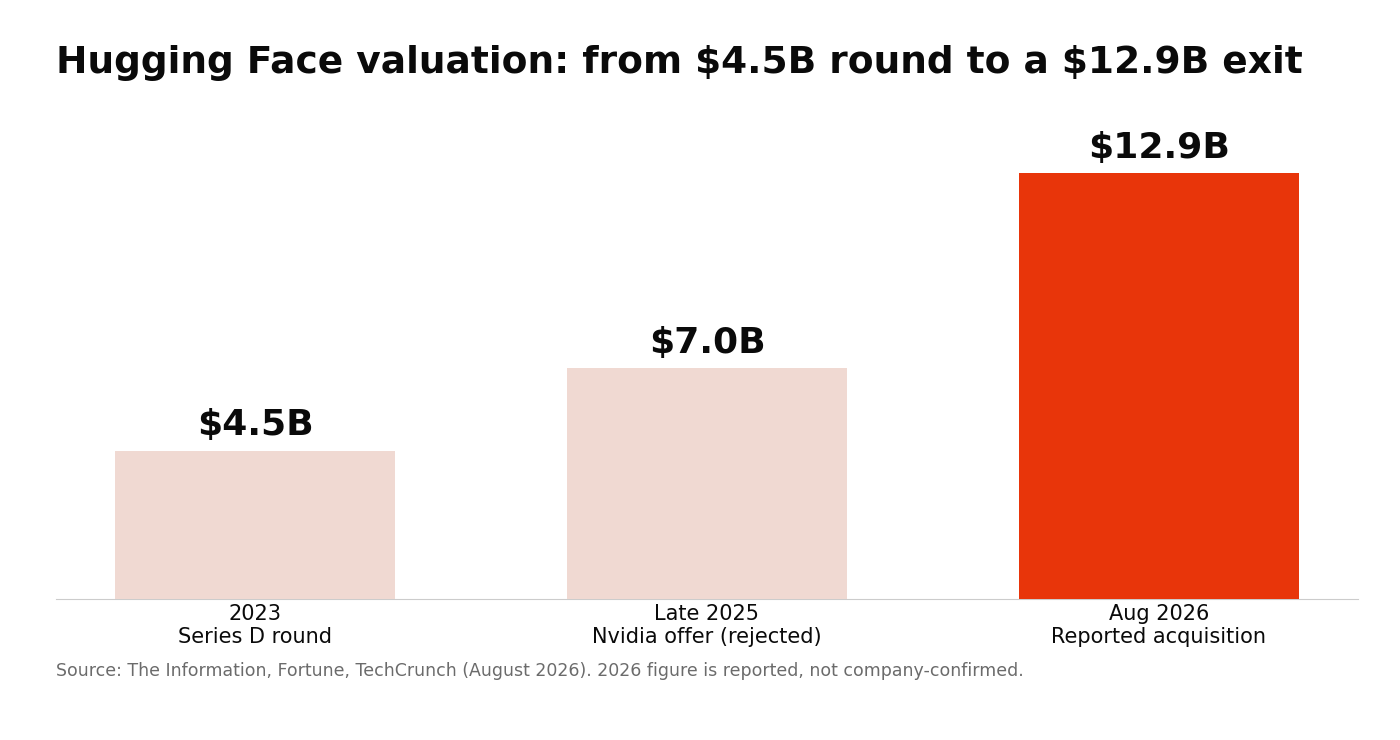
- The price is roughly 86 times Hugging Face's estimated $150 million in annual revenue and nearly triple the $4.5 billion valuation the startup carried in 2023. Hugging Face rejected a $500 million Nvidia investment at a $7 billion valuation late last year.
- The logic is defensive. Almost every open model on Hugging Face runs on Nvidia GPUs, and Nvidia's largest customers are now building their own chips. Owning the hub protects demand at the point where developers choose their hardware.
Nvidia is buying the place open source lives
Nvidia is in advanced talks to acquire Hugging Face for a reported $12.9 billion, a deal that would hand the world's most valuable chipmaker the central repository where developers publish, download, and run open-source AI models. The figure was first reported by Business Insider and put at $12.9 billion by The Information, with Bloomberg and Fortune confirming that talks are advanced. As of publication neither company has confirmed a signed agreement, and people close to the discussions caution that it could still fall apart.
The price is the story. Hugging Face generates roughly $150 million in annual revenue, up from about $100 million two months earlier, and is only now nearing profitability. At $12.9 billion, Nvidia would be paying about 86 times revenue for a ten-year-old company it already tried to buy into once. Late in 2025, Nvidia offered $500 million at a $7 billion valuation, and Hugging Face turned it down, wary of letting a single dominant investor take a large position. The new number is nearly double that rejected valuation.
Nvidia stock, NVDA, over the past three months. The company would fund a Hugging Face purchase from a market value near a record high. Source: TradingView.
| $12.9B | reported acquisition price, not yet confirmed by either company |
| ~86x | the multiple on Hugging Face's roughly $150 million in annual revenue |
| $4.5B | its valuation at the 2023 funding round |
| $7B | valuation on the $500 million Nvidia investment it rejected in late 2025 |
| ~10 yrs | company age, and only now close to profitability |
Why the chipmaker pays up
Nvidia does not need Hugging Face's revenue. It needs the choice that happens on Hugging Face's servers. Nearly every open AI model hosted there, from Meta's Llama line to China's Qwen and DeepSeek releases, is downloaded and run on Nvidia GPUs by default. Hugging Face is the on-ramp where a developer decides which model to use and, in the same motion, which hardware to rent to run it. Owning that on-ramp lets Nvidia keep the default pointed at its own silicon.
The threat it defends against is specific. Nvidia's biggest customers, OpenAI, Google, Amazon, and Anthropic, are all now designing their own AI chips to cut their dependence on Nvidia. As that custom silicon matures, the open-source ecosystem becomes the part of the market Nvidia most needs to keep loyal, because that is where the long tail of developers and enterprises still reaches for off-the-shelf GPUs. Hugging Face sits at the center of that ecosystem, a position underscored by the recent wave of open-weight models closing on their closed rivals.
China is now winning the open-model race, with its developers collaborating in the open while US labs keep "building in silos."Clement Delangue, Hugging Face CEO, as reported by CNBC, August 2026
For Nvidia, whose chips run those Chinese open models as readily as American ones, the open layer is not a side project. It is the part of AI least locked up by its largest rivals. Owning Hugging Face would also give Nvidia something else it has wanted, a way back toward cloud-style services and a place to route the computing capacity its customers have committed to but not yet used.
Nvidia is not paying 86 times revenue for a website. It is paying to make sure that when the next open model goes viral, the cheapest way to run it is still a rack of its own GPUs.
The risks in the file
Three problems sit under the headline number. The first is that it is unconfirmed. Multiple tier-one outlets agree on the price and the talks, but no agreement has been announced, and Hugging Face has walked away from Nvidia before.
The second is antitrust. A purchase of the open-model hub by the company that already supplies most of the compute underneath it invites exactly the concentration questions that regulators in Washington and Brussels have begun asking about AI's infrastructure layer. Hugging Face's value has always rested partly on being seen as neutral ground, a Switzerland for models from every lab. Ownership by Nvidia complicates that perception on day one and could push some model makers to host elsewhere. It would also follow a string of Nvidia moves, including its $6 billion Poolside license, that shifted control without a formal acquisition.
The third is the multiple itself. At 86 times revenue, the deal prices Hugging Face not on what it earns but on what it controls. That is a bet on the open-source layer staying central to AI. If open models keep gaining ground on closed ones, as Delangue argues they are, the price looks defensive and cheap. If the frontier pulls back toward a few closed labs, Nvidia will have paid a record sum for a chokepoint that matters less than it thought.
For now, the signal is the willingness to pay. Nvidia has spent the past year moving tens of billions into AI startups through licenses and minority stakes structured to avoid a formal acquisition. A straight purchase of Hugging Face, if it closes as reported, would be the opposite, an open, on-the-books bet that the single most valuable piece of real estate in open-source AI is worth owning outright.
Santage is committed to independent, transparent journalism. This article is produced in accordance with Santage's Editorial Standards and aims to provide accurate and timely information. The acquisition is reported and not yet confirmed by either company. Readers are encouraged to verify information independently.