

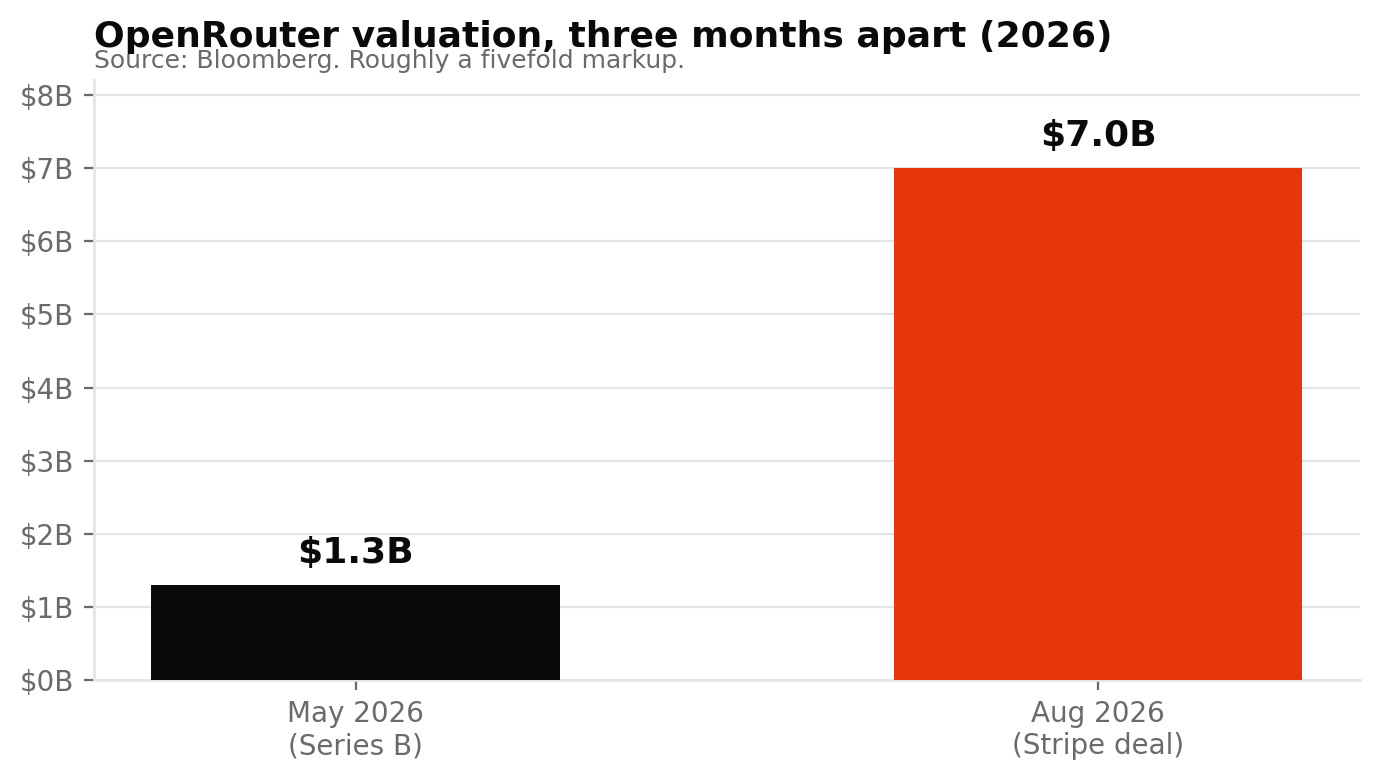
- Stripe has finalized an agreement to buy OpenRouter for more than $7 billion, roughly five times the startup's $1.3 billion valuation from three months earlier, according to Bloomberg.
- OpenRouter routes requests across more than 400 AI models for about 8 million developers, and had raised only around $150 million in venture funding before the deal.
- The acquisition places a payments company, not a model lab, at the metering point of the AI economy, where every token is priced, routed, and increasingly paid for.
Stripe paid a fivefold markup in three months for a model router
Stripe agreed to acquire OpenRouter for more than $7 billion, Bloomberg reported on August 16. The startup, founded in 2023 by former OpenSea co-founder Alex Atallah, was valued at $1.3 billion as recently as May. The new price is close to a fivefold markup in roughly three months, and it is more than 45 times the total venture capital OpenRouter had raised, about $150 million from CapitalG, Andreessen Horowitz, and Menlo Ventures.
OpenRouter is not a model or a chatbot. It is a switchboard. It gives developers a single interface to more than 400 models from different labs, routes each request to a chosen model, falls back to a backup if the primary fails, and reports which models the wider ecosystem is actually using. As of May 2026 it served around 8 million developers, with its fastest growth coming from teams wiring AI agents into software.
| Acquisition price | More than $7 billion |
| OpenRouter valuation in May 2026 | $1.3 billion |
| Models available through one interface | 400+ |
| Developers served | ~8 million |
| Venture funding raised before the deal | ~$150 million |
Why the money moved one layer up, from the model to the meter
The size of the number only makes sense against the backdrop of collapsing model prices. Blended inference costs just hit a year-to-date low, and the frontier labs are cutting prices against each other by the month. When the underlying product commoditizes, margin does not disappear. It moves to whoever controls access, measurement, and payment. OpenRouter sits at exactly that layer. It sees which models are winning before anyone else does, and it stands between the developer and every lab's billing meter.
OpenRouter's other asset is visibility. Because every request passes through it, the platform holds a live map of which models developers actually reach for, how demand shifts week to week, and where new labs break through. That is the kind of ecosystem wide signal the model labs themselves cannot see, and it compounds. The more traffic the router carries, the sharper its view and the harder it is to displace.
For Stripe, the logic runs straight into its core business. The company already operates payment rails for a large share of the internet. The emerging problem it wants to own is agentic commerce, software agents that not only call models but transact, buying compute, subscriptions, and eventually goods on a user's behalf. An agent that shops needs to pay for its own tokens and pay the merchant at the other end. Owning the router puts Stripe at the point where both of those payments can be metered and settled, and it does so without Stripe ever having to train a competitive model of its own.
Stripe did not buy a model. It bought the place where every model gets priced, routed, and paid for.
What shifts when the toll booth belongs to the payment network
The immediate tension is neutrality. OpenRouter's value to developers was that it played no favorites among labs. A router owned by a payments giant with its own commercial ambitions will have to work to keep that trust, because the moment routing decisions look steered, the switchboard becomes a liability rather than a utility.
The larger signal is where the industry now thinks the durable value sits. For two years the picks and shovels of AI meant GPUs and data centers. This deal says the metering layer, the thin software that prices and directs traffic across a commoditizing field of models, is now worth model lab money on its own. For the labs, that is an uncomfortable message. It suggests that as their outputs converge in quality and fall in price, the company that aggregates and bills for all of them can capture value they cannot, no matter how good the next model is. For developers, it raises the cost of a layer they had come to treat as free plumbing.
The detail most coverage missed
Andreessen Horowitz, which coined the LLMflation thesis that model prices fall tenfold a year, was an OpenRouter backer. The firm that argued models would commoditize also funded the toll booth that profits when they do. Its own prediction just paid off at more than $7 billion, and the mechanism was not a better model but the marketplace that sits above all of them.
The lesson of $7 billion is not that model routing is a lucrative niche. It is that when the product commoditizes, the margin moves to whoever controls the meter. Stripe did not buy an AI model. It bought the toll booth every model has to pass through, and it paid model lab money to own it.
Santage is committed to independent, transparent journalism. This article is produced in accordance with Santage's Editorial Standards and aims to provide accurate and timely information. Readers are encouraged to verify information independently.