
- Nvidia agreed to pay $6 billion for a non-exclusive license to Poolside's Model Factory and $1 billion for an equity stake, valuing the startup at $12 billion pre-money, up from $3 billion.
- 109 Poolside employees are moving to Nvidia while the three co-founders keep running the company as an independent entity, and existing backers are cashed out by the end of 2027.
- No acquisition is being filed, so no antitrust review, part of a pattern that has moved nearly $50 billion into AI startups since 2024 without a single merger filing.
The deal is a buyout that never files as one
Nvidia is putting $7 billion into Poolside, an AI coding startup, and structuring almost none of it as a purchase. The larger piece, $6 billion, buys a non-exclusive license to Poolside's Model Factory, the system the company uses to build and fine-tune coding models. A separate $1 billion buys equity at a $12 billion valuation, quadruple the $3 billion the startup carried months earlier, according to reporting confirmed by Bloomberg. Around 109 employees take Nvidia offers. The co-founders, including former GitHub chief technology officer Jason Warner, stay in place and Poolside continues to exist.
On paper, competition is preserved. Poolside still has a logo, a leadership team, and a product roadmap. In practice, Nvidia now holds a license to the startup's core technology, an equity position, and the bulk of the engineering talent that built it.
| $6 billion | license for Poolside's Model Factory, non-exclusive |
| $1 billion | equity investment at a $12 billion pre-money valuation |
| 4x | jump in Poolside's valuation from roughly $3 billion |
| 109 | employees moving to Nvidia |
| $0 | filed as an acquisition, and therefore no merger review |
Why the structure, not the price, is the signal
This is not a one-off, and it is not only Nvidia. Since 2024, Big Tech has run the same play repeatedly: license a startup's core technology, hire its founders and best engineers, leave a legally independent shell standing, and skip the merger filing a clean acquisition would trigger. Microsoft did it with Inflection, Amazon with Adept and Covariant, Google with Character.AI and Windsurf, Meta with a 49 percent stake in Scale AI. Nvidia itself licensed Groq for roughly $20 billion and bought Enfabrica's networking team for about $900 million. Poolside makes the pattern current.
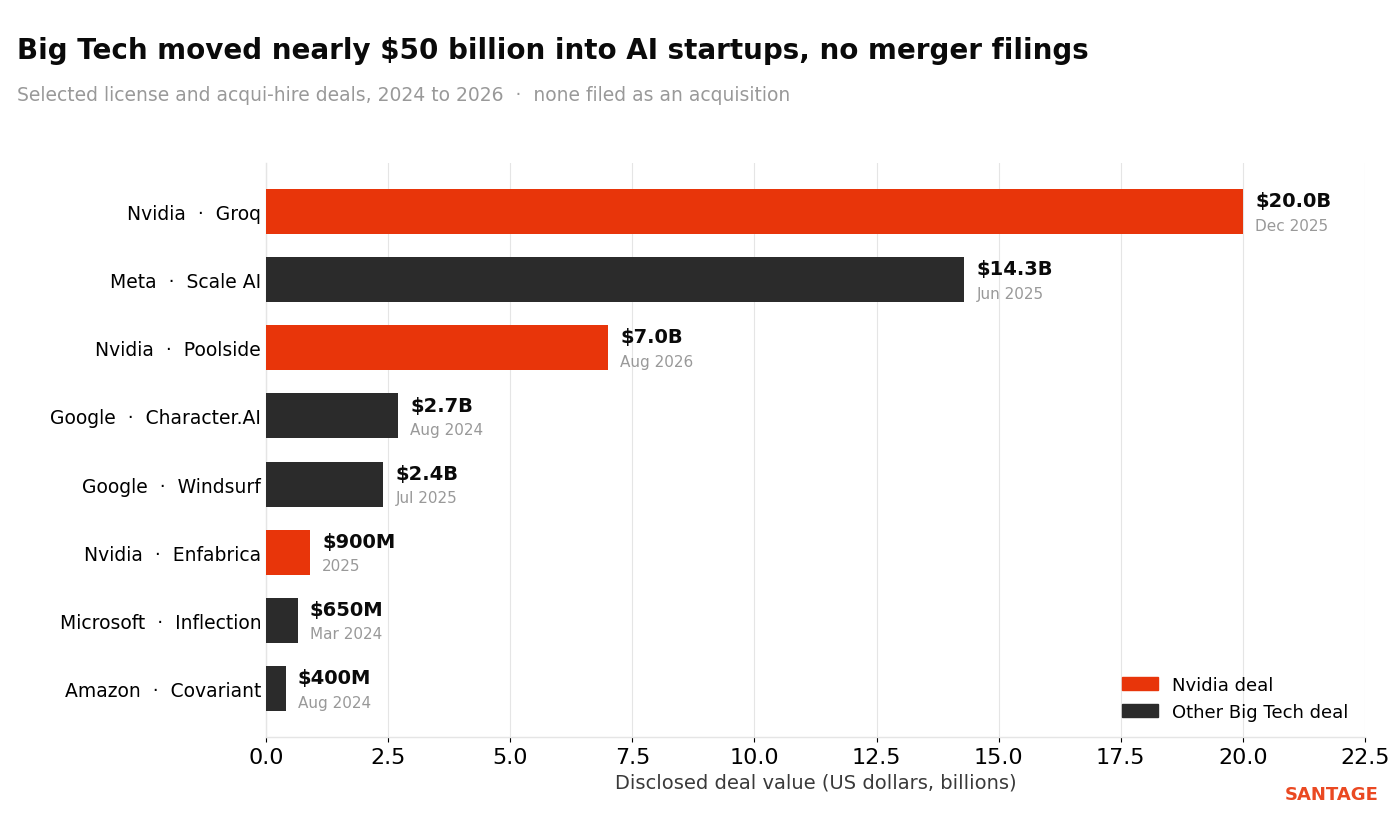
The dollars add up to a consolidation wave that never appears in merger statistics. The table below shows how consistent the structure is: a license or a minority stake, the founders retained, the antitrust file left empty.
| Deal | Date | Structure | Value | Acquisition filed |
|---|---|---|---|---|
| Nvidia, Groq | Dec 2025 | Non-exclusive license | ~$20B | No |
| Meta, Scale AI | Jun 2025 | 49% equity stake | ~$14.3B | No |
| Nvidia, Poolside | Aug 2026 | License plus equity | $7B | No |
| Google, Character.AI | Aug 2024 | Non-exclusive license | $2.7B | No |
| Google, Windsurf | Jul 2025 | License plus hiring | $2.4B | No |
| Microsoft, Inflection | Mar 2024 | License plus mass hiring | ~$650M | No |
The appeal is straightforward. A $7 billion acquisition of a frontier AI startup by the most valuable chipmaker on earth would draw a second request from antitrust regulators in Washington and Brussels and could sit in review for a year. A license plus a minority stake plus a wave of job offers reaches the same destination, control of the technology and the people, while staying below the threshold that triggers a formal look.
Nvidia does not need to own Poolside. It needs Poolside's models running on Nvidia hardware and Poolside's engineers on Nvidia's payroll. The license delivers both, and the antitrust file stays empty.
What shifts for founders and regulators
For founders, the license-and-invest exit is becoming the default outcome for a strong AI team that will not reach escape velocity alone. Backers get liquidity, in this case a full cash-out by the end of 2027, employees get a landing spot at a trillion-dollar buyer, and the company technically lives on. It is a soft landing dressed as continued independence, and it concentrates the best applied-AI talent inside a handful of incumbents without ever showing up as consolidation in the data.
For regulators, that is the problem. Antitrust enforcement is built to catch ownership changes, and this generation of AI deals is engineered to move control without moving ownership, staying beneath the acquisition thresholds that trigger review. Every quarter that gap stays open, more of the AI stack, models, inference, networking, coding, settles under the same few names while the official market map still shows a crowd of independent startups. Nvidia did not buy Poolside. It bought everything that made Poolside worth buying, and left the part that keeps the deal out of a regulator's inbox.
Santage is committed to independent, transparent journalism. This article is produced in accordance with Santage's Editorial Standards and aims to provide accurate and timely information. Readers are encouraged to verify information independently.