

- Zhipu released GLM-5.3 through its coding service and called it the most powerful open-weights coding model, crediting a 50 percent capability gain to post-training alone, with open weights promised within about two weeks pending a security review.
- An anonymous model named Ox Alpha, free on OpenRouter with a 1,048,576 token context window, matched Zhipu's public GLM vocabulary on all 95 tokenizer probes with a mean error of zero, evidence of shared lineage rather than proof of ownership.
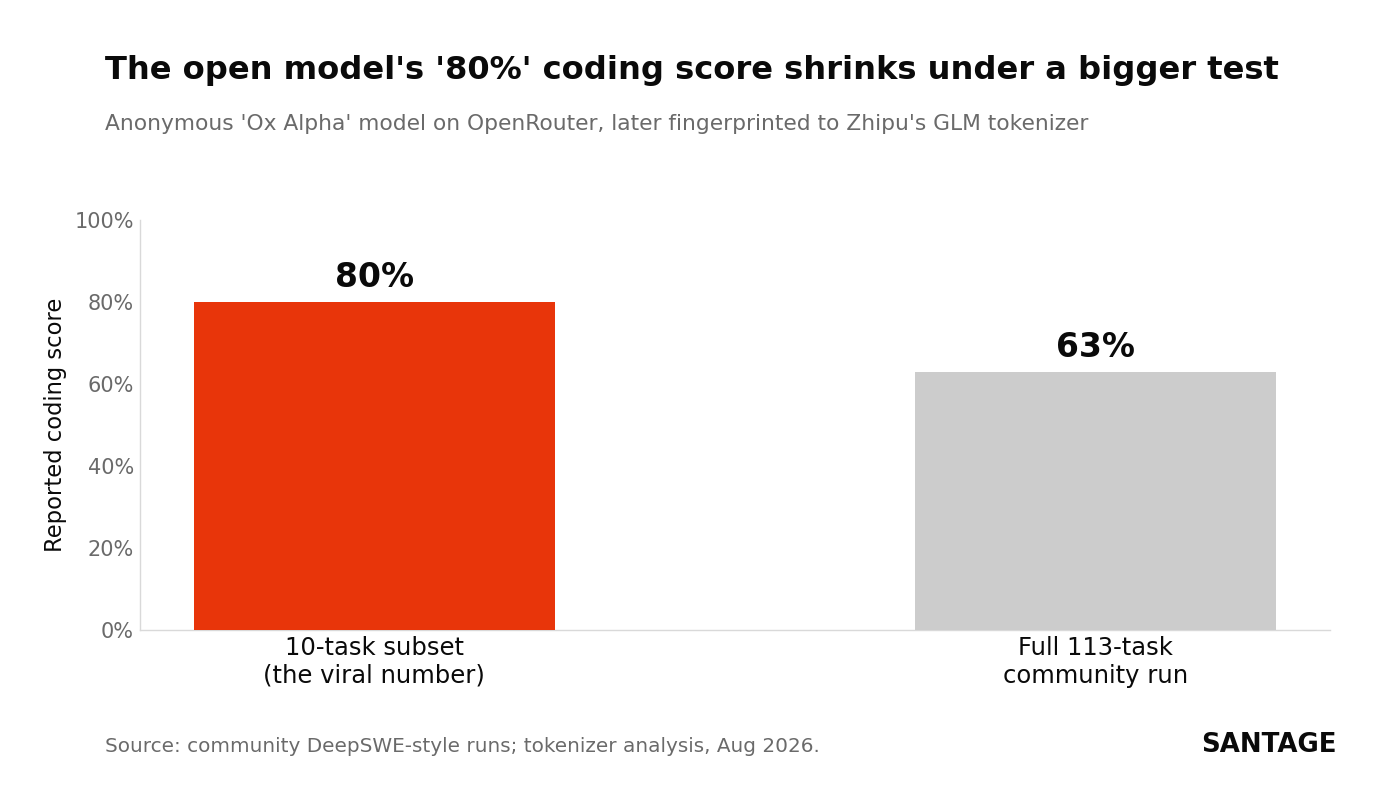
- The same model's viral 80 percent coding score came from a 10 task subset and fell to about 63 percent on a fuller 113 task community run, a gap that shows why the open coding race is now argued in benchmarks, not just weights.
Zhipu ships GLM-5.3 and calls it the strongest open coding model
The most consequential open-weight release of the month did not arrive with a keynote. Zhipu, the Beijing lab behind the GLM family, pushed GLM-5.3 out through its paid coding plan and made a direct claim about where it sits, in its release notes. The lab says the model is the most powerful open-weights coding system available, that its coding ability improved by roughly half over the prior version through post-training rather than a larger base, and that the weights will go public within about two weeks once security reviews finish.
The claim is unusually specific about method. A capability jump earned in post-training, not in a bigger pre-trained model, is a statement that the remaining gains in coding are coming from how a model is taught to use tools and fix its own mistakes, an area where open labs can iterate quickly and cheaply.
GLM-5.3 is the most powerful open-weights coding model.Zhipu (Z.ai) release notes, crediting a roughly 50 percent coding gain to post-training and reporting 2,436 vulnerabilities found across 269 projects in testing
An anonymous model on OpenRouter carried the same fingerprint
While GLM-5.3 was reaching paying developers, a second model appeared without a name. Listed only as Ox Alpha, it went live on OpenRouter around August 20 as a free preview with a million token context and image and video inputs. Within days it was near the top of community coding boards, and the obvious question was who built it.
The clearest answer came from the tokenizer. An analysis matched Ox Alpha's vocabulary against Zhipu's released GLM tokenizer across 95 separate probes and found a perfect match, with a mean absolute error of zero, according to a technical breakdown by implicator.ai. That is strong evidence of shared lineage. It is not proof of ownership, since a third party could in principle serve a model on Zhipu's public vocabulary, a caveat worth keeping in view.
The performance story needs the same care. The number that spread was 80 percent on a coding evaluation, but that came from a 10 task subset. A fuller 113 task community run landed near 63 percent, and it was not an audited leaderboard result.
Capability stopped being the only moat, so the fight moved to price and signal
Put the two events together and the shape of the open coding race becomes clear. Labs no longer need to prove that an open model can approach frontier coding quality, because several already have. What they need now is clean evidence, gathered before a launch, of how the model behaves against real developers rather than against a static benchmark. Releasing a capable model anonymously on a public router is a way to buy that evidence quietly, without the model's reputation or the lab's name shaping the first wave of results.
That reframing matters for anyone choosing a coding model. The headline score is now the least reliable part of a launch, because it can be drawn from a favorable slice and amplified before a fuller run corrects it. The durable signals are the ones Zhipu chose to lead with, a named method for the capability gain and a public log of the vulnerabilities the model found, both of which can be checked.
| 95 of 95 | tokenizer probes where Ox Alpha matched Zhipu's public GLM vocabulary |
| 1.05M tokens | context window offered free during the Ox Alpha preview |
| 2,436 | vulnerabilities GLM-5.3 reported finding across 269 projects in testing |
The detail most coverage is missing
The framing that GLM-5.3 is already an open model is premature. The weights are not out yet, and Zhipu has tied their release to a security review that could move. For now the strongest open coding system from this lab is reachable only through a paid service and, in cloaked form, a free preview that can be pulled at any time. Meanwhile a leaked repository listing points to a 125 billion parameter Qwen model previewing a next generation architecture, still unverified until the files appear.
The open source pitch used to be simple, that you could run a frontier grade model yourself. The releases this month complicate it in a useful way. The capability is real and it is arriving fast, but the proof around each launch is getting harder to read, tested in disguise and headlined from its best angle. Buyers who want the benefit of open models will have to get as good at auditing the claims as the labs have become at making them.
Santage is committed to independent, transparent journalism. This article is produced in accordance with Santage's Editorial Standards and aims to provide accurate and timely information. Readers are encouraged to verify information independently.