
- The forced unwind of Situational Awareness, sold to Citadel around July 30 after a 67% July loss, was not caused by a wrong call on AI. The fund's infrastructure thesis was intact. It was caused by roughly four times leverage on a concentrated book meeting a market that moved against it faster than collateral could cover.
- The episode exposed how much borrowed money now sits underneath AI hardware stocks, and how a single forced seller can erase more than $1 trillion in semiconductor value on the way down and spark an 8.5% relief rally on the way out.
- Citadel buying the distressed book at a discount stabilized the tape, but the deeper signal is that the AI trade is now delevering rather than deflating, and the two look similar until they do not.
The most leveraged bet in the boom just broke
Leopold Aschenbrenner was, by the only measure that matters to a hedge fund, right. His 2024 thesis that artificial intelligence would remake the economy faster than the market expected translated into a real portfolio of the picks and shovels behind it: memory, compute, power. For six months that portfolio compounded at a rate almost no fund has ever posted, up a reported 439% and peaking near $45 billion in net asset value.
Then it went to about $10 billion in a matter of weeks. Nothing about the AI thesis changed in July. What changed was that a concentrated, roughly four-times-levered book ran into a sector-wide selloff, and leverage does not care whether you are eventually right. When SK Hynix, CoreWeave, Nebius, Micron and Bloom Energy all fell together, the fund's collateral fell with them, its lenders asked for more, and there was none to give. The positions that made the fund the story of the first half became the reason it could not survive the second.
Why one fund's problem became everyone's
The reason a single fund's margin call mattered to the whole market is that it was never really a single fund. Situational Awareness was a leveraged expression of the exact trade thousands of other investors hold in smaller size: long the physical layer of AI. When it was forced to sell more than $16 billion of that trade into a thin summer market, it drove the very prices that were triggering its own margin calls, a reflexive loop that pulled the broader semiconductor complex down with it. More than $1 trillion in chip market value evaporated from the late-June peak before the selling stopped.
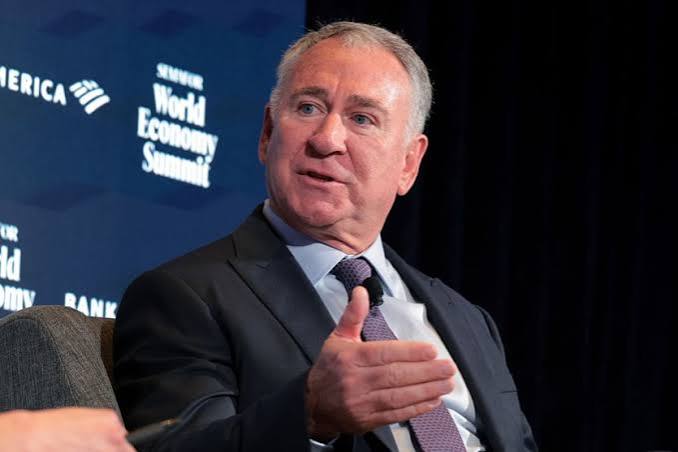
That is why the man on the other side of the trade had been warning about this for a year. Ken Griffin, whose Citadel ultimately bought the book, has spent months arguing that the market is pricing AI as if the payoff were imminent when the timeline is far longer.
"The dream may not take three or five years to play out. It could be 20 years. It can be 30 years."Ken Griffin, founder and CEO of Citadel, warning that the AI boom faces a dot-com-style sorting of winners and losers before its value is settled
The book that broke the fund
The anatomy of the loss is visible in the holdings themselves. This was not a diversified fund caught in a broad drawdown. It was a narrow set of AI-infrastructure names, held in size and on margin, that all declined at once.
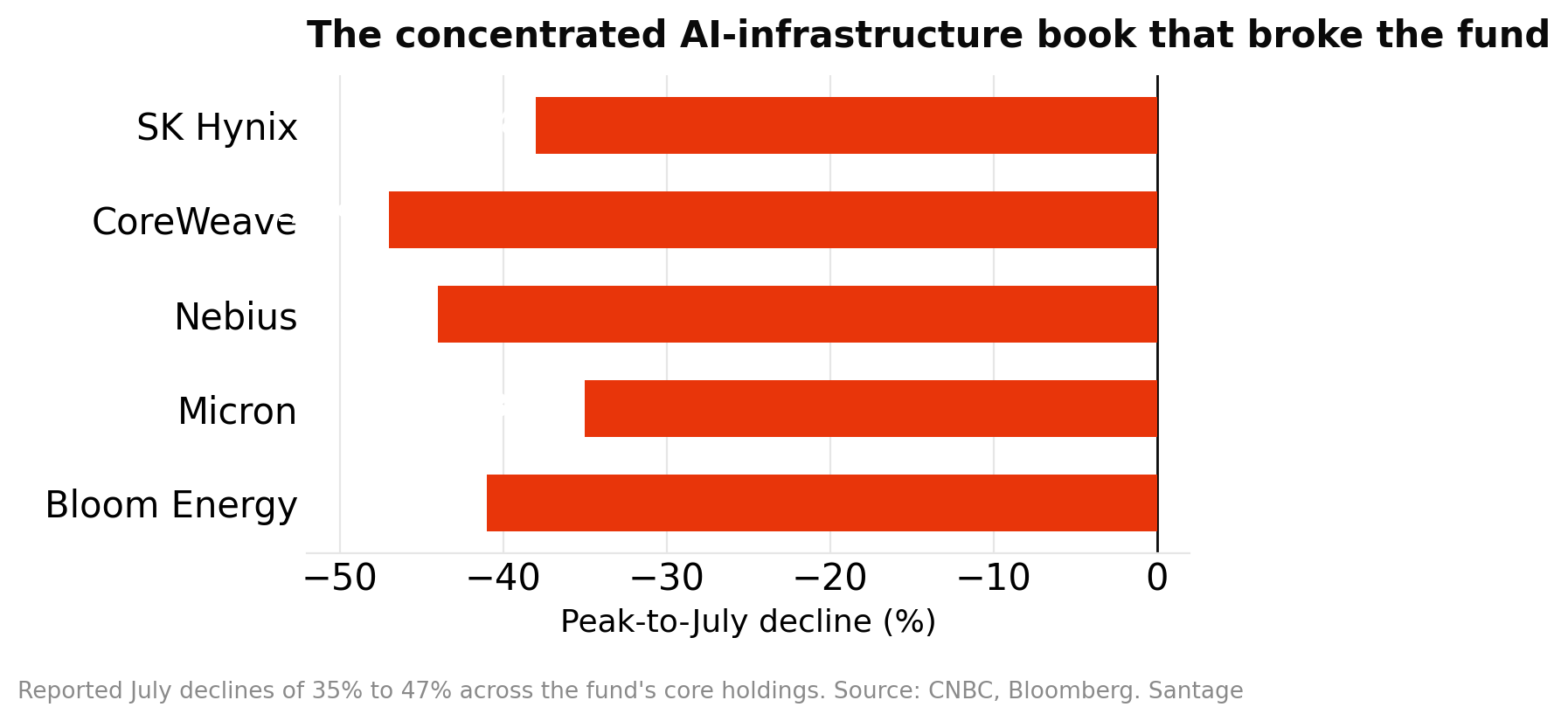
Concentration is what produces a 439% half. It is also what produces a 67% month. The same design choice sat behind both numbers. Aschenbrenner did not fail to see AI. He failed to build a structure that could survive being early and wrong at the same time, which every long-horizon investor eventually is.
The thesis was never the risk. The leverage on top of the thesis was. Being right about AI and being able to hold the position through a drawdown turned out to be two entirely different bets.
Citadel's ruthless, stabilizing hand
Griffin's role reads two ways at once, and both are true. By stepping in as a buyer of size when Situational Awareness had to sell, Citadel removed the market's largest forced seller and handed the AI trade a floor. The semiconductor ETF jumped about 8.5%, its best day in more than a year, and former holdings such as IREN, SanDisk and CoreWeave rose more than 20% as the overhang lifted. In the narrow sense, a $10 billion-plus purchase by one firm may have prevented a much larger cascade.
| Reported leverage on the fund's public book | About 4x |
| Semiconductor market value erased from the June peak | More than $1 trillion |
| Rebound in top former holdings after the sale | More than 20% |
| iShares Semiconductor ETF relief-rally gain | About 8.5% |
In the wider sense, it was a firm that had publicly doubted the AI timeline buying the assets of a firm that had bet everything on it being short, at prices set by that firm's distress. That is not a contradiction. It is how disciplined capital is supposed to behave when leverage forces someone else's hand, and it is exactly the "sorting of winners and losers" Griffin had described in the abstract, now happening in a single trade.
Delevering is not the same as deflating
The comforting read is that the AI selloff has bottomed, marked by a forced seller clearing and a sharp bounce. The more useful read is narrower. What washed out in July was leverage, not conviction. The private stakes that funds like this one prize, Situational Awareness kept its roughly $5 billion Anthropic position, did not trade at all. The public names that cratered are already rebounding. This looked like a bubble bursting and behaved like a margin book unwinding, and those are different events with different endings.
The open question is how much borrowed money still sits underneath the trade. One four-times-levered fund was large enough to move the entire semiconductor complex by itself. If it was the only one built that way, July was a contained accident. If it was merely the most visible, then the lesson of Situational Awareness is not that the AI thesis is wrong. It is that the market has not yet finished finding out who else is holding it on margin.
Santage is committed to independent, transparent journalism. This article is produced in accordance with Santage's Editorial Standards and aims to provide accurate and timely information. This is market analysis, not investment advice. Readers are encouraged to verify information independently.