
- In a single week, Microsoft, Meta, Amazon and Alphabet reported second quarter 2026 results and faced the same investor question about roughly $600 billion in combined AI capital spending. The market gave opposite answers.
- Microsoft and Amazon rose after showing that AI is now a large external revenue line: Azure AI at a $37 billion run rate up 123%, and an AWS AI business past $25 billion. Meta fell about 10% as its AI spend stayed internal and free cash flow collapsed 91% to $784 million.
- The dividing line is no longer how much a company spends on AI. It is whether that spend has started to sell.
The same bill, two verdicts
For two years, Big Tech's AI story was a spending story, and investors mostly gave every hyperscaler the benefit of the doubt. That posture ended this week. The four largest AI spenders reported within days of each other, all carrying capital budgets that would have looked absurd in 2023, and the market split them cleanly into companies it trusts to earn a return and companies it has started to question.
Microsoft set the tone on July 29. Revenue rose 18% to $90.0 billion, net income rose 31% to $35.8 billion, and Azure grew 43%. For the first time, annual Azure revenue passed $100 billion, Microsoft Cloud passed $214 billion, and total revenue passed $331 billion. Crucially, Microsoft put a number on the AI itself: an Azure AI business running at a $37 billion annual rate, up 123% year over year. The stock rose.
"We are advancing the frontier on the cost-to-outcome curve, ensuring every customer can turn tokens into business results. This year, Azure revenue surpassed $100 billion for the first time, and Microsoft 365 Copilot reached over 30 million paid seats."Satya Nadella, Microsoft CEO, in the fiscal Q4 2026 results
Why the market rewarded selling over spending
The reason the reaction diverged is visible in one chart. The companies that rose were the ones able to show AI as revenue leaving the building, sold to external customers at a measurable and fast-growing run rate. The company that fell could show only the cost.
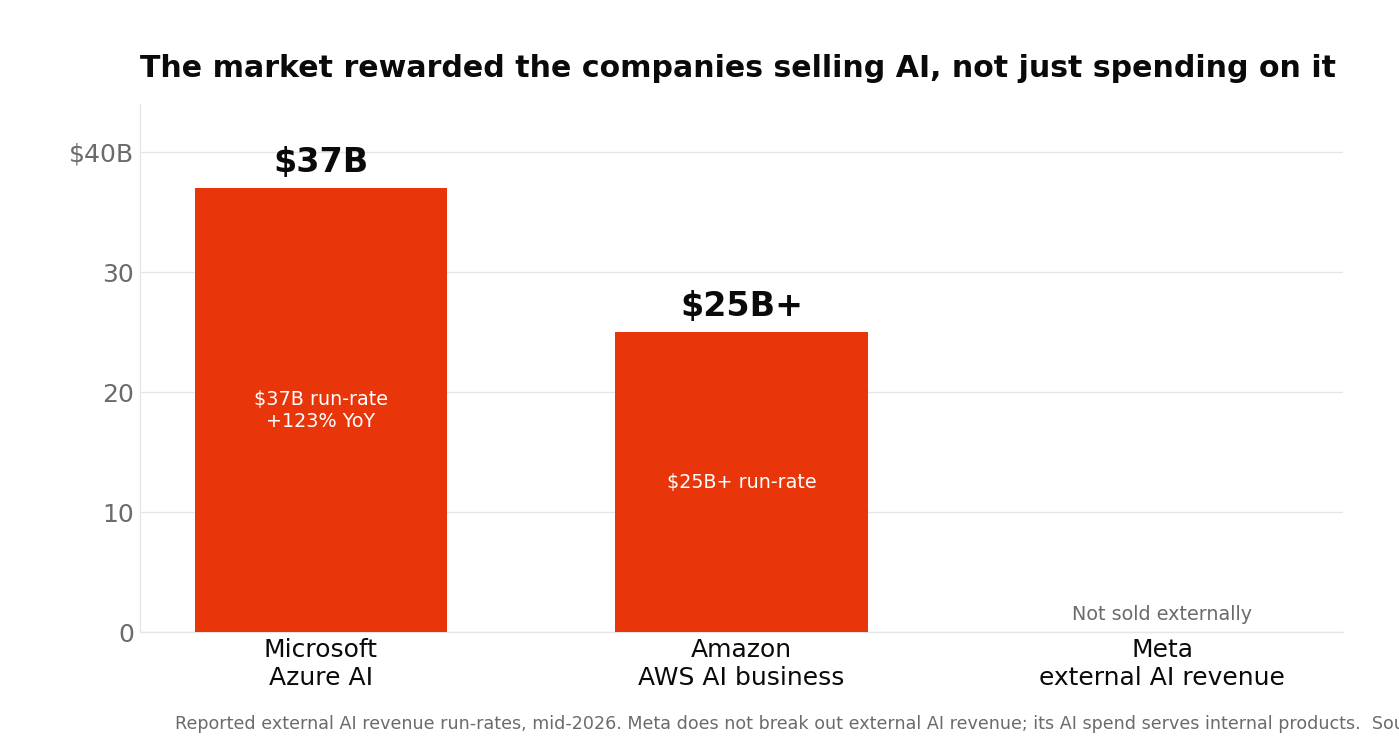
Amazon extended the pattern a day later. AWS grew 37%, its fastest since 2021, with an AI business and a custom-chips business each past a $25 billion run rate and a $496 billion backlog of contracted work. Like Microsoft, Amazon raised its spending, to about $220 billion for the year, but it did so while pointing to demand it cannot yet satisfy. Shares rose about 9%. Investors are willing to fund a bigger bill when the backlog behind it is visible.
Meta is the counterexample, and its numbers explain the punishment. Revenue grew faster than either cloud leader, up 28% to $60.8 billion, yet profit fell 14% to $15.85 billion, and free cash flow dropped 91% to just $784 million as capital spending climbed. Meta then raised its full-year capex floor to a range of $130 billion to $145 billion. The problem is not that Meta spends heavily. It is that Meta's AI spend flows into recommendation systems, Llama models and internal tooling, none of which appears as a line item a customer pays for. The market can see the outflow and not the inflow.
The question has changed. Investors are no longer asking how committed a company is to AI. They are asking to see the invoice it sends someone else.
The monetization test, in numbers
Read across the week, the split is stark, and it maps almost perfectly onto business model. Cloud providers that rent AI capacity have a customer on the other side of every dollar. A platform that uses AI to improve its own products has to argue that the benefit will show up later, in engagement and ad pricing, rather than now, in a bill.
| Microsoft Azure AI run rate | $37 billion, up 123% |
| AWS growth, fastest since 2021 | 37% |
| Meta free cash flow | $784 million, down 91% |
| Meta full-year capex guidance | $130 billion to $145 billion |
The case for Meta, and the risk for everyone
The bearish read on Meta may prove too impatient. Every prior wave of Meta infrastructure spending, on mobile, on Reels, on its ad-ranking systems, looked like unmonetized cost before it became the engine of the business. Mark Zuckerberg is making the same bet again, that AI applied to its own products will compound into advertising revenue and eventually into consumer AI products that do carry a price. If that is right, the internal spend is not a weakness but a lead, and this quarter's selloff is a buying window. Meta's 28% revenue growth is not the profile of a company in trouble.
There is also a risk hiding inside the winners' story. Azure AI and AWS growth are impressive, but a large share of hyperscaler AI revenue comes from a small set of well-funded model labs and startups buying compute with venture money. That is real revenue today. It is also more concentrated and more cyclical than the enterprise software Microsoft and Amazon usually sell, and it depends on those customers continuing to raise and spend at the current pace.
For now, the market has drawn its line, and it is a reasonable one. In 2024 and 2025, conviction about AI was enough. As of this week, the bar is a customer, a contract and a run rate. The companies that cleared it were rewarded, the one that has not was marked down, and the rest of the sector now knows exactly what it will be asked to show next quarter.
Santage is committed to independent, transparent journalism. This article is produced in accordance with Santage's Editorial Standards and aims to provide accurate and timely information. This is market analysis, not investment advice. Readers are encouraged to verify information independently.