

- Meta and BlackRock announced a venture on July 28 to build a 1 gigawatt AI data center in El Paso at roughly 14 billion dollars total cost, with BlackRock funds taking 80% and Meta keeping 20%.
- BlackRock contributes about 4.9 billion dollars in cash at close, while Meta hands over land and construction in progress worth about 2.3 billion, moving most of the campus off Meta's balance sheet.
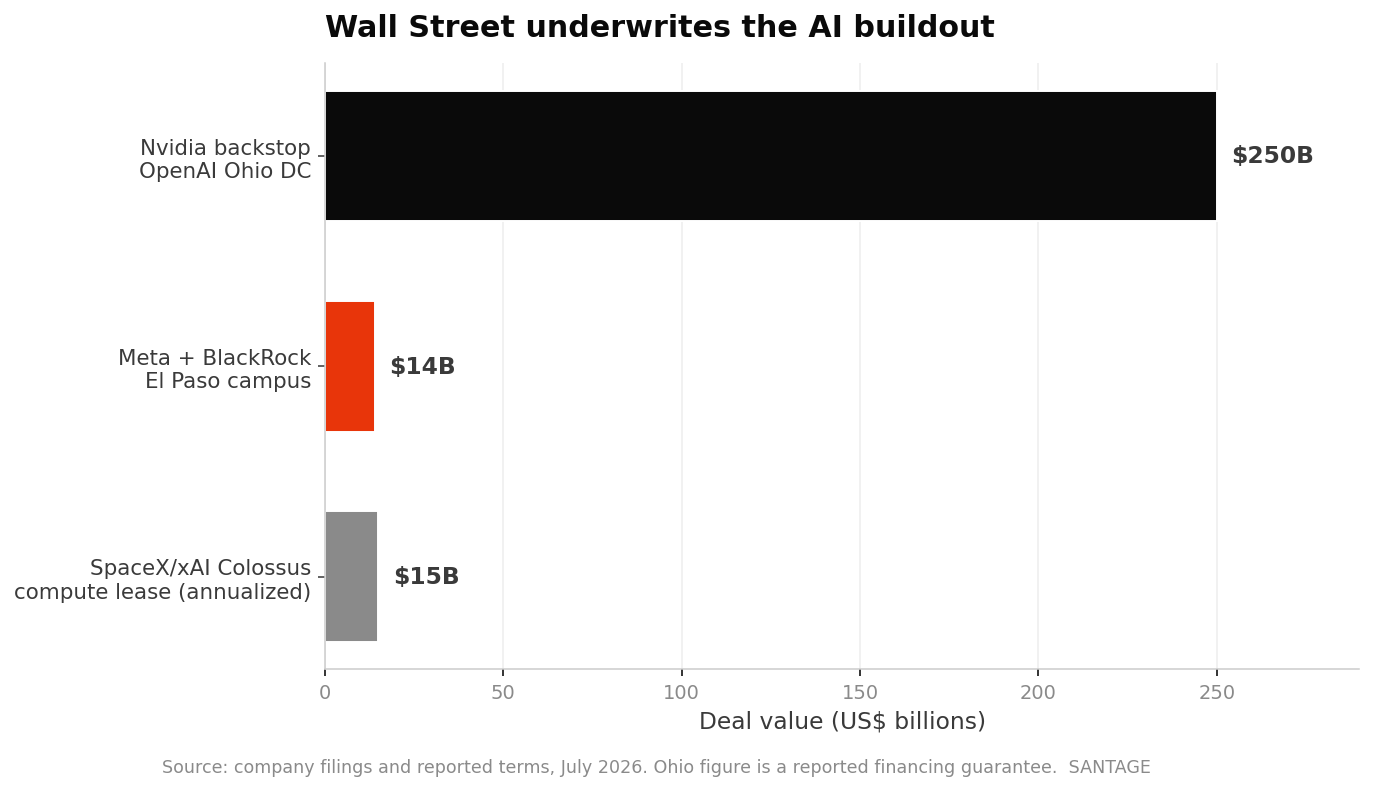
- The structure mirrors a wider shift: Nvidia is separately in talks to guarantee up to 250 billion dollars of debt for OpenAI's Ohio site, a sign that the AI buildout is now financed by capital markets, not tech cash flow.
BlackRock funds take 80% of Meta's El Paso campus
Meta and BlackRock said on July 28 they will jointly develop and own a data center campus in El Paso, Texas, at an estimated 14 billion dollars, delivering 1 gigawatt of compute for Meta's AI systems with first capacity online in 2028. BlackRock managed funds, working with Global Infrastructure Partners and HPS Investment Partners, take an 80% ownership stake. Meta retains 20%.
The capital split is the story. BlackRock contributes roughly 4.9 billion dollars in cash at financial close. Meta contributes the land and construction already in progress, worth about 2.3 billion. On site, about 2,300 people are already working, construction is expected to peak above 4,000 jobs, and roughly 300 permanent roles remain once the campus runs.
- Total development cost: ~14 billion dollars, 1 gigawatt of capacity
- Ownership: BlackRock funds 80%, Meta 20%
- BlackRock cash at close: ~4.9 billion dollars
- Meta contribution: land plus construction in progress, ~2.3 billion dollars
- First capacity online: 2028
Why Meta wants a gigawatt of compute off its balance sheet
Meta could fund this campus outright. It chose not to, and that choice is the point. By selling 80% to BlackRock funds, Meta keeps the compute it needs while moving the bulk of the cost, and the depreciation, off its own books. The land-and-construction contribution lets it recover capital already spent. It is infrastructure financing logic, the model used for toll roads and power plants, applied to AI compute.
That matters because the numbers have outgrown even the largest tech balance sheets. A single gigawatt-class campus now costs more than most public companies are worth, and the hyperscalers are building many at once. When the check is this large, spreading it across pension funds, insurers and credit managers is not a weakness. It is the only way to build at the pace the models demand.
The same playbook is spreading across the buildout
Meta is not alone, and the El Paso deal is the tidy version of a pattern showing up everywhere in the same week. Nvidia is separately reported to be in talks to guarantee up to 250 billion dollars of debt tied to OpenAI's planned 10 gigawatt data center in southern Ohio, a project whose full cost including chips could pass 500 billion dollars. Nvidia is also weighing financing for the chips themselves, and it wrote a 5 billion dollar check into Ilya Sutskever's Safe Superintelligence in the same stretch.
Read together, the through-line is that the companies buying compute increasingly do not own it. They lease it, partner on it, or have it guaranteed by the vendor selling them the chips. SpaceX's own filings showed its AI unit paying more than a billion dollars a month to lease Colossus compute. The balance sheet holding the asset is no longer the company using it.
The AI buildout has quietly become a capital-markets story. The scarce input is no longer chips or power. It is someone willing to own the asset.
The risk hiding in off-balance-sheet AI compute
There is a catch that the clean deal terms obscure. When Nvidia guarantees the debt for a data center that buys Nvidia chips, and asset managers underwrite campuses leased back to the tech firm that built them, capital starts to circle. Demand and financing begin to come from the same few balance sheets, which flatters growth on the way up and concentrates risk on the way down. Regulators and credit analysts have already started using the phrase circular financing.
Meta's El Paso venture is the disciplined face of this shift: a real asset, a real tenant, a diversified financial partner, off the tech balance sheet by design. The question mid-2026 leaves open is whether the rest of the buildout, the 250 billion dollar guarantees and vendor-financed chips, is the same prudent instinct scaled up, or the same optimism that funded every infrastructure boom right up to the moment it stopped.
Santage is committed to independent, transparent journalism. This article is produced in accordance with Santage's Editorial Standards and aims to provide accurate and timely information. Readers are encouraged to verify information independently.