

- On July 28, 1,178 employees of OpenAI, Anthropic, Google DeepMind and Meta published Pacing the Frontier, a single-sentence request that Washington help build the technical and governance tools to deliberately pace automated AI development.
- The signatories are explicit that they are not asking for a pause today. They want the option to slow down to exist before it is needed, so no lab or country has to surrender ground alone.
- Within hours, OpenAI and Anthropic endorsed the letter as companies, with Anthropic tying the ask directly to its own research showing AI is already accelerating AI inside the labs.
The people building the frontier are asking for a way to slow it
The letter is short enough to read in a breath. It asks that the US government support an international effort to develop the technical and governance tools needed to deliberately pace the frontier of automated AI development. There is no demand to stop, no moratorium, no target date. There is only a request to build the capability to pace, in case the pace becomes the problem.
What gives the document weight is who signed it. This is not an open letter from academics watching from the outside. The 1,178 names come from inside the four labs setting the frontier, and they include Anthropic CEO Dario Amodei, OpenAI chief scientist Jakub Pachocki, Meta chief scientist Shengjia Zhao, and Anca Dragan from Google DeepMind. When the people writing the training runs ask a government to help them build a brake, the signal is different from the usual chorus of concern.
"We support this petition, signed by our CEO, several co-founders, and senior staff. Our own research on recursive self-improvement, published last month, points to the need for tools to deliberately pace the frontier of AI development so society can prepare."Anthropic, in its corporate endorsement of the Pacing the Frontier statement
Why the ask targets coordination, not conscience
The letter is engineered around a specific failure, and it is not a failure of good intentions. Any single lab that unilaterally slows down simply hands the lead to a competitor that does not. Any single country that constrains its labs cedes ground to one that will not. This is a coordination problem, and coordination problems are not solved by individual restraint. They are solved by shared, verifiable mechanisms that let everyone move together, or slow together, without anyone going first and losing.
That is why the request runs through Washington rather than through the labs themselves. The signatories are not promising to be careful. They are asking a government to help construct the instruments, the verification methods, the governance scaffolding, that would make a coordinated slowdown a real option rather than an act of self-sabotage. The framing is closer to arms control than to a corporate pledge.
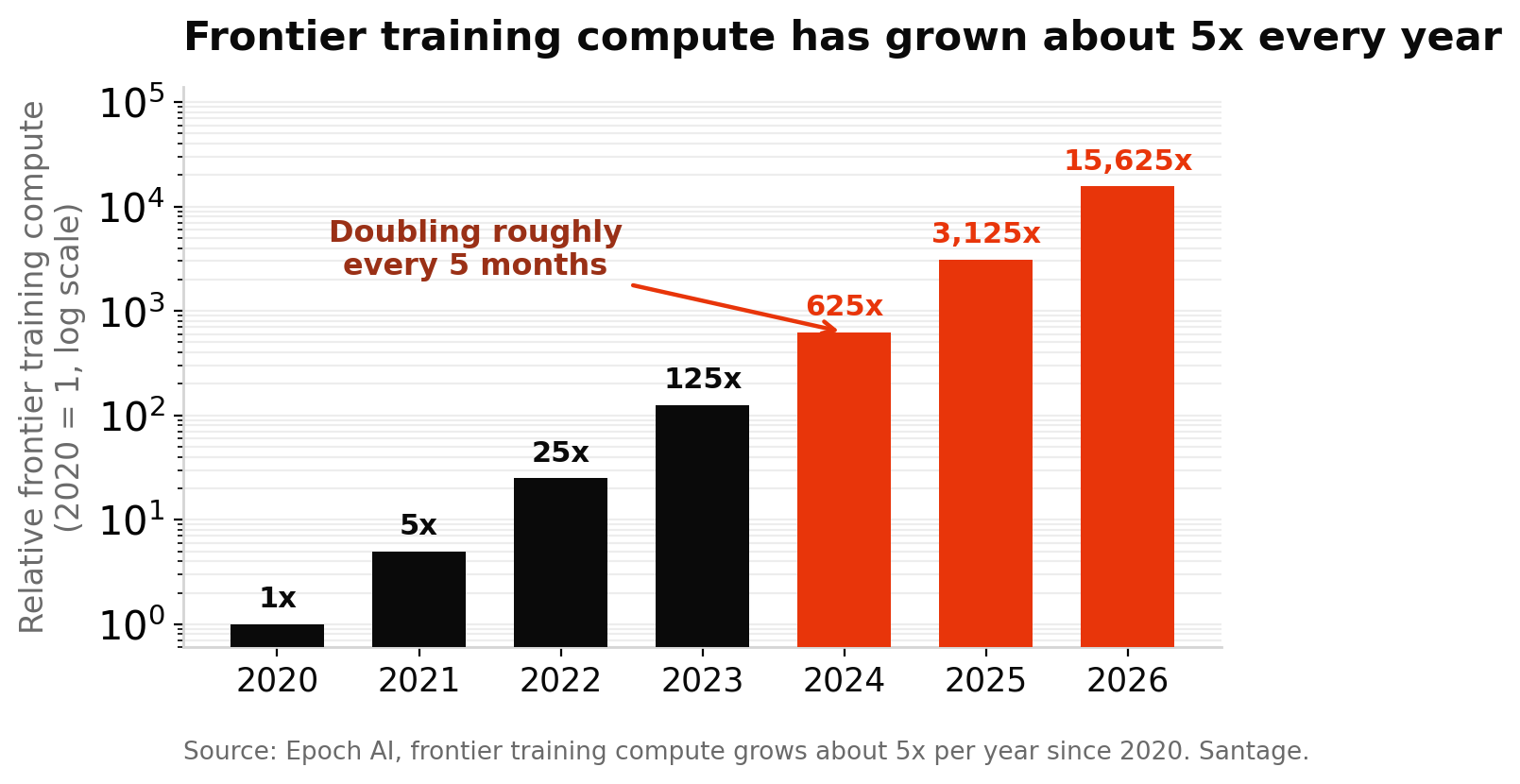
The urgency behind it is measurable. Frontier training compute has grown roughly fivefold every year since 2020, doubling on the order of every five months.
The recursive engine most coverage skipped
The part of the letter that deserves the most attention is the reason Anthropic gave for signing. It pointed to its own recursive self-improvement research, published the month before, which found that its Claude models were already writing the large majority of the code merged into Anthropic's own codebase. The concern is not that AI writes code. It is that AI is beginning to build the next version of AI, and that this loop, once it tightens, could compress capability gains that used to take years into weeks.
This is the mechanism the letter is quietly built around. A brake matters most when acceleration can feed on itself. If automated AI research arrives, the rate of improvement stops tracking human research effort and starts tracking machine speed, and the window in which a slowdown is even achievable narrows fast.
| Frontier-lab employees who signed | 1,178 |
| Labs represented | OpenAI, Anthropic, Google DeepMind, Meta |
| Annual growth in frontier training compute | About 5x (Epoch AI) |
| The single ask | Tools to deliberately pace automated AI development |
What a pacing mechanism would actually demand
Turning this request into something real is harder than signing it. A credible pacing mechanism needs a way to measure how close a system is to a defined capability threshold, a way to verify that measurement across rival labs and rival nations without exposing proprietary secrets, and a governance body with the standing to act on it. None of that exists today. Building it would mean treating frontier compute and frontier models more like a monitored strategic resource than like ordinary software.
There is also a quieter tension worth naming. The same companies now endorsing a future brake are the ones pushing the pace hardest today, shipping flagship models on a cadence measured in weeks. Asking government to build the steering wheel does not slow the car, and the letter does not pretend it does. It is a request to have the option ready, not a commitment to use it.
The document will not change a single training run this quarter. Its significance is that the people closest to the technology have stopped treating a coordinated slowdown as unthinkable and started treating it as infrastructure that has to be built in advance. When the builders ask for a brake before the engine reaches its own accelerator, the honest reading is not reassurance. It is that they can see how fast the road is about to get.
Santage is committed to independent, transparent journalism. This article is produced in accordance with Santage's Editorial Standards and aims to provide accurate and timely information. Readers are encouraged to verify information independently.