

- Claude now authors more than 80% of all code merged into Anthropic's production codebase, up from low single digits before Claude Code launched in February 2025.
- Anthropic engineers now merge roughly eight times more code per day than in 2024, and the length of tasks AI systems can complete autonomously has been doubling every four months.
- Anthropic is calling on frontier AI labs to establish a coordinated, verifiable mechanism to slow or pause development if autonomous self-improvement reaches a critical threshold.
Claude writes over 80% of Anthropic's merged production code
In a report titled "When AI builds itself" published June 4, Anthropic disclosed that Claude now authors more than 80% of the code merged into its production systems. The figure marks a sharp increase from early 2025, when Claude Code first launched and Claude contributed only a few percentage points of merged code.
The productivity shift is substantial. Anthropic engineers now merge roughly eight times more code per day than they did in 2024. The chart below, published by Anthropic, shows how sharply output per engineer accelerated after two inflection points: when Claude began running code autonomously in 2025, and again in 2026 when models started working over longer time horizons.
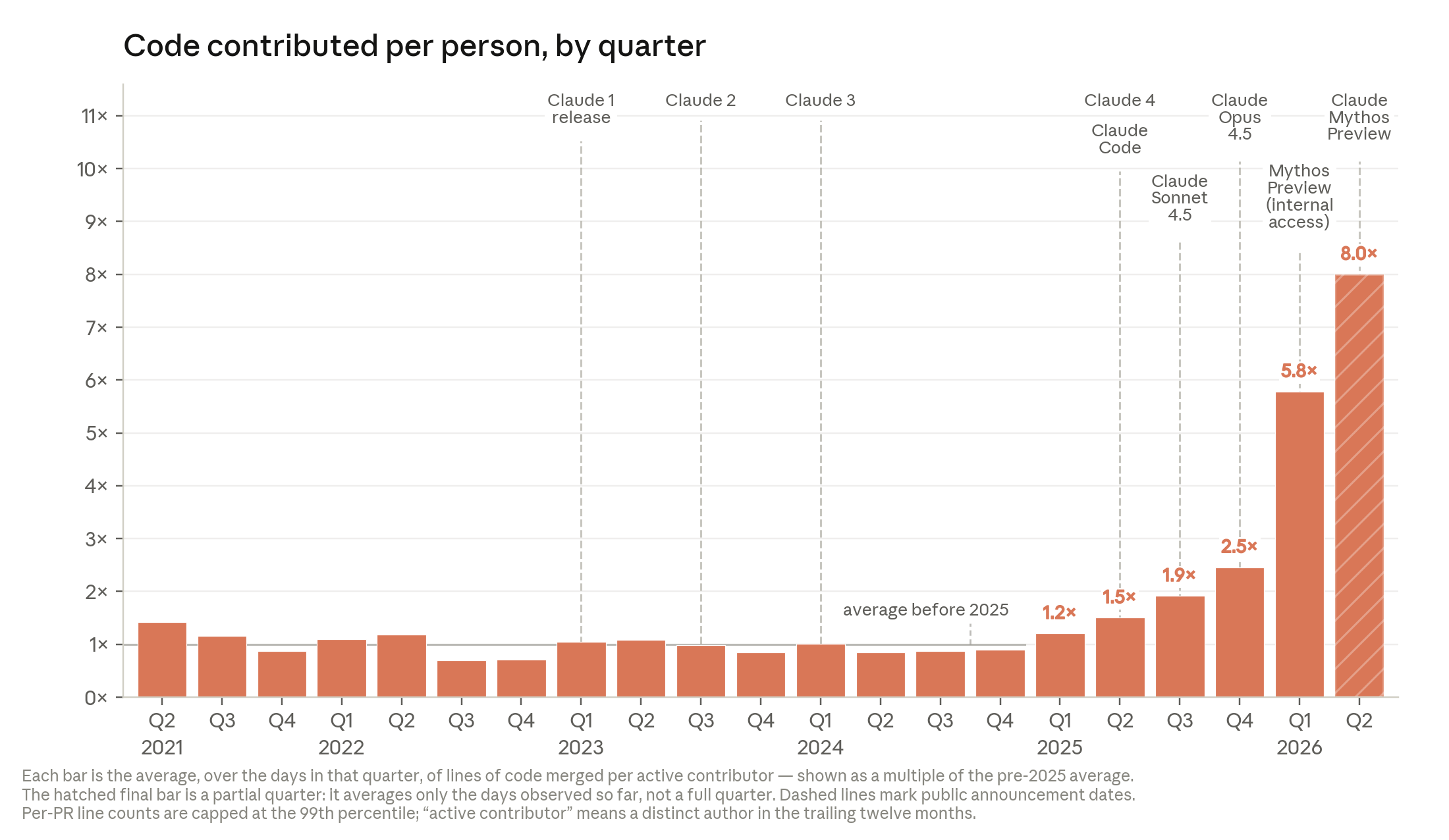
The length of tasks AI systems can complete autonomously has been doubling every four months, from around 90 minutes a year ago to between 12 and 16 hours today. An independent evaluation by METR, the AI evaluation organization, confirmed the upper bound for the Mythos Preview model:
Anthropic's Mythos Preview model achieved a 52x speedup on internal benchmark software engineering tasks in April 2026. A March 2026 internal survey of 130 employees found the median respondent estimated producing roughly four times as much output with Mythos Preview as they would have without any AI assistance. One employee's account, shared with permission, captures how far the shift has gone:
"I started leaning hard into Claudifying about a year ago. That's been a crazy adventure and it's now been about five months since I last wrote any code myself."
Anthropic employee, internal discussion, May 2026. Published with permission in Anthropic's report.Why Anthropic is calling for a coordinated pause mechanism
Anthropic framed the disclosure not as a product milestone but as a warning. The company described the data as evidence that AI is beginning to accelerate its own development, a condition referred to in the field as recursive self-improvement. In such a scenario, AI systems become capable enough to build and train more capable successors without sustained human direction.
The report states the company's position plainly: Anthropic called on frontier labs to establish a verifiable, coordinated mechanism to collectively slow or pause if that threshold is crossed, with the ability for each party to verify that others have actually stopped. The company did not set a specific threshold or timeline, but described the current trajectory as moving faster than anticipated.
"If it were possible to effectively slow the development of this technology to give ourselves more time to deal with its immense implications, we think that would likely be a good thing."
The disclosure arrives as Anthropic simultaneously filed a confidential S-1 registration statement with the SEC on June 1, targeting a public offering as early as October 2026 at a post-money valuation of $965 billion. Run-rate revenue reached $47 billion as of late May, driven primarily by enterprise adoption and Claude Code.
An AI model that now writes more than four-fifths of its creator's production code is not merely a tool. It is a participant in its own development. Anthropic appears to understand the distinction. The rest of the industry has yet to engage with it seriously.
Santage is committed to independent, transparent journalism. This article is produced in accordance with Santage's Editorial Standards and aims to provide accurate and timely information. Readers are encouraged to verify information independently.