

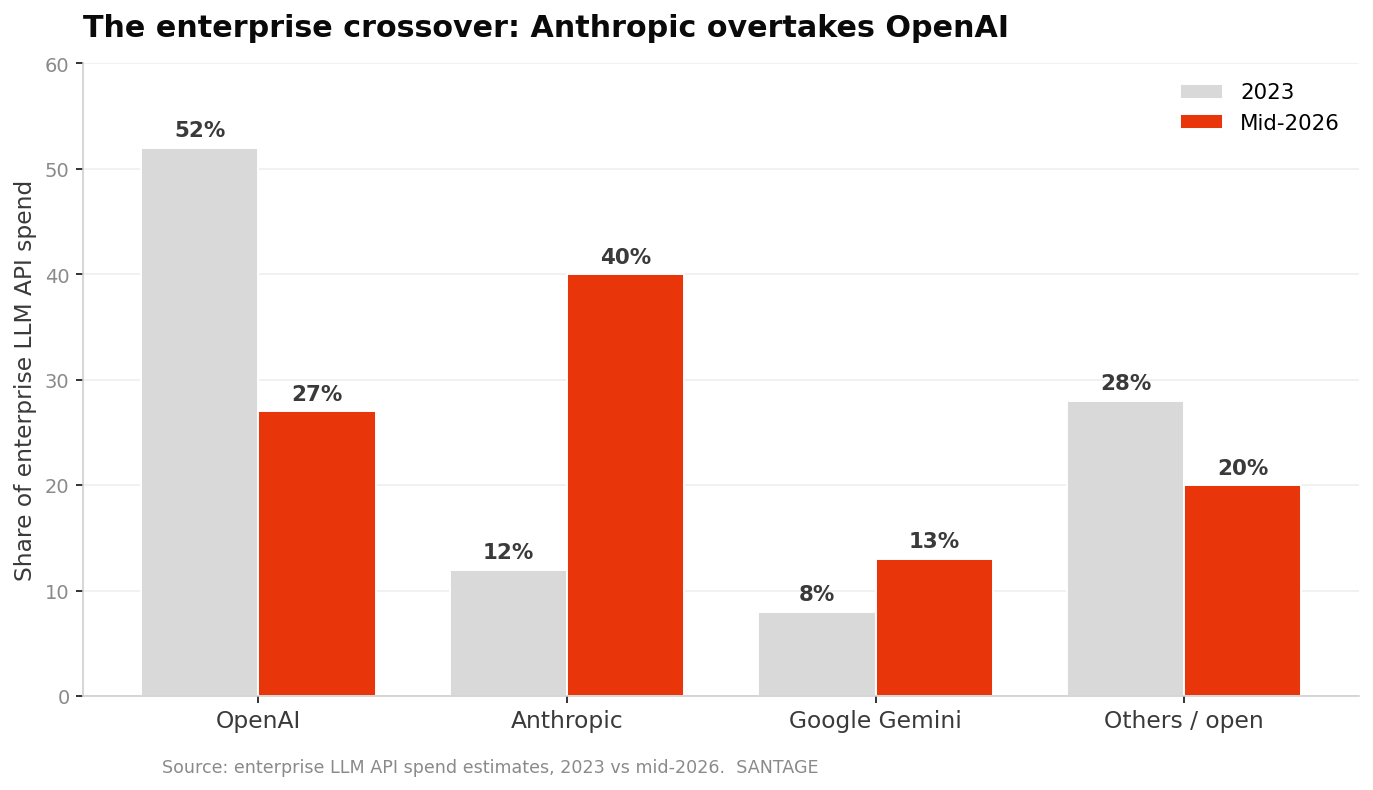
- Anthropic now holds roughly 40% of enterprise LLM API spend against OpenAI's 27%, a reversal of the 2023 split when OpenAI led with more than half the market.
- OpenAI still dominates consumers, with ChatGPT holding a majority of AI web traffic, while Anthropic sits in low single digits there.
- Google has the widest distribution in the industry, default AI on more than 90% of smartphones by late 2026, yet its Gemini models keep missing on the quality that enterprise buyers pay for.
Anthropic's enterprise lead is now a revenue lead too
For two years the frontier race was scored on benchmarks. In mid-2026 it is scored on invoices, and the invoices tell a story the leaderboards missed. Anthropic's annualized revenue run rate crossed 47 billion dollars, up from roughly 9 billion at the end of 2025, and now runs ahead of OpenAI's reported pace. Its May Series H valued the company at 965 billion dollars, above OpenAI's 852 billion. A confidential IPO filing followed.
The engine underneath is enterprise. Anthropic's revenue is roughly 80% enterprise, the mix investors reward with the highest multiples because it is stickier and less promotional than consumer subscriptions. The company captured that lead by owning the single most valuable agent workload, software engineering, where Claude became the default, and by pairing it with a safety and reliability posture that shortens procurement inside regulated buyers.
Google owns the distribution and still cannot close the model gap
Google should be winning. Gemini powers Android and, after Apple's WWDC 2026 deal, a rebuilt Siri across roughly 1.4 billion iPhones, putting it on track to be the default assistant on more than 90% of the world's smartphones. No rival has anything close to that surface area. Distribution on that scale is supposed to be decisive.
It has not been, because distribution moves consumers, not enterprise budgets, and the enterprise buyer keeps choosing on capability. Google's Gemini 3.5 Pro shipped to a third straight round of benchmark and reliability misses this summer, a pattern serious enough that it reads as structural rather than a bad release. When the model that ships under the biggest brand in computing is the one buyers route around, the problem is not reach. It is the product.
The consumer moat and the enterprise moat are different moats
This is the mistake most single-company coverage makes: it treats the AI race as one leaderboard when there are two, and different firms are winning each. OpenAI's ChatGPT still holds a majority of consumer AI traffic, a brand and habit lead that is hard to dislodge and that Anthropic has barely contested. Anthropic owns the enterprise API and the developer default. Google owns the operating-system layer but monetizes it least.
- Enterprise API spend: Anthropic ~40%, OpenAI ~27%, Google Gemini ~13%
- Consumer AI web traffic: OpenAI majority, Gemini rising via distribution, Claude low single digits
- Valuation: Anthropic ~965B, OpenAI ~852B, Alphabet ~4.2T public market cap
- Revenue run rate: Anthropic ~47B annualized, roughly 80% enterprise
Each moat is real, and none of the three can simply buy the other. OpenAI cannot manufacture Anthropic's enterprise trust with a price cut. Anthropic cannot manufacture ChatGPT's consumer habit with a better benchmark. Google cannot convert 90% device share into API revenue while its model keeps missing.
The frontier race stopped being one contest. It is now three companies each winning a different market, and each unable to buy its way into the others.
What decides the next 12 months
The variable to watch is not the next model release, it is whether any of the three can break out of one market into another. If Anthropic converts its enterprise trust into a credible consumer product, it becomes the clear leader. If Google finally ships a Gemini that matches its distribution, it collapses the whole board at once. If OpenAI turns ChatGPT's consumers into enterprise seats before Anthropic reaches consumers, it reclaims the lead it lost.
For now the honest scorecard is uncomfortable for the company with the most attention and the most reach. Google has the distribution to win the AI race and, as of July 2026, the weakest model of the three trying to. Reach was supposed to be the moat. It turns out the moat was always the model.
Santage is committed to independent, transparent journalism. This article is produced in accordance with Santage's Editorial Standards and aims to provide accurate and timely information. Readers are encouraged to verify information independently.