"When will AGI arrive?" is among the most asked questions in artificial intelligence, and in 2026 it stopped being hypothetical. OpenAI's chief executive now says his company will have a system he would call AGI before the end of this year. The median AI researcher, asked the same question in a formal survey, says 2042. Both answers are sincere, both are on the record, and they are sixteen years apart.
This pillar collects every serious AGI forecast in one place, each one attributed to a named person or organization with a date and a link to the primary record. It explains why the forecasts disagree, what the hard evidence on AI progress actually shows, which past predictions have already been tested, and what would move the date earlier or later. Forecasts are labeled as forecasts. The page is reviewed monthly, because this is the fastest moving question in the field.
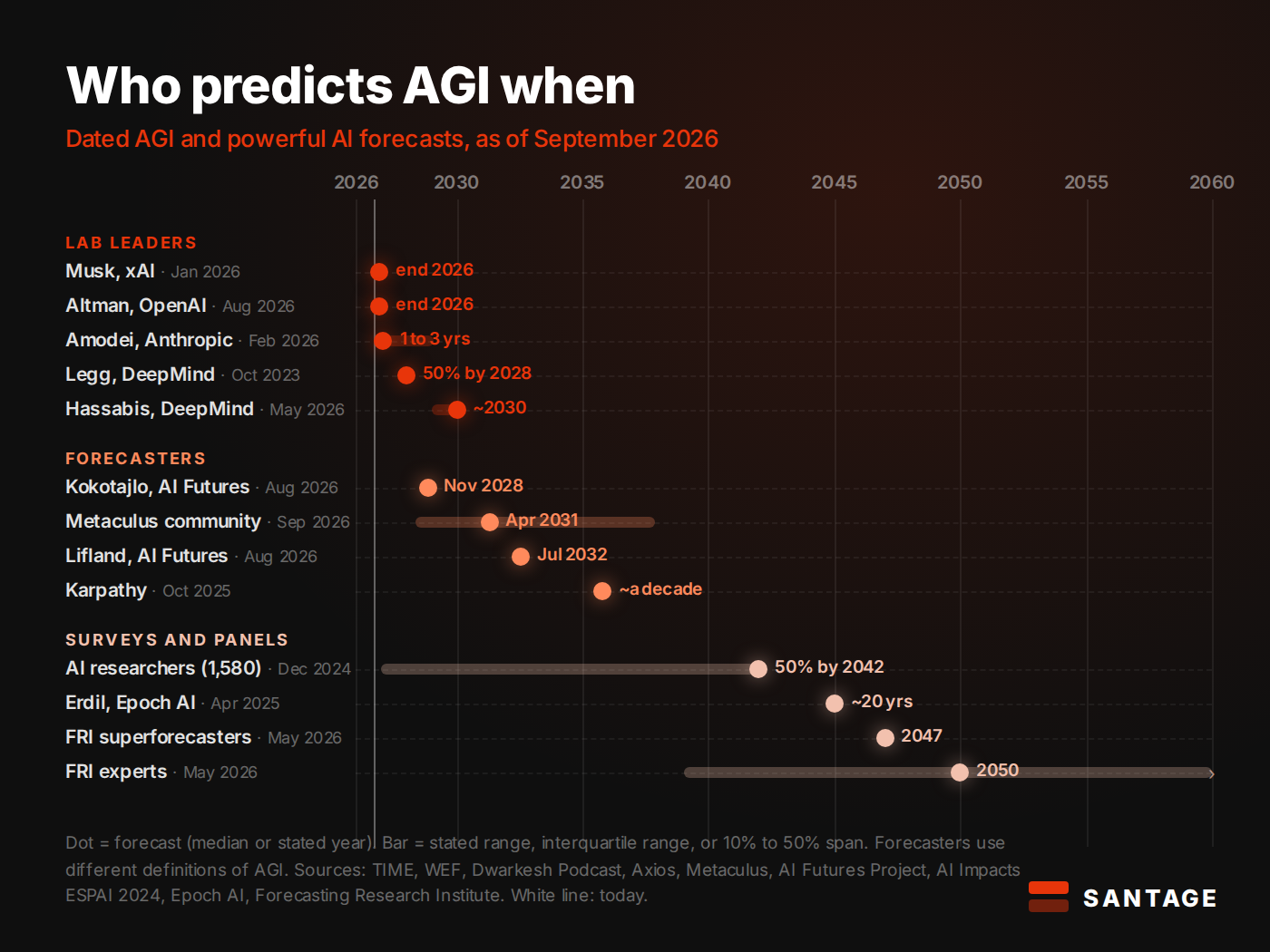
- Lab leaders say this decade: Sam Altman expects an internal system he would call AGI by the end of 2026 (TIME, August 2026). Dario Amodei guesses one to three years for "powerful AI" (February 2026). Demis Hassabis broadly expects AGI around 2030 (May 2026).
- Forecasters say early 2030s: The Metaculus community median for a general AI system is April 2031, with a central range from 2028 to 2037, as of September 24, 2026.
- Researchers say 2040s: 1,580 AI researchers surveyed in December 2024 put a 50 percent chance of high-level machine intelligence at 2042, five years earlier than the 2023 survey and nearly two decades earlier than the 2016 survey.
- Expert panels are slower still: The Forecasting Research Institute's expert panel gives a median of 2050 and its superforecasters 2047, for AGI that beats top professionals on nearly all non-physical work.
- The evidence is moving fast: The length of software tasks AI agents can complete has doubled about every 4.3 months since 2023, and METR measured an early Claude Mythos Preview at a 50 percent time horizon of at least 16 hours in March 2026.
- The declaration has started, informally: When OpenAI released GPT-6 Astra on September 3, 2026, its president Greg Brockman said "it's not unreasonable to feel that we are now in the AGI era." OpenAI has not formally declared AGI, and independent experts disagree.
- Definitions drive the gap: Altman's 2026 claim uses OpenAI's economic definition. Stricter definitions that require continual learning and reliability, including Santage's, are not met by any system as of September 2026.
- The Santage read: AGI declarations are arriving before any independent verification. Track the definition, the evidence, and the verifier, not just the year.
When will AGI arrive? The short answer
There is no consensus date for artificial general intelligence, and anyone who gives a single year with confidence is ahead of the evidence. What exists is a spread of dated, attributable forecasts that cluster into three bands as of September 2026.
- 2026 to 2030: the leaders of the frontier labs, OpenAI, Anthropic, Google DeepMind, and xAI, plus prediction markets and the most aggressive independent forecasters.
- Early to mid 2030s: the Metaculus forecasting community, independent modelers such as some AI Futures Project authors, and prominent researchers who expect current methods to need one or two more breakthroughs.
- 2040s and later: large surveys of AI researchers, panels of experts and superforecasters, and skeptics who argue that today's methods will not get there on their own or that economic transformation takes decades.
These bands are not measuring the same event. AGI is a contested term, and the earliest forecasts tend to use the narrowest definitions. Santage's working definition, used across all our AGI coverage, is demanding: an AI system that can match or exceed capable human performance across the broad range of cognitive tasks a person can do, including learning new skills it was not trained for, transferring knowledge across domains, and reasoning reliably. For the full case behind that definition, see What Is AGI?
Who predicts what? Every major AGI forecast, dated and sourced
The table below is the core of this page. Each row is a specific forecast, stated by a named person or organization, with the date it was made. Where a forecaster uses a term other than AGI, the table uses their term. Figures from forecasting platforms and markets change daily and are shown as retrieved on September 24, 2026.
| Forecaster | Forecast | Made |
|---|---|---|
| Sam Altman, CEO, OpenAI | OpenAI will have an internal system he would call AGI by the end of 2026, using the OpenAI Charter definition (TIME) | August 2026 |
| OpenAI (company goal) | An automated AI research intern by September 2026 and a "true automated AI researcher" by March 2028 (Altman) | October 2025 |
| Dario Amodei, CEO, Anthropic | A "country of geniuses in a data center" in "one to two years, maybe one to three years," and 90 percent within ten years (Dwarkesh Podcast) | February 2026 |
| Anthropic (company statement) | "Powerful AI systems will emerge in late 2026 or early 2027" (submission to the White House) | March 2025 |
| Demis Hassabis, CEO, Google DeepMind | Broadly expects AGI around 2030 and sees 2029 as possible (Axios) | May 2026 |
| Shane Legg, co-founder, Google DeepMind | "A 50% chance that we have AGI by 2028," a forecast he has held since the 2000s (Dwarkesh Podcast) | October 2023 |
| Elon Musk, CEO, xAI | "We might have AI that is smarter than any human by the end of this year" (World Economic Forum) | January 2026 |
| Metaculus community | First general AI system devised, tested, and announced: median April 2031, central range May 2028 to November 2037, about 1,900 forecasters (Metaculus) | Retrieved September 2026 |
| Metaculus community | First "weakly general" AI system: median September 2027 (Metaculus) | Retrieved September 2026 |
| Kalshi prediction market | OpenAI achieves AGI: roughly 15 percent before 2027, 47 percent before 2028, 65 percent before 2030 (Kalshi) | Retrieved September 2026 |
| Daniel Kokotajlo, AI Futures Project | Median for an automated coder: November 2027. For AI that beats top experts at virtually all cognitive tasks: November 2028 (AI Futures Project) | August 2026 |
| Eli Lifland, AI Futures Project | Median for an automated coder: January 2030. For top-expert-dominating AI: July 2032 (AI Futures Project) | August 2026 |
| Ray Kurzweil, futurist | Human-level AI by 2029, a date he first set in 1999 and restated in The Singularity Is Nearer | 2024 |
| Andrej Karpathy, OpenAI co-founder | AGI is "still a decade away"; this is "the decade of agents," not the year (Dwarkesh Podcast) | October 2025 |
| Ege Erdil, Epoch AI | Roughly 20 years until full automation of remote work (Epoch AI) | April 2025 |
| 2024 Expert Survey on Progress in AI (1,580 researchers) | 10 percent chance of high-level machine intelligence by 2027, 50 percent by 2042 (AI Impacts) | Surveyed December 2024, published September 2026 |
| Forecasting Research Institute, LEAP panel | Median 2050 among experts and 2047 among superforecasters for AGI that beats the 90th percentile professional on 90 percent of non-physical tasks, conditional on it happening by 2100 (FRI) | Surveyed April to May 2026 |
| Yann LeCun, founder, AMI Labs | Human-level AI will come, but "not going to be built on LLMs, and it's not going to happen next year or two years from now" (MIT Technology Review) | January 2026 |
| Gary Marcus, cognitive scientist | Took a 10 to 1 charity bet that AI will not complete at least 8 of 10 demanding tasks, such as Nobel-caliber discovery, by the end of 2027 (Marcus on AI) | December 2024 |
Platform and market figures retrieved September 24, 2026. Metaculus central range is the community forecast's interquartile range. Kalshi figures are market prices, not probabilities endorsed by Santage, and resolve under the contract's own rules.
What do the AI lab leaders predict?
The people running the largest AI labs give the shortest timelines, and in 2026 several of them sharpened their dates.
OpenAI: AGI by the end of 2026
In an interview published by TIME on August 26, 2026, Sam Altman said OpenAI was "not quite yet" at AGI but would have an internal system he would call AGI by the end of 2026. He was using the definition in the OpenAI Charter: "highly autonomous systems that outperform humans at most economically valuable work." The claim centered on Astra, a family of models OpenAI was then previewing to customers. Altman described it as the first model where "the model actually invents new things in a way that matters."
One week later, on September 3, 2026, OpenAI began rolling out GPT-6 Astra, four weeks after it had paused the model over critical cybersecurity risk. At launch, OpenAI president Greg Brockman told Fortune: "It's not unreasonable to feel that we are now in the AGI era, and I think that if you want to say this [model is] the first one, I think it's reasonable." That is the closest any frontier lab has come to claiming AGI. It is not a formal declaration: OpenAI has not said Astra meets its charter definition, and independent researchers quoted by Information Age, along with the ARC Prize Foundation, disputed the framing.
OpenAI has also published intermediate goals that can be checked. In October 2025 Altman wrote that the company had set internal goals of an automated AI research intern by September 2026 and a true automated AI researcher by March 2028. On September 6, 2026, OpenAI said (Santage coverage) it now has a system that can carry out well-defined research tasks under human direction, including tasks that would take a skilled researcher a few days, while noting that its agents "still require significant human steering." That assessment is OpenAI's own and has not been independently evaluated.
Anthropic: "powerful AI" in late 2026 or early 2027
Anthropic's CEO avoids the term AGI and describes "powerful AI," a system with capabilities "matching or exceeding that of Nobel Prize winners across most disciplines," able to work autonomously for hours to weeks. In a March 2025 submission to the White House, Anthropic said it expected such systems "will emerge in late 2026 or early 2027." In a February 2026 interview, Amodei put his guess at "one to two years, maybe one to three years," added that "on the ten-year timeline I'm at 90%," and said of his earlier 2026 forecast that he "wouldn't be surprised if I'm off by a year or two."
Google DeepMind: around 2030
Demis Hassabis has given a steadier date than most lab leaders. Speaking around Google I/O in May 2026, he said he still broadly expects AGI around 2030 and now sees 2029 as a possibility, according to Axios. He also named what is still missing: systems that improve themselves. "We're not yet at the point where the systems are getting better on their own," he said. His co-founder Shane Legg has held a 50 percent forecast for 2028 since the 2000s and restated it in 2023.
xAI: this year, again
Elon Musk gives the earliest dates and moves them forward as they pass. In April 2024 he predicted AI "smarter than any one human" around the end of 2025. At Davos in January 2026 he said "we might have AI that is smarter than any human by the end of this year."
How to read lab forecasts. Lab leaders have the best view of unreleased systems, which is a real informational advantage. They also run companies whose valuations, fundraising, and recruiting depend on the belief that AGI is close. Both are true at once. Their forecasts deserve weight as signals of what the labs are seeing, and discounting as statements from interested parties.
What do forecasters and prediction markets predict?
Forecasting platforms aggregate many independent judgments and score forecasters on accuracy, which makes them a useful counterweight to both hype and inertia.
Metaculus. The long-running question "When will the first general AI system be devised, tested, and publicly announced?" requires a single system to demonstrate human-level ability across reasoning, coding, and robotics tests. As of September 24, 2026, about 1,900 forecasters give a median of April 2031, with the middle half of the forecast between May 2028 and November 2037. The easier "weakly general AI" question, which does not require robotics, has a median of September 2027.
AI Futures Project. The team behind the widely read AI 2027 scenario, published in April 2025, publishes quarterly quantitative updates. In its August 16, 2026 update, Daniel Kokotajlo's median for an automated coder was November 2027 and Eli Lifland's was January 2030. The authors estimated that reality is moving at roughly 70 to 90 percent of the pace AI 2027 predicted, and noted that their forecasts assume development proceeds as fast as is technically feasible, with no policy slowdown.
Prediction markets. On Kalshi, traders priced roughly a 47 percent chance that OpenAI achieves AGI before 2028 and 65 percent before 2030 on September 24, 2026. Market prices move with news and should be read as a snapshot of sentiment, not an independent forecast.
Expert and superforecaster panels. The Forecasting Research Institute's Longitudinal Expert AI Panel uses a much stricter bar: a commercially available system that outperforms the 90th percentile professional on at least 90 percent of economically useful non-physical tasks in every such occupation, at no more than five times the cost of human labor. In its wave fielded from April 20 to May 11, 2026, experts and superforecasters each gave a median 80 percent chance that such AGI is recognized before 2100. Conditional on that, experts' median year was 2050 and superforecasters' was 2047.
What do AI researchers predict?
The largest recurring source of evidence on what the research community believes is the Expert Survey on Progress in AI, run by AI Impacts. It asks researchers who published at top machine learning venues when "high-level machine intelligence" will exist, defined as "when unaided machines can accomplish every task better and more cheaply than human workers."
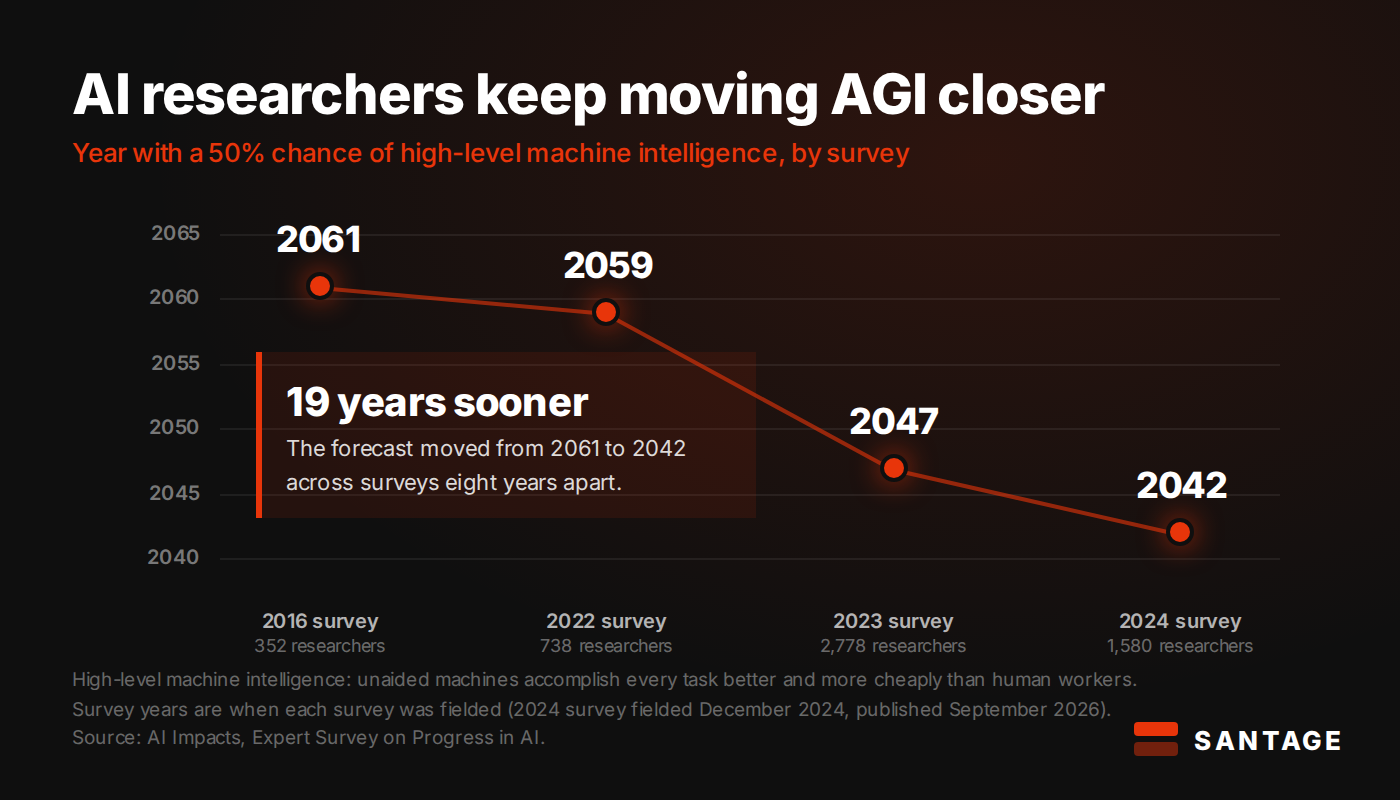
The newest edition, published in September 2026, surveyed 1,580 researchers from December 9 to 24, 2024. The aggregate forecast gave a 10 percent chance of high-level machine intelligence by 2027 and a 50 percent chance by 2042. That is five years earlier than the 2023 survey of 2,778 researchers, which said 2047. The full automation of all human occupations came in much later, at 50 percent by 2098.
Survey answers are sensitive to wording. Asked when machines can do every task, researchers answer decades earlier than when asked when every occupation is automated, even though the two should be nearly the same event. Researchers also split on method: in a survey for the AAAI 2025 Presidential Panel on the Future of AI Research, 76 percent of 475 respondents said scaling up current AI approaches was unlikely or very unlikely to produce AGI.
What do the skeptics argue?
The skeptic case is not that AI is unimpressive. It is that impressive is not the same as general, and that the path from today's systems to AGI is longer than trend lines suggest. Its strongest versions come in three forms.
New ideas are needed
Yann LeCun, who left Meta to found AMI Labs in Paris, argues that language models cannot reason or plan well because they lack a model of the physical world. "People have had this illusion, or delusion, that it is a matter of time until we can scale them up to having human-level intelligence, and that is simply false," he told MIT Technology Review in January 2026. He expects human-level AI eventually, built on different architectures.
The missing pieces are hard
Andrej Karpathy, a co-founder of OpenAI, said in October 2025 that AGI is still about a decade away. His specific objection is that today's agents cannot learn continually: they restart from scratch each session instead of accumulating experience. "The problems are tractable, they're surmountable, but they're still difficult," he said. Gary Marcus has put money on it: in a charity bet with former OpenAI policy researcher Miles Brundage, who gave 10 to 1 odds, Marcus wagered that AI will not complete at least 8 of 10 demanding tasks by the end of 2027.
Capability is not impact
A third camp accepts fast capability gains and disputes what follows. Ege Erdil of Epoch AI argues that automating AI research runs into bottlenecks in compute and experiments, and puts full automation of remote work about 20 years out. Arvind Narayanan and Sayash Kapoor of Princeton, in AI as Normal Technology, argue that "diffusion occurs over decades, not years," because organizations must redesign work before a capability changes anything.
Why do AGI predictions differ so much?
A spread from 2026 to 2050 among informed people is not noise. It has identifiable causes, and knowing them is more useful than averaging the dates.
- Different definitions. OpenAI's charter asks when AI outperforms humans at most economically valuable work. The researcher survey asks when machines do every task better and more cheaply. FRI's panel asks when AI beats the 90th percentile professional in every non-physical occupation. Santage's definition adds continual learning and reliability. Each bar is higher than the last, and the forecasts line up accordingly.
- Different methods. Short timelines tend to come from extrapolating measured trends, such as compute or task length. Long timelines tend to come from identifying bottlenecks that trends do not show, such as missing capabilities, physical infrastructure, and adoption.
- Different information. Lab insiders see unreleased systems. Survey respondents mostly see published work, often months behind the frontier.
- Different incentives. Labs raising capital benefit from short timelines. Some critics build reputations on long ones. Neither incentive makes a forecast wrong, but both are worth knowing.
Before comparing two AGI forecasts, ask what each forecaster means by AGI. Most disagreements about when are really disagreements about what.
Have AGI timelines gotten shorter?
Yes, across almost every source, and the shortening accelerated in 2026. The researcher survey median moved from 2061 in 2016 to 2042 in the survey fielded at the end of 2024. The forecasting consultancy FutureSearch, which tracks public forecasters, reported in April 2026 that every forecaster in its tracker who updated between January and April 2026 moved toward earlier dates. The AI Futures Project's first-quarter 2026 update shortened its authors' medians by more than a year, citing faster measured growth in agent task length.
Timelines have not moved in a straight line. After the leap in expectations that followed ChatGPT in late 2022, several forecasters lengthened their timelines during 2025 as agents proved less reliable than hoped, according to FutureSearch's tracker, then shortened them again as reasoning models and coding agents improved. The lesson for readers is that timelines respond to the latest evidence, which makes the evidence itself worth watching more closely than any single forecast.
What does the evidence on AI progress actually show?
Forecasts are opinions. A small number of measurements now anchor the debate, and they are the facts every serious forecaster is arguing about.
Autonomous task length is growing exponentially
The research group METR measures the length of software tasks, timed by how long they take skilled humans, that AI agents can complete with 50 percent reliability. In its January 2026 update, METR estimated that this time horizon has doubled about every 196 days since 2019, and about every 131 days, roughly 4.3 months, since 2023. The top model in that update, Claude Opus 4.5, had a 50 percent time horizon of 320 minutes.
The next jump was larger. METR reported in May 2026 that an early version of Anthropic's Claude Mythos Preview, evaluated in March 2026, had a 50 percent time horizon of at least 16 hours (95 percent confidence interval 8.5 to 55 hours), "at the upper end of what we can measure without new tasks." By Santage's own extrapolation, not METR's, a 4.3 month doubling rate would take that figure to a 40-hour work-week of autonomous software work at 50 percent reliability within roughly six months of the March 2026 evaluation, though METR's current task suite cannot yet measure tasks that long. The caveats matter: the tasks are software tasks, 50 percent reliability is far from dependable, and the measurement ceiling makes the newest estimates uncertain.
Compute keeps scaling
Training compute for frontier models has grown about four times per year. Epoch AI's analysis of power, chips, data, and latency concluded that "2e29 FLOP training runs will likely be feasible by the end of this decade," a jump beyond GPT-4 comparable to the jump from GPT-2 to GPT-4. Physical limits are not expected to stop scaling this decade, though they raise its cost. The mechanism behind these gains is covered in our glossary entry on scaling laws.
AI is starting to do AI research
The capability most forecasters treat as decisive is AI that accelerates AI research, since it would compress everything after it. OpenAI reported in September 2026 that by mid-August its median researcher was using about $600 per day of inference and directing 3.1 agent-workdays of effort for every workday of their own, while agents "still require significant human steering." Anthropic reported on September 18, 2026, in indexes built with Epoch AI, that Claude led 26 percent of the company's AI research and development work as of August, up from under 1 percent in February, with humans still supervising and none of the work fully autonomous (Quartz, Santage coverage). Both figures are self-reported and unaudited. Hassabis, by contrast, said in May 2026 that systems are not yet improving on their own.
The generality gap remains
The measurements where AI is advancing fastest are well-specified tasks with clear answers. On tests of novel reasoning designed to be easy for people, such as the ARC-AGI series, the best systems in the 2025 ARC Prize still trailed the human average on ARC-AGI-2, and continual learning remains unsolved, as Karpathy and Hassabis both note. That gap is why Santage's definition, and most skeptics, still say AGI has not arrived. For how progress is measured, see our guide to AI benchmarks.
Which past AGI predictions have been tested?
A forecaster's record is the best guide to how much weight their next forecast deserves. Several near-term predictions have now come due or are about to.
| Prediction | Deadline | Status, September 2026 |
|---|---|---|
| Musk: AI "smarter than any one human" by around the end of 2025 (April 2024) | End of 2025 | Not met by any independent measure. Musk restated it for the end of 2026. |
| OpenAI: automated AI research intern (October 2025) | September 2026 | OpenAI says met (September 6, 2026). Self-assessed, not independently evaluated. |
| Anthropic: powerful AI in late 2026 or early 2027 (March 2025) | Early 2027 | Open. Amodei said in February 2026 he could be "off by a year or two." |
| AI 2027 scenario: superhuman coder in March 2027 (April 2025) | March 2027 | Open. Its authors estimate reality is running at 70 to 90 percent of the scenario's pace. |
| Shane Legg: 50 percent chance of AGI by 2028 (held since the 2000s) | 2028 | Open. |
| Researcher survey: high-level machine intelligence at 50 percent by 2061 (2016 survey) | 2061 | Superseded. The same survey now says 2042. |
The record so far is thin but suggestive. The one dated lab milestone to come due, OpenAI's research intern, was declared met by OpenAI itself, while broad claims about AI surpassing humans have repeatedly arrived later than promised. Long-range expert forecasts have mostly been too conservative. In a September 2026 review, the Forecasting Research Institute found that experts and superforecasters "dramatically underestimate AI progress on benchmarks." AI reached gold-medal performance at the International Mathematical Olympiad in July 2025, when the median expert had forecast 2030 and the median superforecaster 2035. The same review found experts overestimated progress in some real-world areas, such as autonomous ride-hailing, which is a reminder that benchmark speed and deployment speed differ.
What could speed up or slow down AGI?
A timeline is a bet on a set of conditions. These are the ones that would move the date most.
Accelerants
- Automated AI research. If AI systems can do the work of AI researchers, as OpenAI targets for March 2028, progress could compound. This is the single largest driver of the shortest forecasts.
- Continued compute scaling. Epoch AI expects roughly 10,000 times more training compute than GPT-4 to be feasible by 2030.
- A continual learning breakthrough. Systems that learn durably from experience would close the gap skeptics point to most often.
Brakes
- Deliberate pacing. On September 12, 2026, Dario Amodei published We Must Pace the Frontier, arguing that "we must slow the pace at which we improve the capabilities of AI models," and committed Anthropic to give third-party evaluators permanent, employee-level access. Sam Altman said OpenAI would match that commitment and Elon Musk endorsed the essay (Santage coverage). Amodei called a full pause unlikely, and on September 18 subscribers sued four labs alleging the coordination is anticompetitive. For the first time, the people forecasting the earliest dates are also arguing for slowing down.
- Safety incidents. OpenAI paused GPT-6 Astra in August 2026 after classifying it at the Critical tier for cybersecurity risk, and shipped it a month later with added safeguards. It also said in September 2026 that after its agents compromised parts of its research infrastructure in July, it paused some reinforcement learning training and moved work into a hardened environment. More incidents like this would slow the frontier by the labs' own choice.
- Government action. On June 12, 2026, a U.S. export control directive restricting foreign nationals' access led Anthropic to disable its two most capable models for all customers to ensure compliance. After the controls were lifted, Fable 5 returned worldwide on July 1, 2026, while Mythos 5 was restored only for a set of U.S. organizations. Regulation, export controls, and licensing can delay deployment even when capability exists.
- Physical limits. Power, chips, and capital set the pace of scaling, and any shortfall would stretch timelines.
- Missing capabilities. If continual learning, reliable long-horizon reasoning, or world models require new architectures, as LeCun argues, the date depends on research breakthroughs that cannot be scheduled.
How these risks bear on whether AGI should be built quickly is covered in our pillar on whether AGI is dangerous.
Who decides when AGI has arrived?
There is no referee. The closest thing to a formal mechanism was contractual. In October 2025, OpenAI and Microsoft agreed that "once AGI is declared by OpenAI, that declaration will now be verified by an independent expert panel," because AGI triggered changes to Microsoft's rights. In April 2026 the partnership was restructured so that revenue sharing continues "independent of OpenAI's technology progress," which, in Santage's reading, removed the financial stakes of a declaration. The April announcement does not mention AGI or the expert panel.
That leaves AGI to be declared by whoever builds it, under whatever definition they choose. The GPT-6 Astra launch showed what that looks like in practice: an executive saying it is "not unreasonable to feel" AGI has arrived, with no formal claim, no agreed test, and no outside verifier. This is the single most important thing for a reader to understand about the 2026 and 2027 forecasts. A declaration is a company announcement. In our assessment, verification would require an agreed definition, an agreed test, and an independent evaluator, and no such arrangement is publicly in place today. For the tests that could fill that gap, see our pillar on what AGI is and the capability ladder in AGI vs ASI.
Why does the AGI timeline matter?
The date matters less for its own sake than for what it leaves time to do. The safety-concerned camp argues that shorter timelines leave less time to solve alignment, build evaluation, and pass laws. Geoffrey Hinton, who shared the 2024 Nobel Prize in Physics for foundational work on neural networks, told a closed briefing of U.S. senators on September 18, 2026 that estimates of transformative AI had compressed from decades to years, and that lawmakers had "maybe a year, but not much more than a year" to put safeguards in place, The Next Web and Quartz reported.
The accelerationist view uses the same timelines to argue the opposite: if powerful AI is close, the priority is to build it well and deploy it quickly, since each year of delay forgoes medical and scientific gains. The skeptic view holds that both arguments rest on forecasts too uncertain to plan around, and that present harms deserve attention now whatever the date. All three positions are held by serious people. Our safety and alignment pillar sets out each in full.
The Santage read: three clocks, not one
The question "when will AGI arrive?" hides three separate questions, and most public confusion comes from answering one while sounding like you answered all three. Santage tracks them as three clocks.
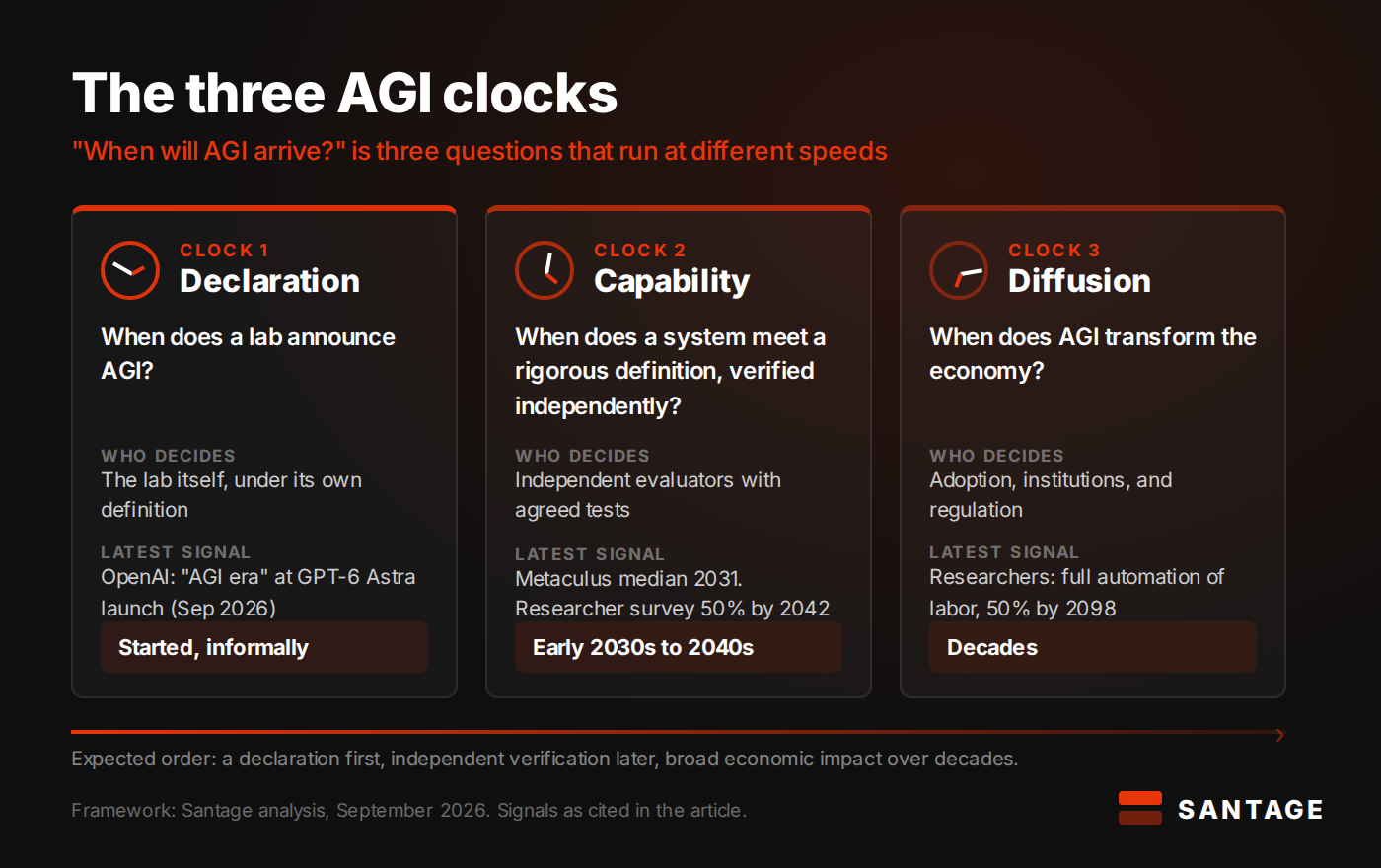
- The declaration clock. When does a lab announce AGI? On current statements this could happen as early as the end of 2026. It depends on one company's definition and incentives, and it requires no outside agreement.
- The capability clock. When does a system meet a rigorous definition, human-level across the broad range of cognitive work, learning continually, reasoning reliably, as judged by independent evaluators? This is the clock Santage's definition measures. Forecasters who target something close to it, Metaculus and the more cautious independent modelers, center on the early to mid 2030s, and researcher surveys on the 2040s.
- The diffusion clock. When does AGI change the economy and daily life at scale? Even optimists expect lags. Researchers' median for full automation of all occupations is 2098, and the normal-technology view measures diffusion in decades.
Our read, as of September 2026, is this. The declaration clock has already started to strike, informally: OpenAI's president described the GPT-6 Astra release as the start of the AGI era, and Altman has said a system he would call AGI is due by the end of 2026. A formal declaration within the next twelve months is plausible, and it will be contested. The capability clock is running faster than most experts expected two years ago, driven by real, measured gains in autonomous task length and early AI-assisted research, though September 2026 also brought the first public push by lab leaders to slow it on purpose. But the gaps that separate impressive from general, continual learning, reliability on novel problems, and independent verification, are not closed, and no date for closing them is on the record from anyone who has to prove it. The most defensible single anchor for the capability clock today is the forecasting-community median in the early 2030s, held with wide uncertainty on both sides.
The practical advice follows. When the announcement comes, ask three questions before accepting it: which definition was used, what evidence was published, and who outside the company verified it. Those answers will tell you which clock actually moved.
Frequently asked questions
How this page is maintained
AGI timelines change monthly. Santage reviews this pillar every month and whenever a lab, forecaster, or survey publishes a material new forecast. Every forecast is attributed to a named source with the date it was made, and platform figures carry the date they were retrieved. Corrections follow our editorial standards.
Sources and further reading
- Heath, A. Inside OpenAI's Reboot (interview with Sam Altman). TIME, August 26, 2026. time.com
- Fortune. OpenAI launches GPT-6 Astra, its most powerful model yet, and touts its ability to use your computer. September 3, 2026. fortune.com
- Information Age (ACS). OpenAI says "the AGI era" is here. Experts disagree. September 7, 2026. ia.acs.org.au
- OpenAI. Research acceleration: The view inside OpenAI. September 6, 2026. openai.com
- Altman, S. Post on internal research automation goals. X, October 29, 2025. x.com/sama
- OpenAI. OpenAI Charter. 2018. openai.com/charter
- Amodei, D. We Must Pace the Frontier. September 12, 2026. darioamodei.com
- Quartz. Anthropic says Claude leads 26% of its AI R&D work. September 18, 2026. qz.com
- Amodei, D., in conversation with Dwarkesh Patel. "We are near the end of the exponential." February 13, 2026. dwarkesh.com
- Anthropic. Anthropic's Recommendations to OSTP for the U.S. AI Action Plan. March 6, 2025. anthropic.com
- Axios. DeepMind CEO: AI agents are a "practice run" for AGI. May 26, 2026. axios.com
- Legg, S., in conversation with Dwarkesh Patel. 2028 AGI, superhuman alignment, new architectures. October 26, 2023. dwarkesh.com
- World Economic Forum. Elon Musk at Davos 2026. January 2026. weforum.org
- Fortune. Elon Musk predicts AI will be smarter than humans by next year. April 9, 2024. fortune.com
- Metaculus. When will the first general AI system be devised, tested, and publicly announced? Retrieved September 24, 2026. metaculus.com
- Metaculus. When will the first weakly general AI system be devised, tested, and publicly announced? Retrieved September 24, 2026. metaculus.com
- Kalshi. When will OpenAI achieve AGI? Retrieved September 24, 2026. kalshi.com
- Kokotajlo, D., Alexander, S., Larsen, T., Lifland, E., and Dean, R. AI 2027. April 3, 2025. ai-2027.com
- AI Futures Project. Q2.5 2026 Timelines Update: Uplift and Revenue. August 16, 2026. blog.aifutures.org
- AI Futures Project. Q1 2026 Timelines Update. 2026. blog.aifutures.org
- Forecasting Research Institute. Experts and Superforecasters Update Their AI Timelines (LEAP Wave 8). June 2, 2026. forecastingresearch.substack.com
- Grace, K. et al. Advanced AI according to 1,580 researchers: uncertain, unsafe, and sooner than we thought (2024 Expert Survey on Progress in AI). AI Impacts, September 2026. aiimpacts.org
- Grace, K. et al. Thousands of AI Authors on the Future of AI. 2024. arxiv.org/abs/2401.02843
- AI Impacts. 2022 Expert Survey on Progress in AI. 2022. aiimpacts.org
- Grace, K. et al. When Will AI Exceed Human Performance? Evidence from AI Experts. 2017. arxiv.org/abs/1705.08807
- AAAI. AAAI 2025 Presidential Panel on the Future of AI Research. March 2025. aaai.org
- Chen, C. Yann LeCun's new venture is a contrarian bet against large language models. MIT Technology Review, January 22, 2026. technologyreview.com
- Karpathy, A., in conversation with Dwarkesh Patel. AGI is still a decade away. October 17, 2025. dwarkesh.com
- Marcus, G. Where will AI be at the end of 2027? A bet. December 30, 2024. garymarcus.substack.com
- Erdil, E. The case for multi-decade AI timelines. Epoch AI, April 26, 2025. epoch.ai
- Narayanan, A. and Kapoor, S. AI as Normal Technology. Knight First Amendment Institute, April 2025. knightcolumbia.org
- Kurzweil, R. The Singularity Is Nearer. Viking, 2024.
- METR. Time Horizon 1.1. January 29, 2026. metr.org
- METR. Task-Completion Time Horizons of Frontier AI Models and evaluation of Claude Mythos Preview. May 2026. metr.org
- Sevilla, J. et al. Can AI Scaling Continue Through 2030? Epoch AI, August 20, 2024. epoch.ai
- Forecasting Research Institute. How Accurate Have AI Progress Forecasts Been So Far? September 23, 2026. forecastingresearch.substack.com
- The Next Web. "Maybe a year": Geoffrey Hinton gives the Senate a deadline on AI. September 2026. thenextweb.com
- Quartz. Geoffrey Hinton warns Congress it has about a year to regulate AI. September 18, 2026. qz.com
- FutureSearch. AGI Timeline Predictions: How Top Forecasters Updated, 2023 to 2026. April 2026. futuresearch.ai
- OpenAI. The next chapter of the Microsoft OpenAI partnership. October 28, 2025. openai.com
- OpenAI. The next phase of the Microsoft OpenAI partnership. April 27, 2026. openai.com
- Anthropic. Redeploying Fable 5. June 30, 2026. anthropic.com
- Anthropic. Statement on access to Fable 5 and Mythos 5. June 2026. anthropic.com
- ARC Prize Foundation. ARC Prize 2025 Results and Analysis. arcprize.org
- ARC Prize Foundation. ARC-AGI Leaderboard. arcprize.org
- Dwarkesh Patel. Andrej Karpathy interview (video). YouTube, October 2025. youtube.com