Artificial general intelligence is the destination the entire AI industry now says it is racing toward, and the one term almost no one agrees on. AGI describes an AI system with the broad, flexible competence of a human mind, able to reason, learn, and adapt across any domain rather than a single narrow task. In 2026 it has moved from science fiction to the stated mission of the world's most valuable AI companies, yet there is still no shared definition, no agreed test, and no consensus on whether it arrives this decade or this century.
This guide sets out what AGI actually means, how it differs from the AI we use today and from the superintelligence that might follow, why serious researchers define it so differently, how progress is measured, and how close we really are. Where a claim is a forecast rather than a fact, it is labeled as one and attributed to a named source with a date.
- Definition: AGI is an AI system that can match or exceed capable human performance across most cognitive tasks, including learning and transferring skills it was not explicitly trained for.
- Not today's AI: Systems like ChatGPT, Claude, and Gemini are broad but narrow of true generality. Google DeepMind's framework places them at Level 1, "Emerging AGI," not full AGI.
- Not superintelligence: AGI is human-level generality. Artificial superintelligence (ASI) exceeds the best humans at nearly everything, and most researchers expect AGI to arrive first.
- Contested term: There are at least nine serious, competing definitions of AGI, from the OpenAI Charter's economic framing to human-level cognition to the ability to learn any task.
- The measurement gap: On ARC-AGI-2, a test of fluid reasoning built to be easy for people and hard for machines, humans average about 60 percent while the best AI systems in 2025 reached the mid-30s to low-50s, at far higher cost.
- Timelines diverge sharply: Lab leaders point to two to five years, a large 2023 survey of researchers put a 50 percent chance around 2047, and prominent skeptics argue current methods will not get there at all.
- Status in 2026: No system meets a serious definition of AGI. The frontier has shifted from raw scale to reasoning, but continual learning, reliability, and genuine generality remain unsolved.
What is artificial general intelligence (AGI)?
Artificial general intelligence (AGI) is an AI system that can understand, learn, and perform across the full range of cognitive tasks that a capable human can, rather than being confined to a narrow, predefined job. IBM defines it as "a hypothetical stage in the development of machine learning in which an artificial intelligence system can match or exceed the cognitive abilities of human beings across any task."
The operative word is general. A chess engine can crush any human on earth, but it cannot write an email, and a medical imaging model that spots tumors cannot book a flight. These are narrow AI: superb inside a boundary, helpless outside it. A human, by contrast, can learn to drive, argue a case, cook a meal, and pick up a new language, transferring understanding from one to the next. AGI names a machine with that same breadth and adaptability.
Two properties do most of the work in serious definitions. The first is generality, the breadth of tasks a system can handle. The second is performance, how well it does them. A system that is broad but shallow, or deep but narrow, is not AGI. AGI requires both at once, across most of what humans do with their minds.
Santage's working definition, used consistently across our AGI coverage, is this: AGI is an AI system that can match or exceed capable human performance across the broad range of cognitive tasks a person can do, including learning new skills it was not trained for, transferring knowledge across domains, and reasoning reliably, without being limited to a fixed set of tasks. By this definition, no system in 2026 is AGI.
AGI vs narrow AI vs superintelligence: what is the difference?
AGI sits in the middle of a three-step ladder. Below it is the narrow AI that runs the world today. Above it is superintelligence, which does not yet exist even in prototype.
| Type | What it means | Examples |
|---|---|---|
| Narrow AI (ANI) | Excels at specific, scoped tasks but cannot operate outside its domain. Also called weak AI. This is all AI in commercial use today. | Chess engines, image classifiers, recommendation systems, and even large language models when judged against true generality |
| Artificial general intelligence (AGI) | Matches or exceeds capable human ability across most cognitive tasks, including learning and transferring new skills. Does not yet exist. | None yet. This is the target the major labs are pursuing |
| Artificial superintelligence (ASI) | Exceeds the best human minds at virtually all tasks, including scientific creativity and strategy. Hypothetical and beyond AGI. | None. The subject of long-term safety and governance debate |
The distinction between AGI and ASI matters because they are often blurred in headlines. Superintelligence is not a requirement for AGI. A system that reaches the level of an average capable adult across tasks would qualify as AGI without being superintelligent. Most researchers expect AGI to come first and, if progress continues, to accelerate the arrival of ASI, a scenario explored in the alignment debate. For a fuller treatment of that ladder and where 2026 models sit on it, see our pillar on AGI vs ASI.
Why is AGI so hard to define?
AGI is a genuinely contested term. It was popularized in the early 2000s, but the underlying goal, machine intelligence as general as a human's, has been debated since the field began. Different definitions emphasize different things, and which one you pick changes whether you think AGI is near, far, or already here.
In their 2024 paper Levels of AGI, researchers at Google DeepMind surveyed the leading definitions and their weaknesses. The main camps:
| Definition | The idea | The problem |
|---|---|---|
| The Turing Test | A machine is intelligent if it can converse indistinguishably from a human | Measures the ability to fool a judge, not genuine capability. Modern chatbots can pass versions of it without being general |
| Economic value (OpenAI Charter) | "Highly autonomous systems that outperform humans at most economically valuable work" | Measurable, but ignores cognitive abilities with no direct market price, and ties a scientific question to economics |
| Human-level cognition (Legg, Goertzel) | AGI performs the cognitive tasks that humans can typically do | Ambiguous about which tasks and which humans |
| Ability to learn (Shanahan) | A system not specialized for set tasks that can learn to perform as broad a range of tasks as a human | Valued for including learning and metacognition, but hard to bound |
| Flexibility and generality (Marcus) | Human-like flexibility and resourcefulness, tested by concrete challenges like the "coffee test" | Useful benchmarks, but unclear whether passing them is sufficient |
| Current LLMs already qualify (Agüera y Arcas, Norvig) | Frontier models are general enough to count as early AGI | Emphasizes generality while underweighting reliable, human-level performance |
DeepMind's response was to stop treating AGI as a single yes-or-no threshold and instead define levels of progress along two axes, generality and performance. That reframing, described in the next section, is now one of the most cited ways to talk about how close we are.
Ask two people to define AGI and you will often get two different answers. The disagreement is not sloppiness. It is the actual state of the field.
How is progress toward AGI measured?
Because a single finish line is so contested, the most useful frameworks describe a path. The best known is the Levels of AGI framework from Google DeepMind, which grades systems on performance, from emerging to superhuman, and separately on whether that ability is narrow or general.
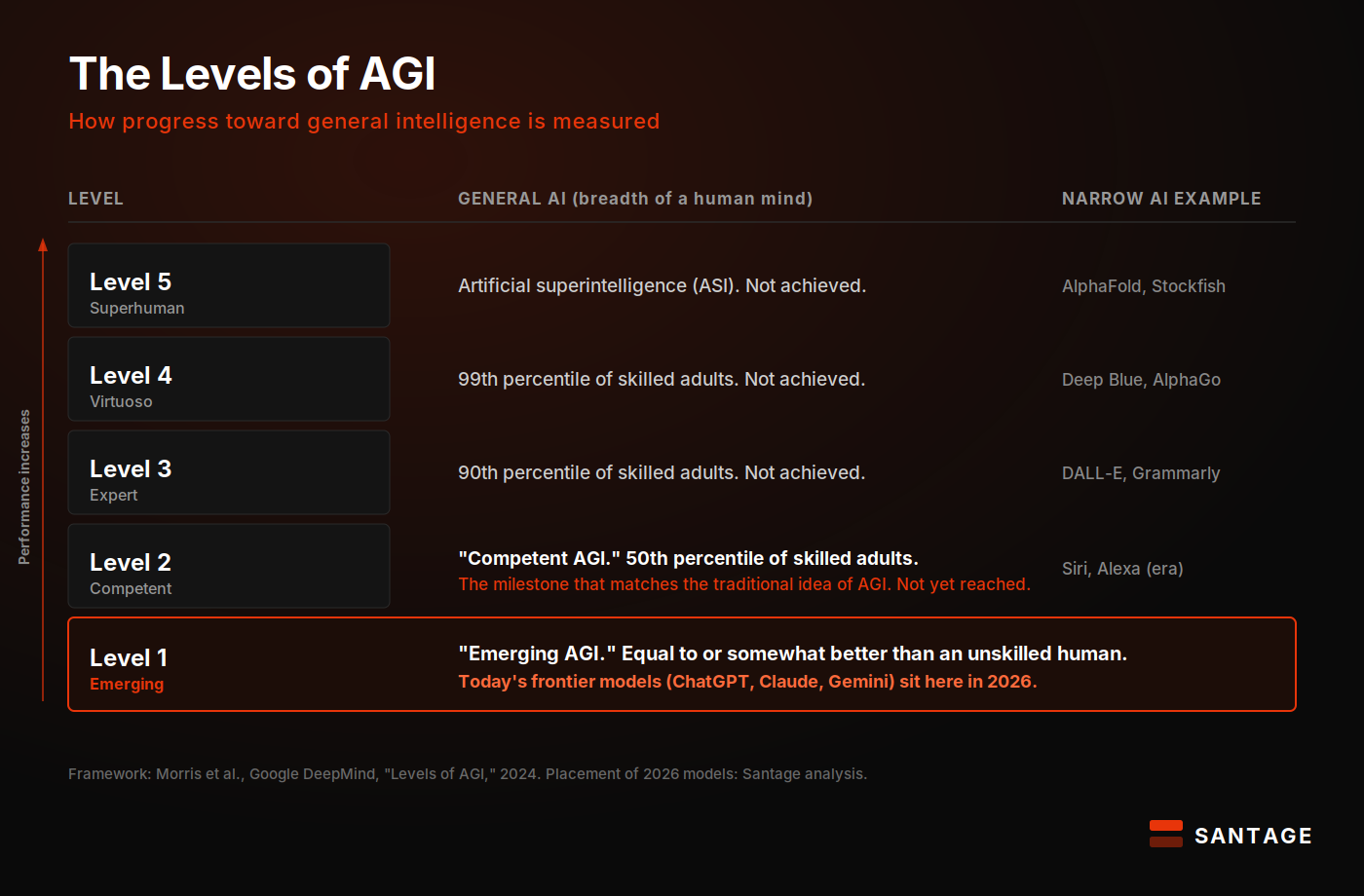
In this framework, a calculator is narrow Level 5 (superhuman at arithmetic), AlphaFold is narrow Level 5 (superhuman at protein-structure prediction), and today's general chatbots are Level 1 general, Emerging AGI: broadly capable, but only equal to or somewhat better than an unskilled human across most tasks. Reaching Level 2 general, "Competent AGI," meaning at least the 50th percentile of skilled adults across a wide range of work, would be the milestone that best matches the traditional idea of AGI, and DeepMind notes it has not been achieved.
Frameworks describe the ladder. Benchmarks try to measure the rungs. The most telling for general intelligence is ARC-AGI, created by researcher François Chollet to test fluid reasoning on novel puzzles that cannot be solved by memorization. Its second version, ARC-AGI-2, is deliberately built to be easy for humans and hard for machines. In controlled testing with more than 400 people, humans averaged about 60 percent, according to Epoch AI. At the benchmark's release, pure language models scored close to 0 percent and frontier reasoning systems only single digits.
Progress since then has been real but revealing. In the 2025 ARC Prize, the best frontier systems reached roughly 37 percent, with one heavily optimized configuration hitting about 54 percent at more than 30 dollars per task, according to the ARC Prize 2025 results. In other words, the machines are climbing, but on a test ordinary humans pass comfortably, the best AI still trails the human average, and does so expensively. The grand prize, set at 85 percent, remains unclaimed.
How close are we to AGI in 2026?
Closer than skeptics expected five years ago, and further than the loudest headlines suggest. The honest answer is that the frontier has changed shape rather than crossed a line.
The defining shift of the past two years is the rise of reasoning models: systems trained with reinforcement learning to spend extra compute thinking step by step before they answer. According to Stanford HAI's 2026 AI Index, these models now match or beat human experts on some PhD-level science questions, competition mathematics, and hard coding benchmarks, capabilities that looked distant in 2023. That progress is genuine and fast.
Yet the same systems remain visibly short of general intelligence in ways that matter:
- No continual learning: a model's knowledge is largely frozen at training time. It cannot durably learn from yesterday's experience the way a person does, a gap widely seen as central to AGI.
- Unreliable reasoning on the novel: as ARC-AGI-2 shows, performance collapses on genuinely unfamiliar problems that humans handle easily.
- Brittleness and hallucination: models still produce confident, fluent errors, which becomes more dangerous as they are wired into agents that take real actions.
- Shallow agency: stringing together long, multi-step tasks without drifting or failing remains hard, which is why reliable autonomous agents are still emerging rather than routine.
So where does that leave us? Under the Levels of AGI framework, the mainstream view in 2026 is that frontier models are impressive Level 1 general systems, emerging AGI, not the Level 2 "Competent AGI" that would match the traditional definition. Some researchers argue the generality already present is enough to call it early AGI. Others argue that without continual learning and reliable reasoning, the label is premature. Both positions are held by serious people, which is the point.
When will AGI arrive?
This is the question with the widest spread of serious answers, and forecasts should always be read as forecasts, tied to who made them and when. The table below captures the current landscape.
| Source | Estimate | Stated |
|---|---|---|
| Sam Altman, OpenAI | "We are now confident we know how to build AGI," with agents entering the workforce as early as 2025 | January 2025 |
| Dario Amodei, Anthropic | "Powerful AI" plausibly within about two to three years | Statements through 2024 and 2025 |
| Demis Hassabis, Google DeepMind | Roughly three to five years, having earlier said as soon as ten | January 2025 |
| Yann LeCun, Meta | "Not centuries, may not be decades, it is several years," but only via new architectures, not today's language models | 2025 |
| AI Impacts researcher survey (2,778 authors) | 50 percent chance of high-level machine intelligence around 2047 | 2023 survey |
A few patterns are worth noting. Leaders inside the labs building AGI tend to give the shortest timelines, which is worth weighing alongside their incentives. Aggregate surveys of the wider research community land much later, around mid-century, though that 2047 figure had already dropped by more than a decade from the previous survey, a sign of how fast expectations are moving. And prominent skeptics, covered below, argue the current paradigm will stall well short of AGI regardless of the calendar.
Santage's position: near-term timelines from lab leaders describe when powerful, economically transformative AI might arrive, which is not the same as settling the definitional question of AGI. Treat specific years as informed bets, not schedule. For the full, continuously updated breakdown of who predicts what, see our pillar on when AGI will arrive.
Who is trying to build AGI, and why?
AGI is no longer a fringe ambition. It is the explicit mission of several of the most valuable private companies in history.
- OpenAI was founded to "ensure that artificial general intelligence benefits all of humanity," the phrase that opens its charter.
- Google DeepMind describes its mission as building AI responsibly to benefit humanity, with AGI as the long-stated goal, and produced the Levels of AGI framework.
- Anthropic frames its work around safely reaching "powerful AI," Dario Amodei's preferred term for what others call AGI.
- xAI, Meta, and well-funded newer efforts such as Safe Superintelligence are also pursuing the frontier, each with a different emphasis on capability, openness, or safety.
The strategic logic is straightforward. A system with human-level generality would be the most economically valuable technology ever built, capable of automating a large share of cognitive work and accelerating research itself, including AI research. That prize is why hundreds of billions of dollars are flowing into compute and talent, and why the same possibility drives the safety debate.
Is AGI dangerous? The core of the debate
The stakes explain the intensity of disagreement. Three serious camps hold genuinely different views, and the strongest version of each deserves stating.
The safety-concerned view
Many senior researchers argue that systems approaching or exceeding human intelligence pose risks we are not ready for, from misuse to loss of control. In May 2023 hundreds of scientists and executives, including Geoffrey Hinton, Yoshua Bengio, Sam Altman, and Demis Hassabis, signed a one-sentence statement from the Center for AI Safety: "Mitigating the risk of extinction from AI should be a global priority alongside other societal-scale risks such as pandemics and nuclear war." Bengio went on to chair the first International AI Safety Report, backed by dozens of governments.
The accelerationist view
Others argue the greater risk is moving too slowly, and that powerful AI could deliver enormous gains in health, science, and prosperity. Amodei's 2024 essay Machines of Loving Grace lays out how transformative AI could compress decades of medical progress into years. In this view, careful but fast development, not a pause, is the responsible path.
The skeptic view
A third camp doubts that today's methods lead to AGI at all, which reframes the risk question. Meta's Yann LeCun argues that language models trained to predict text lack a grounded model of the world and that AGI will require new architectures. Gary Marcus has long argued that deep learning alone hits a wall on reasoning and reliability. In this view, the urgent problems are concrete present harms, bias, misinformation, and misuse, rather than a near-term superintelligence.
These positions are not all equally supported on every point, and they are not mutually exclusive: one can believe AGI is far off and still take its risks seriously. Santage treats the debate at length, steelmanned across camps, in our pillar on whether AGI is dangerous.
The Santage read
The most useful way to hold AGI in 2026 is to separate three questions that are constantly conflated. What is AGI (a definitional question), how close are we (an empirical one), and is it safe (a normative one). Most public confusion comes from answering one while sounding like you answered all three.
On definition, we take the view that AGI requires both generality and reliable, human-level performance, and specifically the ability to learn continuously and transfer knowledge. That bar is deliberately demanding, because the looser "already general enough" framing makes the word mean too little to be useful.
On progress, the evidence points the same way from two directions. Reasoning models have made real, rapid gains on hard, well-specified problems, and they remain below an ordinary human on tests of novel reasoning like ARC-AGI-2. Both are true at once. The frontier is not stalling, and it has not arrived. Anyone claiming certainty in either direction is ahead of the evidence.
On timing, we treat lab timelines as sincere and interested at the same time, and weight them against slower aggregate forecasts and the specific capabilities still missing. The most defensible statement in September 2026 is that powerful, economically significant AI is plausibly near, and that AGI as strictly defined is not yet here and not yet scheduled.
Frequently asked questions
Sources and further reading
- Morris, M. R. et al. (Google DeepMind). Levels of AGI for Operationalizing Progress on the Path to AGI. ICML, 2024. arxiv.org/abs/2311.02462
- IBM. What is Artificial General Intelligence (AGI)? ibm.com
- OpenAI. OpenAI Charter. 2018. openai.com/charter
- Chollet, F. On the Measure of Intelligence. 2019. arxiv.org/abs/1911.01547
- ARC Prize Foundation. ARC Prize 2025 Results and Analysis. arcprize.org
- Epoch AI. ARC-AGI-2 benchmark. epoch.ai
- Grace, K. et al. Thousands of AI Authors on the Future of AI. AI Impacts, 2024. arxiv.org/abs/2401.02843
- Stanford HAI. The 2026 AI Index Report. 2026. hai.stanford.edu
- Altman, S. Reflections. January 2025. blog.samaltman.com
- Amodei, D. Machines of Loving Grace. October 2024. darioamodei.com
- Center for AI Safety. Statement on AI Risk. May 2023. safe.ai
- Bengio, Y. et al. International AI Safety Report. 2025. gov.uk
- GZERO Media. What is artificial general intelligence? Ian Bremmer Explains. 2024. youtube.com