
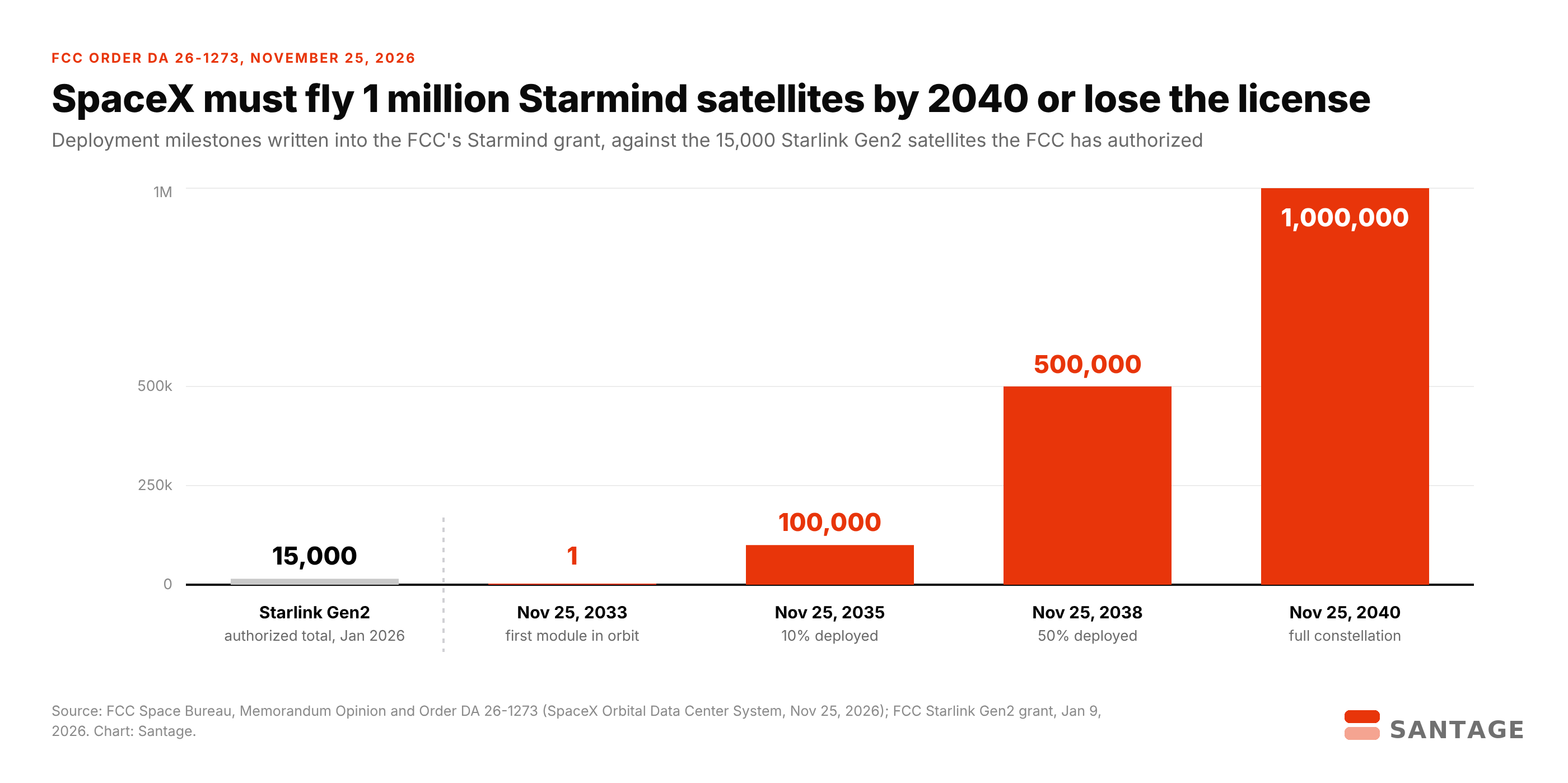
- The FCC's Space Bureau granted SpaceX's Starmind application on November 25, covering up to 1,000,000 orbital compute modules across six shells between 550 and 1,002 kilometers, about 66 times the 15,000 Starlink Gen2 satellites the FCC has authorized.
- The license lapses unless SpaceX flies one module by November 25, 2033, 100,000 by 2035, 500,000 by 2038 and the whole constellation by November 25, 2040.
- The FCC deferred SpaceX's request to send spent satellites above 600 kilometers into disposal or heliocentric orbits instead of burning them up, so any module meant for that route needs a fresh filing.
The Federal Communications Commission on Wednesday authorized SpaceX to put up to 1 million satellites into low Earth orbit as computing nodes for artificial intelligence, the first US license for a constellation of data centers in space, with the first module due in orbit by November 2033 and the full fleet by 2040.
The FCC grants Starmind 1 million orbital compute modules
The order, signed by the chief of the FCC's Space Bureau and stamped "granted-in-part, deferred-in-part," approves a system SpaceX filed for in January. Starmind satellites will carry AI chips, run on solar power and talk to each other and to the ground over laser links, so the radio spectrum the FCC actually licensed is narrow: Ka-band frequencies for backup and emergency telemetry, tracking and command, on an unprotected, non-interference basis.
The commission framed the grant as industrial policy for AI. In its announcement, it said orbital compute would process data "to be used back here on Earth" and added that it is reviewing further orbital data center applications from other companies.
| Starmind orbital shell | Altitude | Inclination |
|---|---|---|
| Shell 1 | 550 to 568 km | 26 to 32° |
| Shell 2 | 565 to 585 km | 97.7° (sun-synchronous) |
| Shell 3 | 686 to 718 km | 30° |
| Shell 4 | 707 to 744 km | 97.2° (sun-synchronous) |
| Shell 5 | 946 to 978 km | 30° |
| Shell 6 | 967 to 1,002 km | 99.4° (sun-synchronous) |
Source: nominal operating altitudes from SpaceX's May 29, 2026 letter, as authorized in the FCC order, November 25, 2026. Table: Santage.
The FCC deferred where spent Starmind satellites will go
Satellites that finish their missions below 2,000 kilometers must normally re-enter the atmosphere within five years. SpaceX asked for flexibility to push modules above 600 kilometers into disposal orbits or out of Earth orbit entirely, toward the Sun. The bureau said SpaceX had not given it enough information to judge whether that complies with its rules and deferred the request, which means a large share of the constellation, four of the six shells, cannot use that end-of-life route without another application.
Viasat, Amazon, the Secure World Foundation and dark-sky astronomy groups filed objections over collision risk, disposal failures and light pollution. The FCC also waived SpaceX's surety bond and let it use the newer, more lenient milestone schedule, after SpaceX withdrew a request to skip deployment milestones altogether.
The FCC licensed the backup radio links of a fleet that does not exist yet and set a 2033 deadline for its first module. What SpaceX won on Wednesday is orbital real estate and regulatory precedent, and both will be worth more to its rivals' filings than to anyone's compute bill this decade.
For AI buyers the timeline matters most. The earliest Starmind hardware is seven years away, while the power and chip shortages driving labs toward gas turbines and remote AI infrastructure are happening now. The grant settles who may build in these shells first, and it leaves the economics, which Santage examined when Google and SpaceX first floated orbital data centers in May, still to be proven.
A million-satellite license works as a reservation on orbit. By writing the 2033 to 2040 schedule and the disposal deferral into a single order, the FCC has turned orbital AI compute from a pitch deck into a regulated asset class, and every competing constellation will now be measured against the terms SpaceX received on November 25.
Santage is committed to independent, transparent journalism. This article is produced in accordance with Santage's Editorial Standards and aims to provide accurate and timely information. Readers are encouraged to verify information independently.