
- The Arizona campus, filed under the affiliate name Tombstone Resources, covers 747 acres and targets up to 6 gigawatts in four phases, with about 5,500 construction jobs and 1,000 permanent roles.
- The $24 billion Starbase site will run on its own gas-fired power plant and carries a $220 million SpaceX commitment to Brownsville's water system, $40 million of it already paid.
- SpaceX's AI segment earned $7.56 billion in the third quarter, more than half of group revenue, and spent $16.44 billion on capital equipment in those three months.
SpaceX said on November 12 that it plans to invest more than $74 billion in two AI supercomputing campuses, about $50 billion in Cochise County, Arizona, and $24 billion at its Starbase rocket site in Texas, a commitment roughly twice the $35 billion to $40 billion the company guided for its total fourth-quarter capital spending.
SpaceX names a price for Arizona and pairs it with Starbase
The company published the plan in a statement on its website and pinned it on X. Until Thursday SpaceX had kept its name off the Arizona project: the special-use application, filed on October 30, came from Tombstone Resources LLC, and SpaceX only appeared publicly as host of a November 4 town hall at Cochise Elementary School. The $50 billion figure had not been disclosed before.
The Starbase half builds on a City of Starbase hearing notice posted November 6, which described a gas-fired power plant and super-compute facility on about 444 acres near the Port of Brownsville with roughly $24 billion of initial investment. SpaceX now says the site has already created more than 3,000 construction jobs and will support more than 500 permanent ones, on top of the more than $15 billion it has spent on Starship infrastructure at Starbase.
"The facility will train frontier intelligence systems to accelerate breakthroughs in medical research, emergency response, advanced manufacturing, and national security, while helping develop and test technologies for the future of space-based computing."
SpaceX, Building the Future, November 12, 2026
Two campuses, two answers to the AI power problem
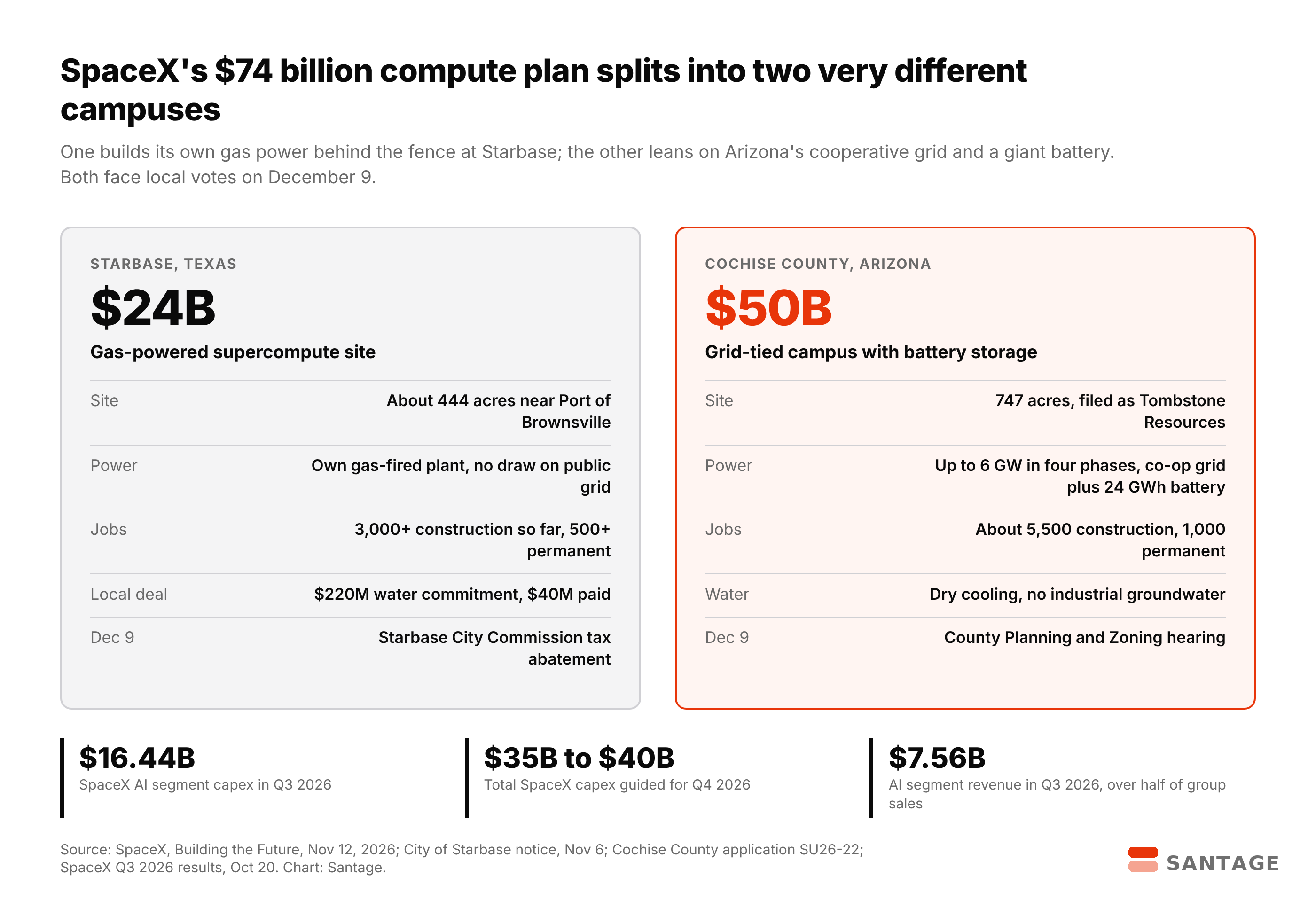
The sites show the two strategies available to anyone building AI infrastructure at gigawatt scale in 2026. At Starbase, SpaceX will generate its own electricity and never touch the public grid, which skips the multi-year interconnection queue and keeps the facility's demand off local bills. Anthropic made a similar choice this week with its $3.4 billion order for gas generators. Cochise County takes the other path: SpaceX is working with local electric cooperatives, the application includes a 24 gigawatt-hour battery and about $3.6 billion in grid upgrades, and the company says the arrangement could cut cooperative members' bills by up to 20%, using dry cooling with no planned industrial groundwater use.
Both routes carry political cost. A petition with about 2,400 signatures asks Cochise County to deny the permit, and the county's Planning and Zoning Commission holds a public hearing on December 9. The same evening, the Starbase City Commission considers a property tax abatement for the Texas site. SpaceX's statement asks for "stable, competitive policies," a reminder that the $74 billion is a plan that still needs local approval.
| Starbase, Texas | Cochise County, Arizona | |
|---|---|---|
| Planned investment | About $24 billion | About $50 billion |
| Land | About 444 acres | 747 acres |
| Power | Own gas-fired plant, off public grid | Co-op grid, renewables, 24 GWh battery |
| Jobs | 3,000+ construction to date, 500+ permanent | About 5,500 construction, 1,000 permanent |
| Next decision | Tax abatement vote, Dec 9 | Planning and Zoning hearing, Dec 9 |
Source: SpaceX, Nov 12, 2026; City of Starbase notice, Nov 6; Cochise County application SU26-22.
The cash comes from a cloud business that already rents to Anthropic and Google
SpaceX can make commitments of this size because its AI arm now pays its way. In its third-quarter results, the Super Intelligence segment, which holds xAI, Grok and Cursor, earned $7.56 billion, more than Starlink, and turned a $431 million operating profit on the back of compute rental to outside labs, a business Santage examined in October. Anthropic, Google and Reflection AI rent Colossus capacity under multi-year contracts, so new campuses arrive with a sales channel already in place.
The arithmetic still demands faith. At $50 billion for up to 6 gigawatts, the Arizona plan works out to roughly $8.3 billion per gigawatt by Santage's calculation, and SpaceX has not said whether that figure includes the chips, which typically cost more than the buildings that house them. SpaceX also arranged $40 billion of GPU lease financing in October and has a separate chip-making project, Terafab, that it now describes as a $100 billion effort. Each campus adds to a capital program that already outruns the AI segment's revenue by more than two to one.
| $74B+ | Planned investment across the two campuses |
| 6 GW | Arizona capacity at full build-out, per the county application |
| $16.44B | SpaceX AI capital spending in Q3 2026 alone |
A rocket company now plans data centers on hyperscaler terms
SpaceX is following the playbook that Microsoft, Google, Amazon and Meta used to build their clouds: own the land, the power and the buildings, then sell capacity to the labs that cannot build fast enough themselves. The difference is speed and concentration. A single company with one controlling shareholder can move from a quiet county filing to a $50 billion public commitment in under two weeks, while utilities, county boards and residents work on the slower timetable of hearings and petitions.
SpaceX's $74 billion plan turns the AI unit that runs the Colossus clusters in Memphis into one of the largest planned builders of compute in the United States, financed by rental income from rival labs. Whether it gets built on SpaceX's schedule now depends less on Elon Musk's capital than on two local votes on December 9, which makes county planning boards the newest gatekeepers of the AI race.
Santage is committed to independent, transparent journalism. This article is produced in accordance with Santage's Editorial Standards and aims to provide accurate and timely information. Readers are encouraged to verify information independently.