
- Onava tested 322 minibinders built from shapes GPT-6.2 designed against five targets, and 35 of them, or 10.9%, showed evidence of binding, with at least one hit on every target.
- Where GPT-6.2 only rewrote sequences for protein shapes already known to work, lab hit rates ran from 14% to 85%, far above the 10.9% it managed when it designed the shape itself.
- OpenAI's own account states that specialized models supplied the amino acid sequences and filtered which candidates went to the bench, so end-to-end design without specialized help is not established.
A general-purpose model that was never trained to do biology wrote code, drew three-dimensional protein shapes, and produced 35 working binders out of 322 candidates in a real laboratory, which puts OpenAI's reasoning models inside a field that has spent five years building specialized tools for exactly this job.
GPT-6.2 drew the shapes, then specialized models finished the job
Protein design has two halves. A researcher must settle on a three-dimensional structure that would do the job, then find an amino acid sequence that folds into it. Purpose-built systems such as RFdiffusion handle the first half, and sequence designers such as ProteinMPNN handle the second, and running them together is specialist work.
What OpenAI reported on Tuesday is that its models can do the first half with no biology tooling at all. Given the structure of a target protein and a mark showing where a binder should attach, GPT-6.2 wrote general-purpose code and produced candidate backbones directly. The model's own reasoning traces show it examining the target's surface, arranging coiled sections against it, and checking the fit, which is the behavior a structural biologist would describe rather than the pattern-matching a sequence model is usually credited with.
The second half still went to the specialists. SolubleMPNN proposed the amino acid sequences for GPT-6.2's backbones, and further specialized models picked which of them were likely to fold correctly before anything reached a bench. Research partner Onava then made and tested the survivors against five targets: PD-L1, IL-7Rα, TrkA, VEGF-A and IL-17A. Thirty-five of 322 bound, split 5, 3, 1, 8 and 18 across those targets.
| 10.9% | Lab hit rate on new minibinder shapes, 35 of 322 |
| 5 of 5 | Targets with at least one confirmed binder |
| 43.7% | Internal research model on MotifBench, against RFdiffusion's 27.8% |
| 14 | Protein tasks benchmarked |
The hit rate splits by how much of the design the model actually owned
The single most useful thing in OpenAI's release is not the headline number but the spread underneath it. When GPT-6.2 was handed a protein shape already proven to bind and asked only to write a fresh sequence for it, lab results jumped: 75 of 88 designs bound MDM2, 26 of 42 bound VEGF-A, and across six nanobodies against IL-4Rα, 128 of 182 redesigned loops still gripped their target. When the model had to invent the shape, the rate fell back to roughly one in nine.
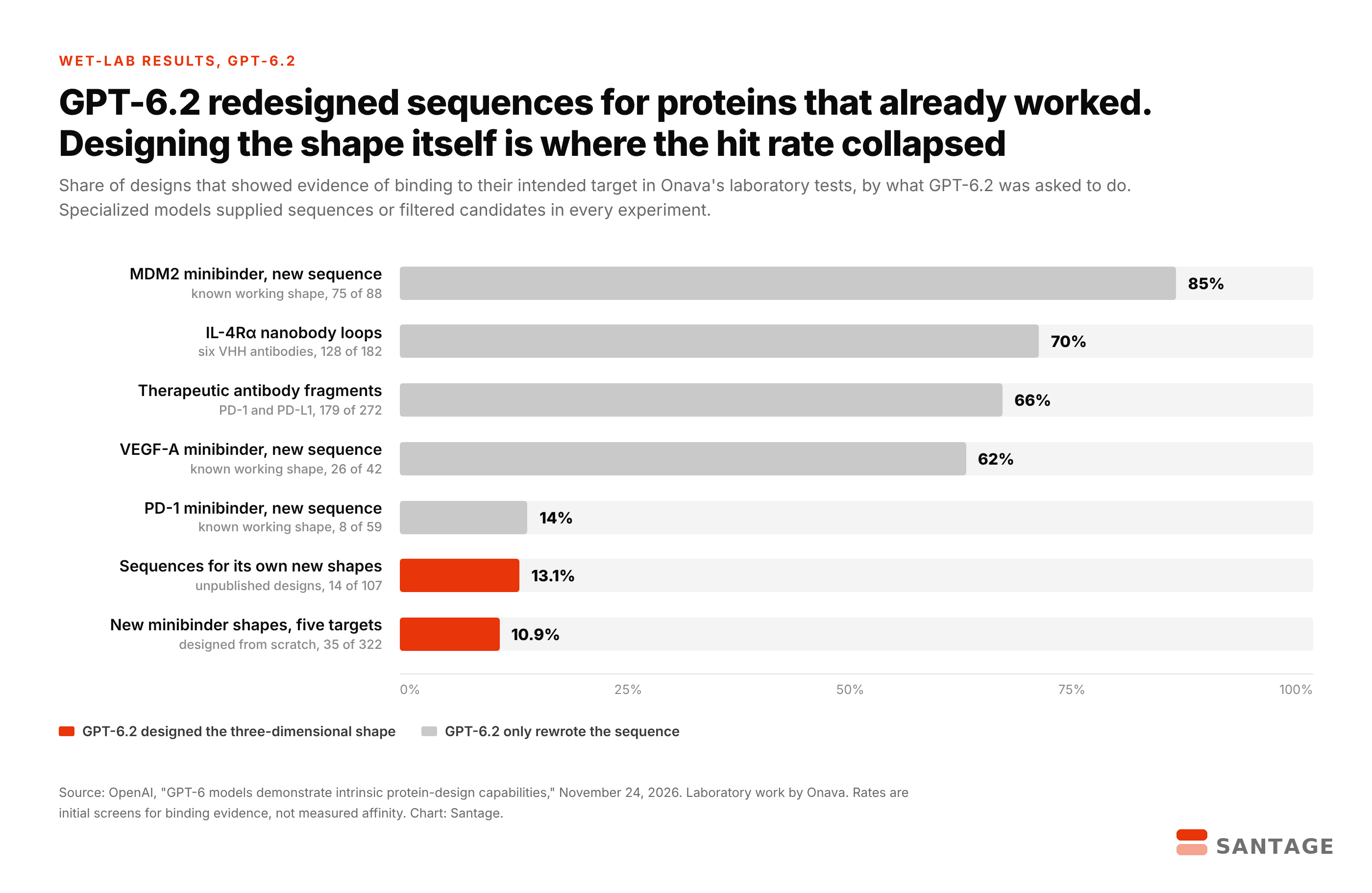
PD-1 is the instructive exception in that upper group, where only 8 of 59 redesigned sequences bound and the median sequence differed from the original by just 15%, against 50% for VEGF-A and 43% for MDM2. A model that strays less from the known answer and still fails more often is not simply copying from memory, and OpenAI leans on a sharper piece of evidence for the same point: given two unpublished minibinder shapes it had generated itself, GPT-6.2 wrote two sequences for the same PD-L1 structure that differed from the original at 52 and 58 of 90 positions and from each other at 44, and both showed binding.
| Lab experiment | What GPT-6.2 supplied | Designs tested | Showed binding | Rate |
|---|---|---|---|---|
| New minibinder shapes, five targets | Three-dimensional structure | 322 | 35 | 10.9% |
| Sequences for its own unpublished shapes | Structure and sequence | 107 | 14 | 13.1% |
| MDM2 minibinder redesign | Sequence only | 88 | 75 | 85% |
| VEGF-A minibinder redesign | Sequence only | 42 | 26 | 62% |
| PD-1 minibinder redesign | Sequence only | 59 | 8 | 14% |
| IL-4Rα nanobody loops | Loop sequences | 182 | 128 | 70% |
| Therapeutic antibody fragments | Loop sequences | 272 | 179 | 66% |
Source: OpenAI research post and preprint, November 24, 2026. Laboratory work by Onava. Rates are initial screens for binding evidence, not measured affinity. Table: Santage.
OpenAI is measuring against tools, Anthropic measured against a campaign
Comparing this with the field's other frontier-lab protein result is where the number gets its context. When Santage covered Anthropic's work in August, Claude ran an entire design campaign as an agent, orchestrating existing open-source design and folding models across 12,500 Nvidia H100 hours, and two independent labs confirmed 354 binders from 1,320 designs against 14 of 15 targets, a 26.8% overall rate.
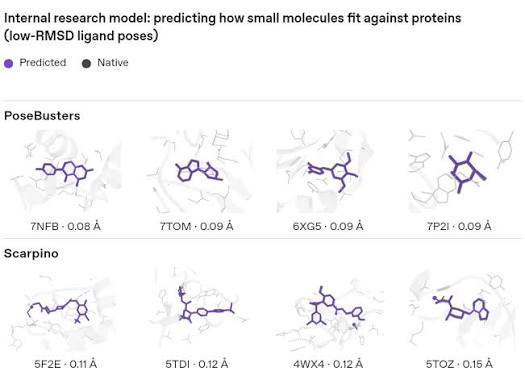
The two results are not the same claim. Anthropic's model was the conductor of specialized tools and was judged on the campaign's output. OpenAI's model is being judged on whether it can replace one of those tools, the structure generator, and it is measured against RFdiffusion and Proteina directly. On the computational benchmarks an internal OpenAI research model does win those comparisons: 43.7% against RFdiffusion's 27.8% on motif scaffolding, 18.9% against Proteina's 17.1% on fold design, and 96% against DiffDock-L's 50% on PoseBusters docking. In the wet lab, the one place where a generative claim can fail honestly, GPT-6.2's 10.9% sits near the historical field norm of 10 to 15% and below what RFdiffusion's original study reported.
A general model that reaches the field's average hit rate without any biology training is a more disruptive result than a specialized model that beats it, because the specialized model took five years of protein-specific research and this one arrived as a side effect of reasoning and code.
The capability frontier here is jagged, and OpenAI says so
OpenAI's limitations section is unusually direct about what the work does not show. Filtering still relied on Boltz-2, OpenDDE and ESMFold2, so no end-to-end campaign has been run. Predicting a full protein structure from sequence remains a clear weakness, with the internal model scoring 0.38 on average TM-score against ESMFold2's 0.93. Binding is also only the first property a therapeutic needs, ahead of specificity, stability, activity and safety, and none of those were measured. The company notes that its Preparedness Framework governs the biosecurity side, which matters because the capability that designs a binder for a cancer target is the same capability regulators have spent two years asking frontier labs about.
For drug discovery teams the practical reading is narrower than the headline. Nothing here replaces a structure generator in production today. What changes is the interface: OpenAI showed that the shape, the fold class, the number of coils, the exact atoms that should form a bond and which residues should be buried can all be specified in a prompt, and the model followed those instructions with near-perfect fidelity in computational tests. That is the part specialized models cannot do without retraining, and it is why a 10.9% hit rate from a general foundation model is worth more attention than the same number from a better tool.
Thirty-five binders is a small result that points at a large one. The question protein design has been arguing about is whether structure generation needs its own architecture or is just another thing a sufficiently capable reasoning model can do with code, and OpenAI has now put a wet-lab number on the second answer. At 10.9% that number remains modest, and it is still the first one in this argument that was measured at a bench rather than on a screen.
Santage is committed to independent, transparent journalism. This article is produced in accordance with Santage's Editorial Standards and aims to provide accurate and timely information. Readers are encouraged to verify information independently.