
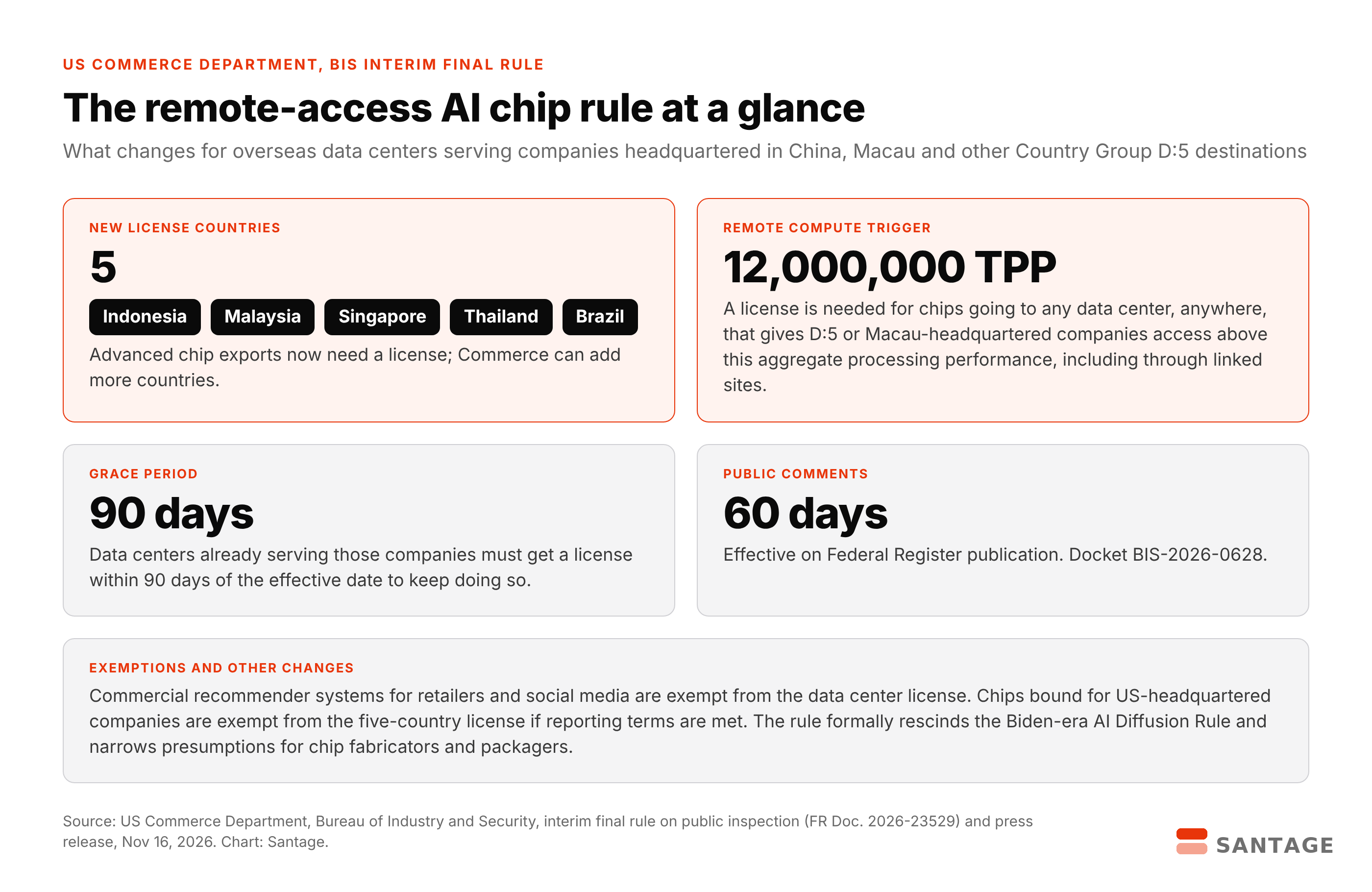
- An interim final rule from the Bureau of Industry and Security requires a license for chips headed to any data center that gives companies headquartered in China, Macau or other Country Group D:5 destinations access to more than 12,000,000 aggregate TPP of compute.
- Data centers already serving those companies get 90 days from the effective date to obtain a license, and five countries, including Singapore and Malaysia, now need licenses for advanced chip imports.
- Commerce says the rule was written by and at the direction of the Treasury Department and the National Security Council, and it formally rescinds the Biden-era AI Diffusion Rule.
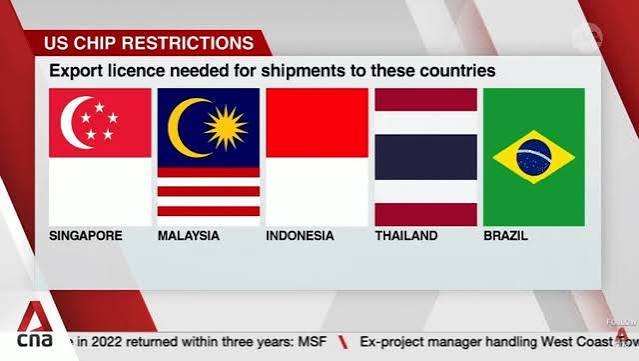
The US Commerce Department has extended its AI chip export controls from where chips are shipped to who uses them, issuing a rule on November 16 that requires licenses for advanced chips going to Indonesia, Malaysia, Singapore, Thailand and Brazil, and for any data center worldwide that rents large amounts of compute to companies headquartered in China.
The rule follows compute rented abroad
Until Monday, US controls on advanced AI chips mostly governed physical shipments. A Chinese company barred from buying Nvidia's top chips could still rent the same hardware in a data center in Southeast Asia and train models remotely. The new rule closes that route by attaching a license requirement to the data center's customers. Any export, reexport or in-country transfer of advanced chips to a facility that will give D:5 or Macau-headquartered companies access to more than 12,000,000 "aggregate TPP" (total processing performance, counted across one site or several digitally linked sites) now needs approval.
Data centers, foreign foundries and chip exporters must run due diligence on customers, including indirect ownership or control by parties in those countries. Commercial recommender systems used by retailers and social media companies are exempt. The rule takes effect when it is published in the Federal Register, and comments are due 60 days later.
"The rule is designed to ensure that existing restrictions on access to sensitive American technology cannot be circumvented through remote computing arrangements involving data centers in third countries."
Bureau of Industry and Security, US Department of Commerce, November 16, 2026
Singapore signed an AI supply chain pact a day earlier
The five-country list lands on the region where Washington has focused its concern about chip diversion. Singapore-based cloud provider Megaspeed sits at the center of the scandal that ended Jensen Huang's tenure at Nvidia, and Treasury Secretary Scott Bessent publicly criticized Commerce last week for not doing more to restrict its purchases, as Santage covered in yesterday's report on Bessent and Nvidia. The timing is awkward for Singapore, which according to the State Department's signatory list signed the San Francisco Declaration on protecting AI infrastructure supply chains on November 15, one day before the license requirement was announced.
Chips bound for companies headquartered in the United States, or whose ultimate parent is, are exempt from the five-country license if reporting conditions are met, which protects US hyperscalers building in Johor, Batam and Bangkok. The burden falls hardest on local and Chinese-linked operators, who now need to prove who their customers are before the next shipment arrives.
The rule shifts the enforcement point from the port to the data center contract, and its real test arrives in about three months, when operators in Southeast Asia that already serve Chinese customers either hold a license or have to turn those customers away.
Santage is committed to independent, transparent journalism. This article is produced in accordance with Santage's Editorial Standards and aims to provide accurate and timely information. Readers are encouraged to verify information independently.